Premio Internazionale Giovanni Malagodi 2025
Karl-Heinz Paqué mit Premio Internazionale Giovanni Malagodi geehrt

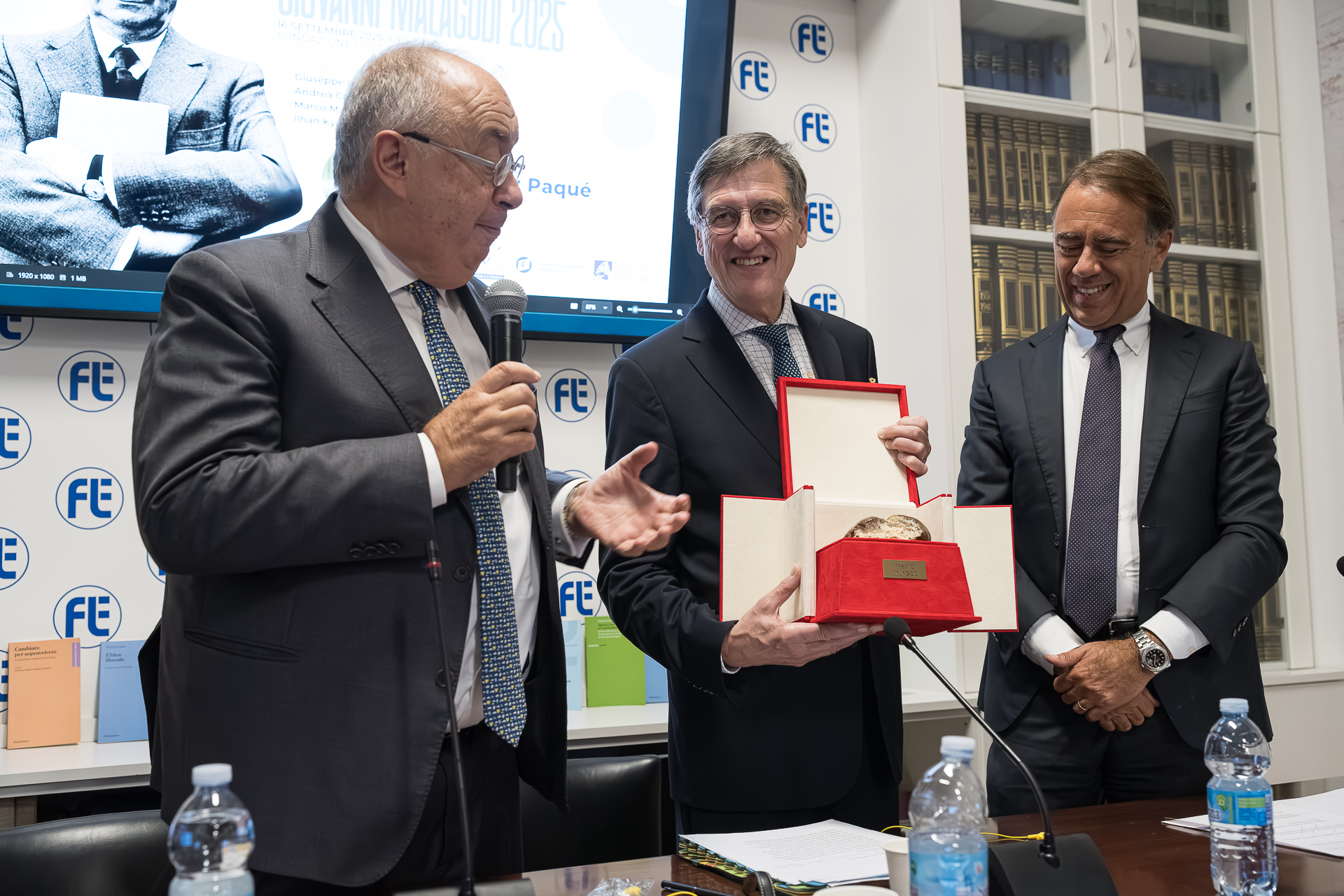
Karl-Heinz Paqué wird mit dem Premio Internazionale Giovanni Malagodi 2025 ausgezeichnet.
© Fondazione Luigi EinaudiAm 16. September 2025 wurde Professor Karl-Heinz Paqué, Vorsitzender des Vorstands der Friedrich-Naumann-Stiftung für die Freiheit und Präsident der Liberal International, von der Fondazione Luigi Einaudi mit dem Premio Internazionale Giovanni Malagodi 2025 ausgezeichnet.
In seiner inspirierenden Rede erinnerte Professor Paqué uns daran:
Wir Liberalen sind Optimisten – sonst könnten wir keine Liberalen sein.
Bildergalerie


Fondazione Luigi Einaudi

Angesichts der heutigen Herausforderungen – vom Erstarken antiliberaler Kräfte über die Gegenbewegung zur Globalisierung bis hin zur Schwächung der demokratischen Mitte – rief Professor Paqué zu „prinzipiengeleitetem Pragmatismus“ als liberalem Weg in die Zukunft auf:
- Bessere öffentliche Dienstleistungen bereitstellen und die Sozialpolitik, Arbeitsmärkte und Rentensysteme reformieren.
- Haushaltsdisziplin, begrenzte Staatsmacht und individuelle Freiheit fördern.
- Die politische Debatte erneuern, indem man gesellschaftlichen Anliegen zuhört, ohne liberale Werte zu verraten.
Diese Auszeichnung, die anlässlich des 120. Geburtstags von Malagodi ins Leben gerufen wurde, ehrt jene, die Freiheit, Verantwortung und die globale liberale Vision hochhalten.
Lesen Sie hier die Rede von Karl-Heinz Paqué :
Es gilt das gesprochene Wort.
Ladies and Gentlemen,
it is a huge pleasure and honor to be awarded today the Giovanni Malagodi Prize by the Luigi Einaudi Foundation. I say this in my role as President of Liberal International who takes enormous pride in being one of the followers of the greatest and longest-serving President of this wonderful global umbrella organization of Liberals. And I say this as Chairman of the board of directors of the Friedrich Naumann Foundation for Freedom in Germany, which is committed to political liberalism in my country and worldwide. You allow me to interpret the award also as a recognition of the work of these two liberal institutions.
On a very personal note, let me add that I have been an admirer of Italian Liberalism since my student times, when I stumbled over a biography of Camillo Benzo Conte di Cavour, the farther of the Risorgimento and founder of modern Italy, a Liberal, who contrasts sharply with the political founder of modern Germany, Count Otto von Bismarck, who was a staunch conservative. I never got away from my personal interest in Italian liberalism, and during my formative years as student of economics at Kiel University and the Kiel Institute of World Economics, it was my academic teacher Herbert Giersch, who revived my interest in it. He was a liberal economist with strong roots in the conviction that nothing else but a market economy helps to achieve growth and prosperity and in the end social justice, very much in the tradition of the first Minister of Economcs in Germany Ludwig Erhard - that German counterpart to the Italian liberal reformer Luigi Einaudi, who after the end of World War II, as minister of finance in the government of Alcide De Gasperi, balanced the budget and stabilized the price level. The only major difference of the reforms of Ludwig Erhard and Luigi Einaudi was that Erhard – under Allied control – had to introduce a new currency, the Deutsche Mark, whereas Einaudi carried out the reforms, but preserved the – then stable – „old“ Lira. And the political parallel between post-fascist Italy and post-Nazi Germany continued in liberal terms in the early 1950s, with the liberal Luigi Einaudi and the liberal Theodor Heuss being highly respected presidents of their respective couintries.
Note also that, as a member and later President of the Mont Pelerin Society, my teacher Herbert Giersch was also intellectually close to Giovanni Malagodi. For all this, let me express my deep personal gratitude to the Fondazione Luigi Einaudi for awarding me this prestiguous prize. It is deeply moving for me. If, in the late 1970s during my studies of economics, somebody had told me that, some five decades later, I would receive an award from the most prestigious foundation of Italian liberalism in the center of Rome, the eternal city, I would have told him that this was mere fantasy. Now this fantasy is reality: thank you very much.
Ladies and Gentlemen,
let me now come to the main topic of my brief talk of thanks: the threats to liberalism and to globalization - today. Let us start by remembering that Giovanni Malagodi, as a banker and politician, was in the late 1940s und early 1950s, deeply involved in negotiations with representatives of the United States – on Marshall Plan aid and trade liberalization. He later left a wonderfully detailed report on this in an extensive oral history interview with the Truman Library. When you read this today, you will be aware how friendly and liberal the spirit was at the time. The Americans wanted Europe to integrate into the global trade order, and they wanted it integrated together as a united entity with free trade among the Europeans.
This is exactly the spirit in which my generation, the baby boomers, grew up – and which liberal politicians like Giovanni Malagodi shaped. It was in our societies of the western hemisphere the spirit of economic integration, of political friendship and of dynamic growth – together with a remarkable upward mobility, which led to falling measures of inequality. These trends lasted until the early 1970s, and they were still strong enough to withstand the challenges of the late 1970s and early 1980s in the course and after the two oil crises, with a growth slowdown and beginning stagnation, higher inflation and rising unemployment.
At the end of the 1980s, the Iron Curtain fell and with it Soviet-style socialism and central planning. Roughly at the same time, many countries of what is now called the „Global South“ opened up economically, including China and India. The „western integration“ of earlier times thus graduated into a genuine „globalization“. I admit that this made many liberals including myself overoptimistic about the future. Economically and politically, we thought the big challenges to liberalism were over and that something like Francis Fukuyama’s diagnosis of the end of history was not far off the mark.
We were completely wrong. Following the decade after the big global financial crisis towards the end of the 2000s, new forceful anti-liberal trends set in: Russia under Putin made an aggressive imperialist turn and fortified its authoritarian state capitalism; China under Xi Jinping turned its own state capitalism into a deliberate instrument of global dominance of markets for products and credit in the Global South, e. g. with the silk road initiative; the European Union at the same time began to set up ever more regulatory devices to achieve social and ecological goals not only in its own territory, but also in the rest of the world of her trading partners – thus engaging in a kind of „moral expansionism“ and lecturing of the Global South. Maybe most dramatically, the United States turned protectionist and isolationist – refusing to continue to play the benevolent hegemon in the liberally minded western world. This showed up in an increasingly tough trade policy and in sharp demands for a higher contribution of Europeans to collective security within NATO.
That is in fact where we stand today. It is a fundamental reshuffling of notably the western world, which already had important consequences. Firstly, in NATO, where the Europeans committed themselves to a 5 percent of GDP-defense spending rule in the future, thus ending the „free ride“ on American military security that basically went on since the early post-war time; and then, secondly, in trade, where it very recently led to an agreement on a 15-percent tariff on EU-exports to the United States plus massive European direct investment promises for the US-market without any concession from the American side. That is hard to swallow for Liberals. While the new defense accord is well understandable and justified in terms of transatlantic equal burden sharing, the „trade deal“ makes not much sense – neither economically nor politically, at least not for liberally minded people who want to see a free world dynamically integrate and grow together as was the case in the long post-war decades.
The question is: How should liberals react to these challenges? Kurt Schumacher, a prominent German Social Democrat, in the early 1950s made a very smart statement. In German, it reads: „Politik beginnt mit der Betrachtung der Wirklichkeit.“ Politics begins with the recognition of reality. What is this reality?
The reality is that literally all western societies – after decades of „globalization“ – have fundamentally changed in terns of the political climate. By and large, they have become more conservative. Everywhere, a growing number of people is fearful that the anonymous forces of change do not lead to an improvement of their economic and social prospects. To the contrary, they are afraid of a coming decline, although – as polls show – many of them do not yet see this decline in their present living conditions. On top of this, they regard the state as hopelessly overburdened and thus failing to deliver the basics of public services, but with high taxes fuelling a big redistributive machine that does not really help the needy, but supports incoming refugees and pet projects of an urban élite that knows nothing of the challenges and hardships of provincial and rural life.
Behind these feelings are just as often true hard facts as there are false perceptions and prejudices. And between the highly developed industrial countries, where these frustrations prevail, the particular motives and reasons for the frustrations are very diverse – ranging from the American case of the traditional mental gap between the coastal regions and the „fly-over-states“ (or „salt-water“ and „sweet-water“ America), to the German case of its eastern post-socialist states, which went through an unforgettably deep and hard industrial restructurung in the 1990s, or the British case of the old-industrial midlands that supported Brexit in the vote of 2016. But the result is always the same: a rising right-wing conservatism, which turns ever more into right-wing populism and so far does not meet much understanding among the more liberally-minded urban élites.
It is interesting to remember that some great liberals, who strongly favoured and advocated globalization during their lifetime – above all the great German-British intellectual Ralf Dahrendorf – also early on warned that a political polarization of society would in all likelihood be the negative by-product of the globalization process. In fact, by now, more than three decades have passed since the symptoms are recognizable. As early as in the 1990s, Italy went through a decay of its traditional party system, with the Democrazia Christiana and also the Partito Liberale Italiano being victims. Other countries followed this path – with a long-standing decline of social and christian democratic parties as well as liberal ones in the democratic center of the political spectrum. To be sure, my Free Democrats in Germany can also tell a story about it: they were kicked out of Parliament with less than five percent of the vote in 2013, re-emerged strengthened with two-digit results in 2017 and 2021, but in the early election this year were kicked out again, at a time when the right-wing-populist AfD achieved more than 20 percent of the vote.
What can be done about the rise of right-wing populism? The answer is theoretically simple, but practically difficult. It is basically threefold: Firstly, the government must „deliver“ and thus improve the trust in its ability to provide the collective goods that it is responsible for. These range from the control of migration to the quality of education and the level of taxation and social contributions that must not be so high as to stifle growth. In most industrial countries (including my country Germany), this means a thorough reform of the public sector including – prima facie – quite unpopular reforms of the labor market regulation as well as the welfare state and the pension system.
Secondly, there must be a major change of the mindset: a return to the common-sense notion that the power and the resources of the state are limited – and must not be overstretched. That, in turn, requires an honest call for more individual responsibility for one’s own life and a tight public budget that avoids shifting a large burden of debt onto the shoulders of future generations. This is the other side of freedom to be emphasized at a time, when – almost everywhere – the population shrinks and ages, which narrows the scope for relying on others to provide the services that are needed.
Thirdly, it is the political discourse that has to change. In particular, the urban élites have to get used to take the concerns of the rest of society seriously – and not discount them as „reactionary“ demands. In fact, in the few cases in Europe where parties of the democratic center have selectively adjusted their programs to give answers to these concerns, they have been quite successful. A prominent case in point is the revival of the Social Democrats in Denmark that was achieved by getting back control of migration, which made many former voters of that party return to it after temporarily deserting to right-wing populism.
Needless to emphazise, all this is easier said than politically done. But at least it must be honestly tried notably by Liberals – of course, without any betrayal of the principles of liberalism. After all, the new stance may be called „principled pragmatism“: keep the core of your liberal values sacrosanct, but adjust the political agenda with a clear view to the real challenges of society – and these do change over time. At the heyday of globalization, they are obviously different from what they were in earlier times when the large-scale consequences of an open world with new technologies and massive migration could not yet be foreseen.
Ladies and Gentlemen,
let us now turn to the external side of globalization in a world of rising right-wing populism and autocratic tendencies. What should be the answers of Liberals to the tide of protectionism in the United States and imperialist state capitalism Chinese and Russian style?
Note first that, as an economist, I dare to forecast that Donald Trump will not achieve either of the two big aims of his protectionism, the removal of the notorious American current account deficit and the re-industrialization of the United States. Both are illusions: To balance the current account, you need a macroeconomic adjustment towards less spending, notably less government spending – and, in this respect, there is no consistent political effort recognizable so far. And to bring back old-style industry to America is even more difficult. In a way, you have to turn back decades of economic history – from sunrise to sunset industries, and for all that matters, this is impossible. Why? Because experience shows: Investment follows trade, not tariffs. Hence trying to make domestic and foreign investors set up new plants in the United States behind protectionist walls will not work.
So, in the end, Trump’s protectionism is likely to fail. The fact is, however, that the rest of the world does not really stand tall against Trump’s aggressive bilateralism, which disregards all non-discrimination rules of the World Trade Organization. Take the European Union, which all too cowardly accepted a 15 percent-US tariff without getting anyting in return – and beyond that promised massive private (!) investment from EU countries in the US. That is certainly not the way to keep the dynamics of globalization going.
But what is it then? In my view, Europe has to do its own homework, which it has not done for more than a decade. The European Union is a heavily overregulated place; and even its internal Common Market works far from perfectly, notably in the trade with services. And, please, remember the sad destiny of the plans for the transatlantic trade agreement TTIP during the Obama administration. It became a victim of the rising skepticism against trade on both sides of the Atlantic. In Germany thousands protested against TTIP fearing that “Chlorine chicken” from the USA would lower consumer protection standards (although German travellers to the US eat excellent chicken there and return home, believe it or not, in good health!). Clearly, we Europeans missed the window of opportunity for more free trade in the time well before Trump.
What to do now? I think Europe has to adopt a strategy of what I again call “principled pragmatism”: let us conclude as many bilateral and plurilateral trade agreements with all those countries in the world, which share our liberal values, but let’s keep these agreements as simple as possible so that they do not take long years or even decades to come about. CETA with Canada is a good agreement, and the EU-Mercosur-agreement, once finally ratified (hopefully soon) belongs to the same category, though all that took much too long. Of course, let us invite the Americans to join the globalization club again whenever they like, but if they want to stay out in the current Trump mood, globalization will go on without them.
That is part of what I call “new globalization”. The other part is a mixture of geostrategy, geopolitics and geoeconomics. It involves – beyond Trump-style protectionsim – the politization of economic relations. And here we have to turn our attention to Russia and of course China, two thoroughly authoritarian and state capitalist countries.
Let us here focus on China, obviously the greatest geopolitical challenge of the coming decades. With his rise to power in 2012/13, President Xi Jinping has replaced the traditional Deng Xiaoping development strategy, which prevailed since the 1980s. For Deng Xiaoping the economy was a goal to create an affluent Chinese society. Under the regime of Xi Jinping, the economy is no longer a goal as such but an instrument used to become a political superpower.
The most prominent example for this is the silk road initiative. China´s silk road initiative creates economic dependencies in many regions of the world, be it in Asia or Africa, in Latin America and even in Europe. And China does not hesitate to use the dependencies politically. China has already taken the next step of politization: the weaponizing of its economy. China used a ban of rare earth export for Japan in 2010 in a fishing trawler dispute. More recently, China has imposed export controls and restrictions on strategic materials like gallium, germanium, and other rare earths as a retaliatory measure against U.S. tariffs. That has alarmed countries around the world.
Let us be frank: the political burdening of trade also happened in Western democracies, it is not an exclusive monopoly of authoritarian states like China (and Russia). We should not forget: The European Union implemented a supply chain law that demands that suppliers from outside of the European Union have to meet social and environmental standards set by the EU. Even though this may be well intended, the EU supply chain law politicizes trade rather than setting these standards in intergovernmental agreements, which come about through negotiatons and not unilateral action. That is also a new form of – if you like – moral geoeconomics.
Of course, in the „new“ globalization, geopolitics and geostrategy are not confined to trade. They massively reach into the realm of security as the last NATO summit showed. With the Russian assault on Ukraine and Donald Trump‘s reaction to it, a watershed of post-war history has been reached. For the first time, the United States put maximum pressure on their NATO-allies to increase the share of public spending for defense – up to a new target of 5 per cent. And the European allies promised to do exactly that, after decades of a „free ride“ on American military spending.
Liberals should welcome this new and more even buden sharing in the important international duty of defending freedom and democracy. However, it obviously means that the additional financial burden must be generated by a more dynamic growth of the European economies – and that in face of an ageing and shrinking population due to general demograhic trends. This requires a motivation of people and a mobilization of resources and capital, that is no less challenging than in the early post-war period. And that, in turn, calls for deep reforms of social security systems and taxation insead of piling up ever more public debt.
All that said, it becomes clear that today‘s challenges for Liberals are in fact quite different from the ones that Lugi Einaudi and Giovanni Malagodi as well as Ludwig Erhard and Thodor Heuss faced in the early postwar period. At that time, after the defeat of fascism and nazism, it was the preservation of freedom vis-à-vis the communist and Soviet socialist threat was at stake. That united „the West“ and, for a couple of decades, made the traditional differences in national ambitions and ouitlook manageable – at least by great statesmen as Alcide De Gaspari, Konrad Adenauer or Charles De Gaulle. This time, the tasks are much more differentiated – and societies after two generations of prosperity may be less ready for them than the post-war societies, which had left extremely bad experiences with totalitarianism just behind them.
But, to be sure, we Liberals are optimists – otherwise we could’t be Liberals. And this is why we continue our common fight for freedom in the years to come. We do it in the common spirit that you find in our liberal parties at home, in the Alliance of Liberals and Dcemocrats for Europe and in liberally-oriented foundations like the „Friedrich-Naumann-Stiftung für die Freiheit“ and, of course, the „Fondazione Luigi Einaudi“.
Thank you very much for your attention.