Demographic change
Europe's demographic dilemma between aging and migration

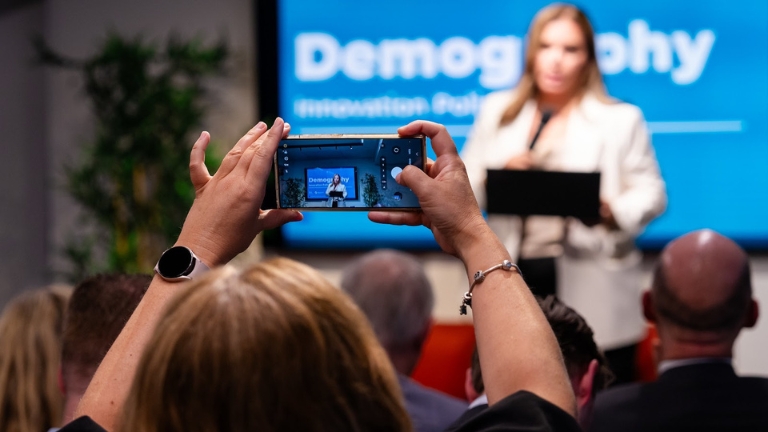
Innovation Policy Lab Vol. 4, 23-24 September 2025 in Brussels
© @FNF EuropeEurope is at a turning point. Falling birth rates, a rapidly aging population, and a shrinking labor market threaten the continent's economic development and social cohesion. As fewer and fewer young people enter the workforce, pressure on pension and healthcare systems is growing. Entire regions are becoming depopulated, and there is a shortage of skilled workers in key sectors such as skilled trades and nursing. The question of how to maintain productivity and prosperity despite a smaller working population will be a key political challenge in the coming decades.
At the same time, migration remains an ambivalent issue. On the one hand, it is one of the few realistic responses to the labor shortage, especially in the nursing and healthcare sectors. On the other hand, restrictive integration policies and social fears make it difficult to successfully integrate migrants. Where exclusion dominates, mistrust and tensions grow. Where integration succeeds, new impetus for innovation, entrepreneurship, and social stability emerges.
But even beyond the migration issue, one thing is clear: sustainable demographic change requires more than technocratic solutions. It requires a reorientation of European policy - from family support and housing policy to education and digitalization to fair pension reforms. Only if Europe combines individual freedom with shared responsibility can the continent maintain its economic strength, social balance, and global competitiveness.
These issues are addressed by the Innovation Policy Lab of the European Liberal Forum under the patronage of Jan-Christoph Oetjen and the Friedrich Naumann Foundation for Freedom. The aim is to develop solutions to Europe's key challenges with fresh, practical ideas - from labor shortages and the depopulation of rural regions to the future of retirement plans.
The structural decline of rural areas remains a core problem. To make these regions livable and workable again, existing services must be bundled and made more attractive. One approach is to create so-called community centers: multifunctional centers that combine supermarkets, doctors' offices, administrative services, and social meeting places under one roof. They shorten distances, reduce costs, and revitalize social life.
The healthcare system also needs new structures. Instead of providing the same range of specialists everywhere, competence hubs should be created – specialized clusters that bundle complex treatments, thereby increasing efficiency and quality. At the same time, local facilities must ensure basic care. Modular construction allows for flexible adaptation to demographic changes: where there is a kindergarten today, a school or health center could be built tomorrow.
Mobility is another key factor for participation. Germany already has functioning models in the form of on-demand buses, which could also be transferred to other European countries. They connect remote locations with larger centers in a cost-efficient manner, thereby promoting social and economic integration.
The growing risk of loneliness in old age can be countered with multigenerational houses that combine living, community, and digital participation. This requires the consistent expansion of fast internet connections to enable remote work, especially in rural areas, and to reduce pressure on urban centers.
The labor market itself also needs new flexibility. Companies must be able to retain older employees for longer and make use of their knowledge. Silver teams, experienced professionals working part-time and in advisory roles, can bridge the gap between generations. A gradual transition to retirement instead of an abrupt departure creates incentives to remain active longer without jeopardizing one's earned pension.
Finally, migration will remain an indispensable part of the solution. A key lever for mastering Europe's demographic challenges is a modern, liberal migration and integration policy. Studies clearly show that migration is not a losing proposition, it increases innovation, productivity, and employment. Highly skilled migrants contribute significantly to research and entrepreneurship, while labor migration in lower-skilled occupations ensures the supply of care, construction, and agriculture. This makes migration a driver of growth and social cohesion.
According to the Grand Challenges for Europe 2050 Report by the Friedrich Naumann Foundation for Freedom, the EU and UK will be short tens of millions of workers by 2050, a deficit that cannot be closed by higher birth rates or longer working lives alone. Migration is therefore the only realistic answer to the labor shortage. Africa's potential, with its growing, young population, could form the basis for a strategic partnership in the future. But only if Europe creates legal channels for immigration instead of building walls.
Labor migration must therefore become more attractive and less bureaucratic for example, through simplified visa procedures, clear, rule-based immigration channels, and early integration. At the same time, it is important to limit irregular migration and strengthen integration structures so that immigration contributes specifically to Europe's economic and social benefit.
Integration can be successfully achieved. Education, political participation, and easier access to society are particularly effective. They correlate strongly with higher labor mobility and employment success. Another recipe for success is migrant entrepreneurship: migrants who start their own businesses create jobs and make an above-average contribution to tax and social security.
However, the reality is that many migrants in Europe still face obstacles: long waiting times for work permits, complicated recognition of foreign qualifications, or limited access to bank accounts and credit.
The goal of a sustainable migration policy must be to facilitate legal migration, strengthen integration services, and create an environment in which immigrants can develop their skills in the interests of all generations in Europe. In this way, migration will not be a crisis issue, but a strategic tool for prosperity, innovation, and social stability.
Europe is facing serious demographic change with a shrinking and aging population. Migration is becoming a decisive factor in preventing labor shortages and economic stagnation. A modern, liberal migration and integration policy can promote innovation, productivity, and social cohesion. Immigration is the only realistic response to the future shortage of skilled workers, particularly through partnerships with African countries and the expansion of legal immigration channels.
Europe is facing one of its greatest challenges since the founding of the European Union. Demographic change is inevitable, but its consequences can be shaped. An aging society, labor shortages, and regional imbalances do not necessarily have to lead to economic and social decline if Europe has the courage to undertake far-reaching reforms.
The key lies in a holistic approach: family-friendly policies, flexible pension models, innovative infrastructure concepts, and digital participation must go hand in hand with an open, rules-based migration policy. Migration should not be seen as a burden, but as an opportunity: a driver of innovation, entrepreneurship, and cultural diversity.
Only if integration is successful and immigrants can freely develop their potential will Europe maintain its economic strength, social cohesion, and global competitiveness. The continent is at a turning point: Whether it ages or flourishes depends on whether it sees the people who come to it as part of its future.
Dennis Schad is an advocate of a unified and strong Europe. He is currently enrolled in a Master's program in Robotics, Cognition, and Intelligence at the Technical University of Munich. He assists in fortifying Europe by working within a defense startup and aiding students in the construction of the first reusable rocket in Europe.