Bosnia and Herzegovina
Contested election in Republika Srpska: What Dodik's narrow victory means

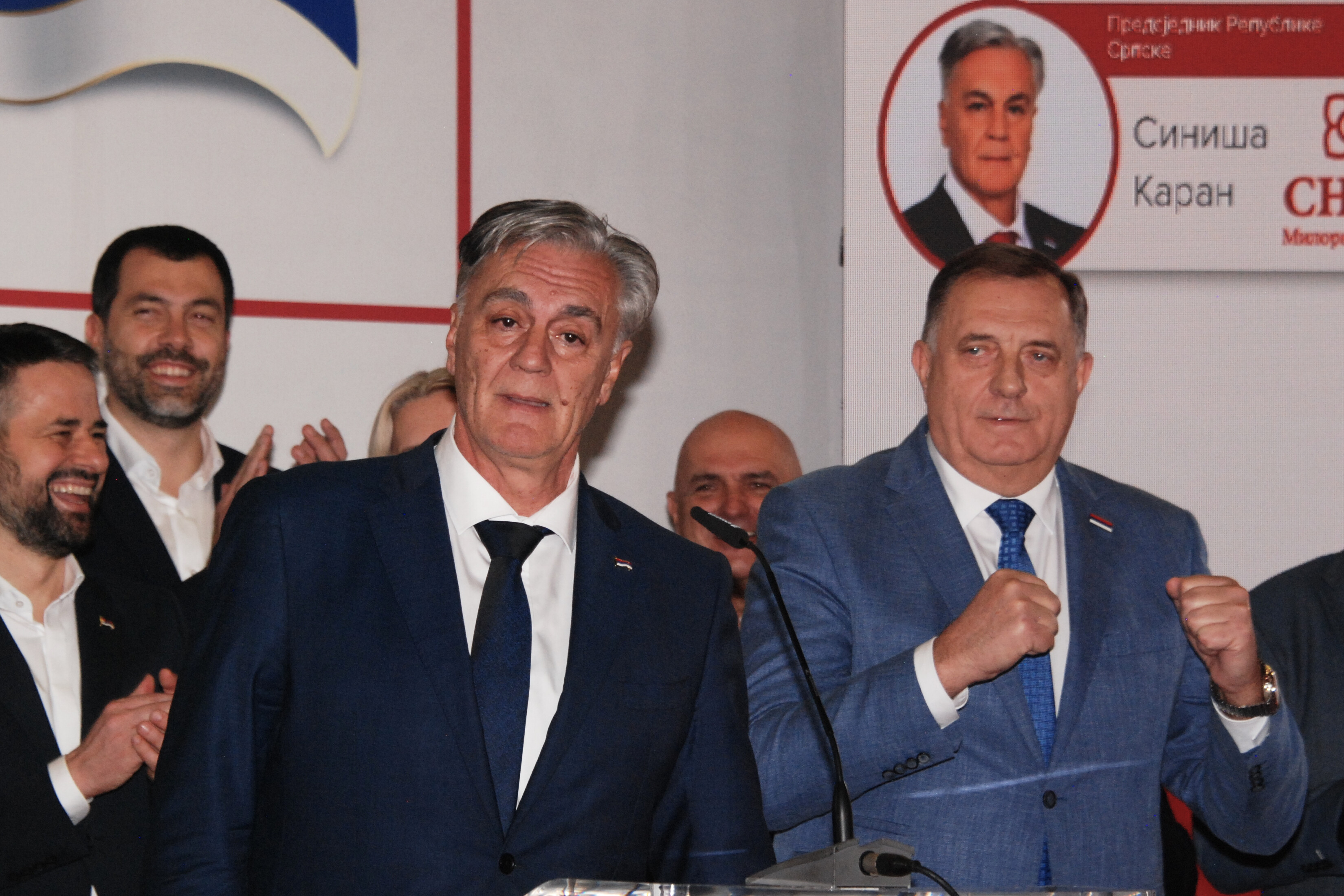
Siniša Karan (front left), supported by former pro-Russian leader Milorad Dodik (right), speaks to the media after his victory in the early presidential elections in Republika Srpska.
© picture alliance / ASSOCIATED PRESS | Radivoje PavicicThe presidential election in Republika Srpska (RS), the Serb dominated entity of Bosnia and Herzegovina, on 23 November produced a marginal and contested victory for Milorad Dodik’s camp. Elections became necessary after the Court of Bosnia and Herzegovina issued a ruling barring the former President from holding public office for six years for continued violations of the constitution.
Despite folding faced with the decision of the Court, Dodik stated his position cleary saying “I remain the most important man and I will be the president of all presidents in Republika Srpska. Is that enough?” With a low turnout of about 35 percent, the substitute candidate of the ruling SNSD, Siniša Karan, won with just over 50 percent of the vote, while the main opposition candidate, Branko Blanuša (SDS), was very close behind.
The victory margin for Karan is a little over 8,000 (at the time of writing with 99% votes counted) votes in an entity of roughly one million inhabitants. The razor-thin outcome is overshadowed by credible allegations of fraud and systemic manipulation in several municipalities, especially at the border with Serbia.
In political terms, this is an alarm bell rather than a triumph for the ruling party. For an autocratic leader who has long relied on administrative control, pressure on institutions and the mobilization of patronage networks, such a narrow result is politically costly. It signals weakening support for Dodik and SNSD ahead of the 2026 general elections and provides the opposition with a tangible narrative of momentum.
Conduct of the election and integrity concerns
In response to their leader being barred from participating, SNSD quickly repositioned and rallied behind Siniša Karan as their substitute candidate. The Central Election Commission of BiH organized the vote, with six candidates formally on the ballot, although the contest in practice was reduced to a binary choice between Karan and Blanuša. The election is not just a regular competition between government and opposition, but part of a broader struggle over the rule of law, the authority of state-level judicial institutions, and the willingness of political elites in RS to respect binding court decisions.
The election day once again highlighted structural weaknesses of electoral integrity in RS, with very low turnout of around 35 percent raising questions about political disengagement, disillusionment with available options, and the credibility of the process itself. Extreme results at selected polling stations, particularly in Doboj and Zvornik, where Karan reportedly received up to 98 percent of the vote at some locations, point to organized manipulation rather than normal electoral variation. In addition, the bussing in of voters from Serbia appears to have been a decisive tool. This practice is not new and has reportedly functioned as a two-way instrument of political support, with RS structures mobilizing voters for Aleksandar Vučić in Serbia, while Serbian actors assist Dodik during elections in RS.
In this case, such cross-border voter mobilization seems to have helped SNSD secure its minimal advantage, but at the price of further eroding trust in democratic procedures and causing reputational damage. At the same time, Dodik’s party is now clearly displaying weakness and can no longer mobilize as before. The opposition and watchdog actors are already calling for the annulment of results in Doboj and Zvornik and documenting irregularities. While it is unlikely that institutions controlled or influenced by SNSD will willingly overturn the outcome, the legitimacy of the RS presidency will remain contested from day one.
Implications for future elections and beyond
There are several major takeaways from these elections. For one, the SNSD’s dominance is eroding. Despite almost complete state capture, the heavy use of state resources, pressure on institutions and tailor-made local mechanisms of control, Dodik’s party could barely secure a win. This signals vulnerability ahead of the 2026 general elections, but also points to possible escalation of political crisis in BiH as a possible response by Dodik. The opposition in RS is emboldened. The result gives the opposition a rare yet quantifiable proof that SNSD can be challenged even within the existing, highly skewed playing field. This can strengthen their readiness to cooperate, professionalize campaigns and invest in monitoring structures and with announced changes to the conduct of elections in 2026 with the use of new technologies (scanners and biometrics) chances for manipulation and frauds will further diminish.
The "Rule of law vs. personal rule" element of the whole story should not unnoticed. The fact that this election was triggered by a binding Court of BiH verdict that Dodik is actively seeking to politically neutralize illustrates the tension between personal power and institutional constraints in RS. How this tension develops will be central to the broader trajectory of BiH, especially when put against the apparent deal Dodik has struck with the US administration and his apparently agreed political retirement. The US administration, while no longer as strongly interested in BiH as before, signalled on several occasion that destabilising actions will not be tolerated, leaving Dodik stranded without his most potent tool.
And finally, the cross-border authoritarian cooperation. The reported coordination between Dodik and Aleksandar Vučić, including mutual support through bussed-in voters, should be read as an element of a wider pattern of illiberal collaboration in the region, undermining democratic standards and electoral credibility. All of this is happening following the meeting between Dodik and Vučić couple a days ago. Despite some frictions arising out of the fact that Vučić was sidelined in Dodik’s negotiations with the US, the two are mutually dependent. Reciprocity is expected when Vučić calls for the elections in Serbia.