Nobel Peace Prize
Venezuela’s Fight for Freedom: María Corina Machado’s Moving Nobel Speech
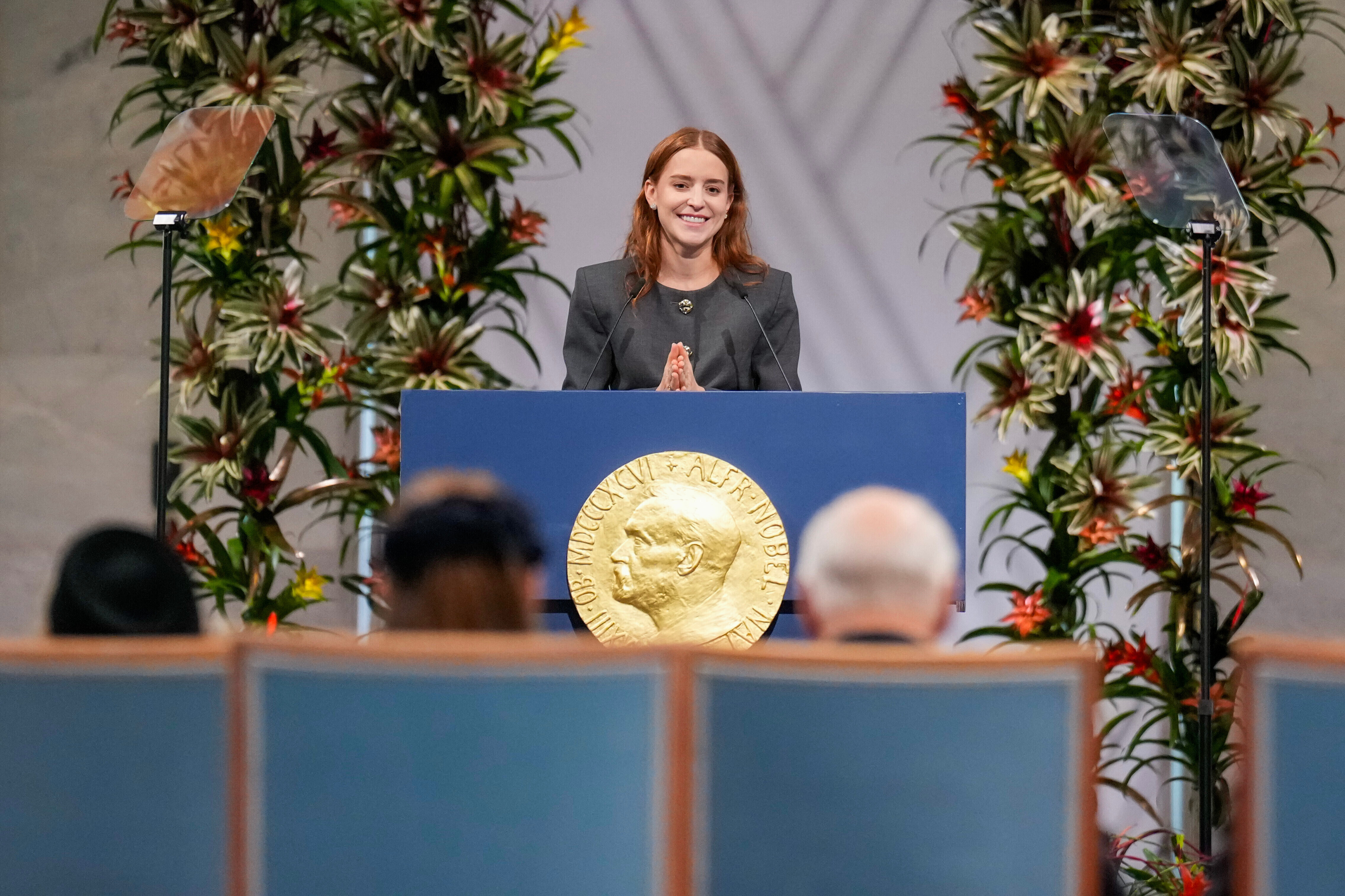
The daughter of the Nobel Peace Prize laureate, Ana Corina Sosa, accepts the award on behalf of her mother, Venezuelan opposition leader Maria Corina Machado, during the Nobel Peace Prize ceremony.
© picture alliance / ASSOCIATED PRESS | Ole Berg-RustenYour Majesties, Your Royal Highnesses, distinguished members of the Norwegian Nobel Committee, citizens of the world, my dear Venezuelans, First, I want to express our infinite gratitude — from my family and from an entire country — to the Norwegian Nobel Committee. Thanks to you, the struggle of an entire people for truth, for freedom, for democracy, and for peace is today recognized around the world. I am here on behalf of my mother, María Corina Machado, who has united millions of Venezuelans in an extraordinary effort that you, our hosts, have honored with a Nobel Peace Prize. But although she has not been able to be here and take part in this ceremony, I must say that my mother never breaks a promise. And that is why, with all the joy in my heart, I can tell you that in just a few hours, we will be able to embrace her here in Oslo — after 16 months living in hiding. And as I await that moment to hug her, to kiss her, to embrace her after two years, I think of the other daughters and sons who do not get to see their mothers today. This is what drives her — what drives all of us. She wants to live in a free Venezuela, and she will never give up on that purpose. That is why we all know — and I know — that she will be back in Venezuela very soon. In the meantime, I face the difficult task of giving voice to her words, the speech she prepared for this occasion. This is her speech.
María Corina Machado’s Nobel Lecture
I have come here to tell you a story. The story of a people and their long march toward freedom. This march brings me here today as one voice among millions of Venezuelans who rose once again to reclaim the destiny that was always theirs. Venezuela was born of audacity, shaped by peoples and cultures intertwined. From Spain, we inherited a language, a culture, and a faith that merged with ancestral Indigenous and African roots. In 1811, we wrote the first constitution in the Spanish speaking world — one of the earliest republican constitutions on Earth — affirming the radical idea that every human being carries a sovereign dignity. This constitution enshrined citizenship, individual rights, religious liberty, and separation of powers. Our ancestors carried liberty on their backs. They crossed an entire continent — from the banks of the Orinoco to the heights of Potosí — to help give rise to societies of free and equal citizens, out of the conviction that freedom is never whole unless it is shared. From the beginning, we believed something simple and immense: that all human beings are born to be free. That conviction became our national soul.
In the 20th century, the earth opened. In 1922, the Reventón de La Rosa erupted for nine days — a fountain of oil and possibility. In peace, we turned that sudden wealth into an engine for knowledge and imagination. Through the ingenuity of our scientists, we eradicated disease. We built universities of global prestige, museums and concert halls. We sent thousands of Venezuelans abroad through scholarships, trusting that free minds would return as transformation. Our cities glowed with the kinetic art of Cruz Diez and Soto. We forged steel, aluminum, and hydropower — proving that Venezuela could build anything it dared to envision.
But Venezuela also became a refuge. We opened our arms to migrants and exiles from every corner of the world: Spaniards fleeing civil war; Italians and Portuguese escaping poverty and dictatorship; Jews after the Holocaust; Chileans, Argentinians, and Uruguayans escaping military regimes; Cubans fleeing communism; and families from Colombia, Lebanon, and Syria seeking peace. We gave them homes, schools, and safety — and they became Venezuelans. This is Venezuela.
We built a democracy that became the most stable in Latin America, and freedom unfolded as a creative force. But even the strongest democracy weakens when its citizens forget that freedom is not something we wait for — but something we become. It is a deliberate personal choice. And the sum of those choices forms the civic ethos that must be renewed every day. The concentration of oil revenues in the state created perverse incentives. It gave the government immense power over society, which turned into privilege and corruption.
"Venezuela is not alone in this darkness"

In his speech for the Peace Prize ceremony, Jørgen Watne Frydnes, Chair of the Norwegian Nobel Committee, paints a moving picture of Venezuela’s courageous struggle for democracy.
My generation was born in a vibrant democracy, and we took it for granted. We assumed freedom was as permanent as the air we breathed. We cherished our rights, but we forgot our duties. I was raised by a father whose life's work — building, creating, serving — taught me that loving a country meant assuming responsibility for its future. By the time we recognized how fragile our institutions had become, a man who had once led a military coup to overthrow democracy was elected president. Many thought charisma could substitute the rule of law. From 1999 onward, the regime dismantled our democracy: violating the constitution, falsifying our history, corrupting the military, purging independent judges, censoring the press, manipulating elections, persecuting dissent, and ravaging our extraordinary biodiversity.
Oil wealth was not used to uplift, but to bind. Washing machines and refrigerators were handed out on national television to families living on dirt floors — not as progress, but as spectacle. Apartments meant for social housing were handed to a select few, with the condition of unquestionable obedience. And then came the ruin. Obscene corruption. Historic looting. During the regime’s rule, Venezuela received more oil revenue than in the previous century combined — and it was all stolen. Oil money became a tool to purchase loyalty abroad, while at home criminal and international terrorist groups fused themselves to the state. The economy collapsed by more than 80%. Poverty surpassed 86%. Today, 9 million Venezuelans have been forced to flee. These are not statistics. They are open wounds.
Meanwhile, something deeper and more corrosive took place. A deliberate method to divide society — by ideology, race, origin, ways of life — pushing Venezuelans to distrust one another, to silence one another, to see enemies in one another. They smothered us. They imprisoned us. They killed us. And they forced us into exile. It had been almost three decades of fighting against a brutal dictatorship, and we had tried everything: dialogues betrayed, protests of millions crushed, elections perverted. Hope collapsed entirely. The idea of a future became impossible. The idea of change seemed either naïve or crazy. It seemed impossible.
Yet from the very depths of that despair, a step that seemed modest — almost procedural — changed the course of our history. We decided — against all odds — to run a primary election. And unlike any other act of rebellion, we chose to trust people to rediscover one another. We traveled by road and dirt path in a country with gasoline shortages, daily blackouts, and collapsing communications. Forbidden from advertising, without money or media willing to speak our names, we crossed it armed only with our conviction. Word of mouth was our network of hope. And it spread faster than any campaign, because our desire for freedom was alive within us — it had never died.
The forced migration that was meant to fracture us instead united us around one sacred purpose: to reunite our families in our land. Grandparents confided in me their greatest fear: dying before meeting their grandchildren abroad. Little girls, with voices too small for such sorrow, begged me to bring back their mothers and siblings scattered across the continent. Our pain fused into one heartbeat: Bring our children home. Now.
In May 2023, during a rally in the town of Maturín, a teacher named Carmen came up to me. She told me she had run into her jefa de calle — a regime agent assigned to her block, who decides house by house who receives a monthly food bag, and who is punished with hunger. Shocked to see this woman at the rally, Carmen asked her: “Why are you here?” And the jefa replied: “My only son, who fled to Peru, asked me to be here today. He told me that if María wins, he will return home. Tell me what I have to do. I’ll do anything.” That day, love defeated fear.
Two weeks later, we reached Delicias, a tiny village swallowed by Colombian guerrillas and drug traffickers, where not even a chicken can be sold without their permission. No candidate had gone there since 1978. As we climbed the mountain, I saw Venezuelan flags waving from every humble home. I naively asked if it was a national holiday that merited all the flags. Someone whispered: “No. Here, flags are hidden. Bringing it out is dangerous. Today, people raise them to thank you for daring to come. You will leave, but we will remain identified.” That day, entire families stood up to the armed groups that ruled their lives. And when we sang the national anthem together, sovereignty returned in a single fragile, defiant chorus. That day, courage defeated oppression.
Our gatherings became intimate encounters of thousands. We embraced, we cried, we prayed. We understood our struggle was much more than electoral. It was an ethical struggle for truth, an existential struggle for life, and a spiritual struggle for good. With less than a year before the presidential election, we had to unite every democratic force and restore trust in the vote. The primaries became that moment — a self organized civic effort that built a nationwide citizens’ network unlike anything Venezuela had ever seen.
On October 22, 2023, against all odds, Venezuela awoke. The diaspora — one third of our nation — reclaimed its right to vote. The son who had left cast his ballot alongside the mother who stayed. Lines stretched for blocks. Turnout was so overwhelming that ballots ran out. We trusted the people — and they trusted us back. What began as a mechanism to legitimize leadership became the rebirth of a nation’s confidence in itself.
That day, I received a mandate — a responsibility that transcended any individual ambition. I felt humbled, and profoundly aware of the weight with which I had been entrusted. Threatened by that truth, the regime prohibited me from running for president. It was a harsh blow. But mandates belong to the people. We set out to find another candidate who could take my place. Edmundo González Urrutia stepped forward — a calm, brave former diplomat. The regime believed he posed no threat. But they underestimated the resolve of millions of citizens.
A plural, vibrant society, rich in its diversity, found unity in a common purpose. Communities, political parties, unions, students, and civil society stood together and worked as one so that the voice of a nation could be heard. We were three months from election day, and almost no one knew his name. But votes were not enough. We had to defend them. For over a year, we had been building the infrastructure to do so: 600,000 volunteers across 30,000 polling stations; apps to scan QR codes; digital platforms; diaspora call centers.
We deployed scanners, Starlink antennas, and laptops hidden inside fruit trucks to the furthest corners of Venezuela. Technology became a tool for freedom. Secret training sessions were held at dawn in church back rooms, kitchens, and basements, using printed materials moved across Venezuela like contraband.
Finally, election day arrived — July 28, 2024. Before dawn, lines wrapped around blocks. A quiet, trembling hope filled the air. Our live tracking showed turnout rising across every state and town. And then the electoral tally sheets — the famous actas, the sacred proof of the people’s will — began to appear: first by phone, then WhatsApp, then photographed, then scanned, and finally carried by hand, by mule, by canoe. They arrived from everywhere — an eruption of truth. Because thousands of citizens risked their freedom to protect them.
Confronted with our overwhelming victory, the regime issued a desperate order: soldiers were to expel our volunteers from voting centers and block them from receiving the original tally sheets they were legally entitled to. But the soldiers disobeyed. Edmundo González Urrutia won with 67% of the vote — in every state, city, and village. Every single tally sheet told the same story. Within hours, they were digitized and published on a website for the world to see.
But the dictatorship responded with terror. 2,500 people kidnapped, disappeared, tortured. Homes marked. Entire families taken as hostages. Priests, teachers, nurses, students — anyone who dared share a tally sheet — hunted down. These are crimes against humanity, documented by the United Nations — state terrorism deployed to bury the will of the people. Some of the more than 220 children detained after the elections were electrocuted, beaten, and suffocated until they repeated the lie the regime needed, falsely incriminating themselves of being paid by me to protest. Women and girls in prison are right now being forced into sexual slavery — made to endure abuse in exchange for a family visit, a meal, or the chance to take a bath.
And yet, the Venezuelan people did not surrender. During the past 16 months in clandestinity, we have built new networks of civic pressure and disciplined disobedience, preparing for Venezuela’s orderly transition to democracy. That is how we reach this day — a day carrying the echo of millions who stand at the threshold of freedom.
This prize carries profound meaning. It reminds the world that democracy is essential to peace. And more than anything, what we Venezuelans can offer the world is the lesson forged through this long and difficult journey: that to have democracy, we must be willing to fight for freedom. And freedom is a choice that must be renewed every day — measured by our willingness and our courage to defend it. For this reason, the cause of Venezuela transcends our borders. A people who choose freedom contribute not only to themselves, but to humanity.
We attain freedom only when we refuse to turn our backs on ourselves — when we confront the truth directly, no matter how painful — when love for what truly matters in life gives us the strength to persevere and to prevail. Only through that inner alignment, that vital integrity, do we rise to meet our destiny. Only then do we become who we truly are — able to live a life worthy of being lived.
Along this march to freedom, we gained profound certainties of the soul — truths that have given our lives deeper meaning and prepared us to build a great future in peace. Therefore, peace is ultimately an act of love. This love has already set our future in motion. Venezuela will breathe again. We will open prison doors and watch thousands who were unjustly detained step into the warm sun — embraced at last by those who never stopped fighting for them. We will see grandmothers settle children on their laps to tell them stories not of distant forefathers, but of their own parents’ courage. We will see our students debate ideas passionately and without fear — their voices rising freely. At last, we will hug again, fall in love again, hear our streets filled with laughter and music again — and all the simple joys of the world that we had taken for granted will be ours.
My dear Venezuelans, the world has marveled at what we have achieved, and soon it will witness one of the most moving sights of our time: our loved ones coming home. And I will stand again on the Simón Bolívar Bridge — where I once cried watching the thousands who were leaving — and welcome them back into the luminous life that awaits us. Because in the end, our journey toward freedom has always lived inside us. We are returning to ourselves. We are returning home.
Allow me to honor the heroes of this journey: our political prisoners, the persecuted, their families, and all who defend human rights; those who sheltered us, fed us, and risked everything to protect us; the journalists who refused silence; the artists who carried our voice; my exceptional team, my mentors, my fellow political and social activists; the leaders around the world who joined us and defended our cause; my three children; my adored father; my mother; my three sisters; and my brave and loving husband, who have all supported me throughout my life — and above all, the millions of anonymous Venezuelans who risked their homes, their families, and their lives out of love. To them belongs this honor. To them belongs this day. To them belongs the future. Gracias.