Nobel Peace Prize 2025
"Venezuela is not alone in this darkness"
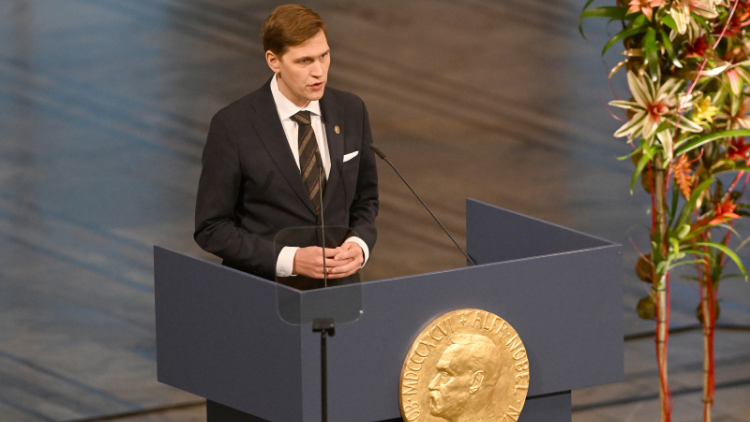
Jørgen Watne Frydnes, chair of the Norwegian Nobel Committee attends the 2025 Nobel Peace Prize presentation ceremony.
© picture alliance / newscom | PAUL TREADWAYYour Majesties, Your Royal Highnesses, esteemed laureate,
Excellencies, distinguished guests, ladies and gentlemen.
Samantha Sophia Hernandez, a girl of 16, was brutally abducted last month by masked members of the Maduro regime’s security forces. She was taken from her grandparents’ home. Where she is now, we do not know — probably in one of the dictatorship’s detention centers. She may be with her father, who disappeared without a trace in January.
What had they done wrong? Her brother, a soldier, refused to follow the regime’s orders to commit brutal acts against the population. For that offense, the entire family must be punished.
Juan Reesense was ordered to turn slowly toward the camera. The video shows him standing as if in a fog, his underwear stained with excrement. He had supposedly confessed to planning a coup — but of course, there was no proof. The day before his arrest, Juan had stood before the National Assembly and repeated one key sentence, a promise to his country and to himself: “I refuse to give up.”
Alfredo Díaz, an opposition leader and former mayor, was pulled from a bus last November and thrown into the depths of El Helicoide, Latin America’s largest torture center — one more political prisoner in a long line of others. This week came the news of his death. Another life gone. Another victim of the regime.
These stories are not unique. This is Venezuela today. It is how the Venezuelan regime treats its own people. A sister, a student, a politician — anyone who still dares to speak the truth may disappear violently into a system built specifically to eradicate that belief. Samantha, Juan, and Alfredo were not extremists. They were ordinary Venezuelans, dreaming of freedom, democracy, and rights. For this, their lives were stolen from them.
Under this regime, children are not spared. More than 200 children were arrested after the elections in 2024. The United Nations documented their experience: plastic bags pulled tight over their heads; electric shocks to the genitals; blows so brutal it hurt to breathe; sexualized violence; cells so cold they caused intense shivering; foul drinking water teeming with insects; screams no one came to stop.
One child lay in the dark whispering his mother’s name so she would not believe he was dead. A 16-year-old eventually came home so ravaged by shocks and beatings that he could not hug his mother without pain shooting through his body. For months he jumped at every sound and barely slept, waking at night convinced the soldiers were back.
As we sit here in Oslo City Hall, innocent people are locked away in dark cells in Venezuela. They cannot hear the speeches given today — only the screams of prisoners being tortured. This is how authoritarian powers try to crush those who stand up for democracy. The United Nations has declared these acts to be crimes against humanity. This is the regime of Nicolás Maduro.
Venezuela has become a brutal authoritarian state facing a deep humanitarian and economic crisis. Meanwhile, a small elite at the top — shielded by power, weapons, and impunity — enriches itself. In the shadow of this crisis, thousands of women and children are forced into prostitution and human trafficking. Daughters simply disappear. Children become objects of trade in the hands of criminals who see human desperation as a business opportunity. A quarter of the population has already fled the country — one of the world’s largest refugee crises.
Those who remain live under a regime that systematically silences, harasses, and attacks the opposition.
Venezuela is not alone in this darkness. Authoritarianism is gaining ground worldwide. We must ask the uncomfortable question: Why is it so hard for us to preserve democracy — a form of government conceived to protect our freedom and our peace?
When democracy loses, the result is more conflict, more violence, more war. In 2024 more elections were held than in any year before, yet ever fewer were free and fair. The power of the law is misused. Independent media are silenced, and critics imprisoned. More and more countries, even those with long democratic traditions, drift toward authoritarianism and militarization.
Authoritarian regimes learn from one another. They share technology and propaganda systems. Behind Maduro stand Cuba, Russia, Iran, China, and Hezbollah, providing weapons, surveillance, and economic lifelines. They make the regime more brutal and more robust.
And yet, amid this darkness, Venezuelans refuse to give up. They keep the flame of democracy alive despite enormous personal cost. Many of them are here with us today: Carlos the poet, Claudia the activist, Pedro the professor, Ana Luisa the nurse, Kina the grandmother, Antonio the opposition politician, and Venezuela’s president-elect, Edmundo González Urrutia.
[Applause]
The Nobel Peace Prize laureate, María Corina Machado, has done everything in her power to attend the ceremony today — a journey in a situation of extreme danger. Although she will not be able to reach this ceremony and today's events, we are profoundly grateful and relieved to confirm that she is safe, and that she will be with us here in Oslo.
At the heart of the battle for democracy shines a simple truth: democracy is more than a form of government. It is the basis for lasting peace. Millions of Venezuelans know this. Year after year, students, trade unions, journalists, business groups, and ordinary citizens have mobilized in waves of resistance. They have filled the streets in protest. When their votes were taken away, they banged pots and pans. When state surveillance became inescapable, they whispered.
People across the political spectrum — from communists to conservatives — have risen to challenge the regime. Through every strategy, they have said: “We strive not for revenge, but for justice. For the sanctity of the ballot box. For democracy. And for peace.”
But they are told that these things are impossible, that they will fail. And when Venezuelans asked the world to pay attention, we turned away. As they lost their rights, their food, their health and safety, and eventually their future, much of the world clung to old narratives. Some insisted Venezuela was an ideal egalitarian society. Others saw only a struggle against imperialism. Still others viewed Venezuelan reality as a contest between superpowers — overlooking the bravery of those seeking freedom in their own country.
What these observers shared was a moral betrayal of those who actually live under the regime.
If you support only those who share your political views, you understand neither freedom nor democracy.
Yet many critics go further — faulting the hard choices that defenders of democracy must make, while ignoring their courage and sacrifice. It is easy to stand on principle when someone else’s freedom is at stake. No democracy movement operates in ideal circumstances. People under dictatorship must choose between the difficult and the impossible, while outside observers demand a moral purity their oppressors never display.
This is unrealistic. It is unfair. And it reveals ignorance of history.
Many who have stood at this podium — Lech Wałęsa, Nelson Mandela — knew well the dilemmas of dialogue. In authoritarian systems, dialogue can lead to improvement — but it can also be a trap, used to buy time, sow division, and control the agenda.
María Corina Machado has participated in dialogue processes for years. She has never rejected the principle of talking to the other side — but she has rejected empty processes. Peace without justice is not peace. Dialogue without truth is not reconciliation.
Venezuela's future may take many forms, but its present is one thing only: horrific. That is why the democratic opposition in Venezuela must have our support — not our indifference or condemnation. Every day its leaders must choose among the few paths actually open to them, not those we might wish for from afar.
Support for democratic development is support for peace.
And since the announcement of this year’s Nobel Peace Prize, one question has been posed: Does democracy really lead to peace?
Research is clear: yes. Not because democracy is perfect, but because its mechanisms make war less likely. Democracies have safety valves — free media, power-sharing, independent courts, civil society, and elections that allow peaceful transfers of power. Differing opinions are not threats, but strengths.
In a democracy, a leader who ignores facts can be replaced at the next election. In an authoritarian regime, such leaders silence those who speak uncomfortable truths. Loyalty replaces reality, and dangerous decisions are taken in the dark.
War is always costly — but in authoritarian regimes, leaders do not pay the price. This is why democracies almost never go to war with each other, while authoritarian states are more prone to conflict.
Nicolás Maduro’s rule shows why. Conflicts are resolved by brute force, not negotiation. Millions are forced into silence. The consequences do not stop at borders. Instability, violence, and the destruction of institutions have shaken the entire region. A neighboring country has been threatened with military invasion.
Venezuela demonstrates clearly that authoritarian rule destroys society from within and spreads instability abroad. Democracy is no guarantee of peace — but it is the most effective system for preventing violence.
Authoritarians claim the opposite: that democracy itself creates unrest, that demanding freedom is dangerous. It is an old argument — now supercharged by disinformation and propaganda.
Ladies and gentlemen, as citizens of democracies, we must be critical of our information sources. Alarm bells should ring when the views we repeat match those of manipulative propaganda systems. In such cases we are not spreading information — we are spreading a dictator’s strategic narrative.
What are we to think when we hear that the Venezuelan opposition is threatening the country with war? That the democratic movement desires invasion? When victims are branded as aggressors?
The Maduro regime insists it is the guarantor of peace. But peace built on fear, silence, and torture is not peace — it is submission disguised as stability. The violence does not come from democracy activists. It comes from those who refuse to cede power.
It was not Nelson Mandela who made South Africa violent, but apartheid’s crackdown on demands for equality. Opposition groups did not start the imprisonments in Belarus, the executions in Iran, or the persecution in Venezuela. The violence comes from authoritarian regimes lashing out against popular calls for change.
Peace and democracy cannot be separated without draining both of meaning. Lasting peace depends on rule of law, political participation, and human dignity. Without democracy, there is no genuine way to disagree — no politics at all.
Democracy is not a luxury. It is not an ornament. It is hard work — action and negotiation, a living obligation. The instruments of democracy are the instruments of peace.
We gather here today to defend something far more important than political divides. We gather to defend democracy — the foundation on which lasting peace rests. When people refuse to surrender democracy, they refuse to surrender peace.
No one understands this better than María Corina Machado. As a founder of Súmate, an organization devoted to building democracy, she chose ballots over bullets. In political office and in civic life, she has defended judicial independence, human rights, and democratic representation. She has spent decades working for the freedom of the Venezuelan people.
The 2024 presidential election was decisive in the selection of this year’s Peace Prize. Machado was the opposition candidate — the country’s unifying voice of hope. When the regime blocked her candidacy, the movement might have collapsed. Instead, she rallied behind Edmundo González Urrutia, and the opposition stayed together.
The movement united around one demand: free elections and representative government — the foundation of democracy. Hundreds of thousands of volunteers mobilized across political lines. They trained as election observers, used technology to document every step of the process, and stood guard at polling stations around the country. They uploaded vote tallies, photographed records, and secured copies before the regime could destroy them — defending that documentation with their lives.
This was grassroots democratic mobilization on a scale unprecedented in Venezuela — perhaps in the world.
When the opposition publicized the tallies showing a clear victory, the regime denied them all, falsified the results, and clung to power violently.
For the past year, Machado has lived in hiding. Despite threats, she has remained in the country — an inspiration to millions. She receives the Nobel Peace Prize for 2025 for her tireless work defending the democratic rights of the Venezuelan people, and for her struggle to achieve a peaceful transition from dictatorship to democracy.
For years, the Venezuelan opposition has relied on democracy’s toolbox: boycotts when the system was rotten, participation when small openings appeared; dialogue, organization, mobilization, documentation. Machado has called for international attention and pressure — not for invasion. She has urged Venezuelans to stand up for their rights through peaceful, democratic means.
Peace research is clear: widespread nonviolent mobilization is one of the most effective methods of achieving political change under dictatorship. When people mobilize, when the international community applies pressure, and when security forces refrain from attacking the population, a tipping point can be reached.
As the leader of Venezuela’s democratic movement, María Corina Machado stands as one of the most extraordinary examples of civil courage in recent Latin American history.
This year’s Nobel Peace Prize fulfills all three criteria of Alfred Nobel’s will:
- The opposition has united political movements and civil society toward one goal — restoring democracy.
This is the modern equivalent of Nobel’s “peace congresses.” - The movement has opposed the regime’s militarization of society, documenting abuses and demanding accountability. This strengthens civilian authority and diminishes the regime’s weapons — Nobel’s call for disarmament.
- True fraternity — fellowship — requires democracy.
Only when people can choose their leaders and speak freely can peace take root.
And so, with the full gravity of this ceremony, we say what authoritarian leaders fear most:
Your power is not permanent. Your violence will not prevail over a people who rise and resist.
Mr. Maduro: accept the election result and step down. Lay the foundation for a peaceful transition to democracy. That is the will of the Venezuelan people.
María Corina Machado and the Venezuelan opposition have lit a flame that no torture, no lie, no fear can extinguish. When the history of our time is written, it will not be the names of authoritarian rulers that stand out, but those who dared to resist — those who stood tall, who kept going when others gave up. Carl von Ossietzky, Andrei Sakharov, Nelson Mandela.
Throughout its long history, the Norwegian Nobel Committee has honored brave women and men who stood against repression, who carried the hope of freedom in prison cells, in the streets, in public squares, showing by their actions that resistance can change the world.
Today we honor María Corina Machado. And we pay tribute to all who wait in the dark — all who have been arrested, tortured, or disappeared, all who continue to hope. To those in Caracas and across Venezuela who must whisper the language of freedom: may they hear us now. May they know that the world is not turning away, that freedom is drawing nearer, and that Venezuela will become peaceful and democratic.
Let a new age dawn.
Thank you.