Venezuela
Venezuela One Year After the Stolen Elections: Resistance and Hope


Opposition leader Maria Corina Machado addresses supporters during a protest against Venezuelan President Nicolas Maduro.
© picture alliance / ASSOCIATED PRESS | Matias DelacroixOne year after the stolen presidential elections on July 28, 2024, Venezuela remains under authoritarian rule. The long-awaited regime change has yet to occur, but the hours of the current regime are numbered. Despite overwhelming evidence of Edmundo González’s victory — including copies of vote tallies from over 80% of polling stations — the regime declared Nicolás Maduro the winner and refused to publish the full results.
González, endorsed by the leading liberal opposition politician from the Vente Venezuela party, María Corina Machado, ran as the unified candidate of the democratic movement — yet the will of the people was systematically suppressed. María Corina Machado was barred from running because the regime simply denied her participation.
In response to protests that broke out immediately after the election in several cities, the regime unleashed brutal repression: over 2,200 people were arrested, and the Inter-American Commission on Human Rights openly condemned the actions as “state terrorism.” According to the NGO Foro Penal, 948 political prisoners are currently detained, including minors and members of the military. While many opposition leaders have been forced into exile or imprisonment, María Corina Machado remains defiant inside the country — active, visible, and under constant threat.
One year after July 28, the picture is clear: democracy has been violently pushed back, but resistance lives on — fueled by courage, organization, and the unwavering will of the people. The struggle is far from over.
To honor this remarkable achievement of Venezuelan civil society and to keep alive the memory of this powerful democratic act, the Latin American Liberal Network (known by its Spanish acronym RELIAL) was hosting a special online event on July 28, 2025. Its centerpiece was the presentation of the book and online portal
“Venezuela 28J: The Deed of a Democratic People,”
which documents the courage and organization of citizens who continue to fight for democracy and freedom despite all odds.
For more information, please visit the YouTube channel of Red Liberal de América Latina RELIAL.
Here are my own closing remarks at this event:
Dear friends of freedom worldwide,
dear friends of a free Venezuela,
As Chairman of the Friedrich Naumann Foundation
and President of Liberal International,
I am honored to welcome you to this important event.
Today, we shine a spotlight
on one of the most inspiring struggles for freedom in the modern world:
The fight of the people of Venezuela for freedom and democracy
I want to thank RELIAL for making this gathering possible.
Warmest regards to María Corina Machado
and Edmundo González Urrutia — true champions of liberty.
And to Félix Maradiaga,
and all our partners from Friedrich Naumann Foundation,
Liberal International, and RELIAL — thank you for standing with us.
The cause of Venezuela has become profoundly personal to me —
largely because of my deep admiration for María Corina Machado.
Over the years, I’ve witnessed how her message —
principled and unwavering —
has resonated across Venezuela and beyond.
She does not rely on populism or false promises.
She offers something far more powerful:
a vision of a nation where every individual —
not a corrupt regime — is the author of their own destiny.
Last year, I joined the Venezuelan diaspora in Germany by invitation of Vente Venezuela Germany as we demanded free and fair elections.
I will never forget that day — Sunday, July 28 —
standing with Venezuelans outside the voting center in Berlin.
Two words defined that moment:
hope and frustration.
Hope for a better future,
as people waited for news from their hometowns.
Also frustration — deep, painful frustration —
among those Venezuelans abroad
who were denied the right to vote
by a regime that feared the more than eight million voices
who have been forced to leave their home.
Two weeks later, something extraordinary happened.
Despite repression, censorship, and manipulation —
Edmundo González, with the endorsement of María Corina Machado,
emerged as the legitimate winner of the election.
And around the world — including right here in Berlin —
tens of thousands of Venezuelans came together —
organized by the comanditos —
to document the truth.
I saw it with my own eyes:
copies of tally sheets, grassroots coordination,
and a movement powered not by money or media,
but by conviction and civic duty.
Some say the Chavista regime is immovable.
But what happened on July 28 tells a different story.
It was a heroic act by more than a million citizens
who proved the impossible is possible when people stand together.
Venezuelans reminded us
that no dictatorship — no matter how entrenched — is invincible.
For years, the Chavista regime persecuted dissent
and destroyed democratic institutions.
But despite the fear and repression,
the people rose.
They spoke loudly —
not only with their votes,
but with their unshakable commitment to truth and justice.
Unfortunately, fraudulent elections
are becoming all too common around the world.
What is rare — and powerful —
is the ability to prove fraud —
and to do so with data and democratic values.
That’s why today’s presentation,
and the report titled
“28J: The Citizens’ Feat in the Fight Against Autocracy”,
is so important.
This document is not just a historical account —
it’s a playbook for resistance,
a manual for democratic resilience,
and a testament to the strength of civic courage.
Reading it, I was reminded
how easy it is to take democracy for granted.
In healthy democracies,
our biggest challenge is to win over voters.
In Venezuela, the opposition had to do that —
and ensure the will of the people couldn’t be erased.
The scale of their efforts is breathtaking:
270,000 polling station witnesses
100,000 staff for collection, scanning, and transport
60,000 polling station coordinators
20,000 special task forces for high-risk areas
And all of this happened
under a regime that monopolized the media,
banned opposition leaders from flying,
denied access to public funds,
and launched campaigns of fear and repression.
There were no campaign posters
for Edmundo González in Caracas.
And yet — thanks to María Corina Machado
and a network of courageous citizens —
his message still reached millions:
through cars, boats, motorcycles, and smartphones.
Person to person. Heart to heart.
Still, the regime arrested those who dared to help.
It controlled everything — except the will of the people.
And that is why it lost.
July 28 was not luck.
It was the result of a brilliant grassroots strategy —
fueled by discipline, unity,
and a dream too big to be silenced.
Many liberal parties around the world
could learn from this movement.
As Pedro Urruchurtu,
International Affairs Coordinator for Vente Venezuela,
who spent more than 400 days trapped in an embassy, reminds us:
“La libertad, como cuestión de dignidad,
es un tesoro, pero también un deber.”
(Freedom, as a matter of dignity, is a treasure — but also a duty.)
Let us carry that spirit forward.
Let us honor it — not just with words, but with action.
Thank you.
An electoral fraudster as president of Venezuela?
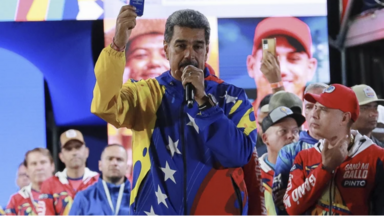
The Venezuelan presidency is scheduled to take office this Friday. The legitimate winner of the election, Edmundo González Urrutia, has announced that he will return to Caracas to take up the mandate that the Venezuelans gave him in the elections. However, the Maduro regime, which is reacting with massive repressive measures, is holding on to power. The weekly column by Karl-Heinz Paqué.
Maduro, Step Aside for Democracy in Venezuela
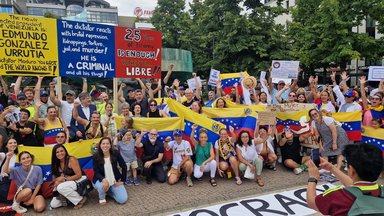
Despite authoritarian pressure, the Venezuelan people voted overwhelmingly for Edmundo González Urrutia and against the dictator Nicolás Maduro. Yet, Maduro refuses to acknowledge his defeat. Liberal opposition leader María Corina Machado has called for global protests. In Berlin, Karl-Heinz Paqué, Chairman of the Friedrich Naumann Foundation, and Deputy President of the Liberal International, urged the international community in a speech to increase pressure on the authoritarian regime to enable a peaceful transition to democracy.