Uganda Election
The price of the ballot and the politics of power

The contest was framed as a battle between continuity and change. While seven candidates appeared on the ballot, the race was effectively a two-horse contest between the 81-year-old incumbent and the 43-year-old leader of the National Unity Platform (NUP). The campaign period, however, was marked by widespread allegations of repression, including the disruption of opposition rallies, arrests of activists, and violent crowd dispersals. Images of Wine being teargassed while addressing supporters drew both domestic and international condemnation.
Attention quickly turned to the credibility of the electoral process and the role of the Electoral Commission, chaired by Justice Simon Byabakama. Byabakama succeeded Badru Kiggundu, whose tenure was repeatedly criticised by the opposition for alleged bias in previous elections. Although Byabakama has been regarded as a figure of professional integrity, concerns over the Commission’s independence resurfaced days before the vote, after a senior presidential aide was captured on video stating that Museveni would “never leave power through voting.”

Robert Kyagulanyi Ssentamu, alias Bobi Wine, together with his wife Barbara Kyagulanyi address the media from their home in Kampala on election day (15 January 2026).
© SuppliedVoting day itself was largely calm but logistically troubled. Heavy police deployment was visible in Kampala, underscoring the tense political climate. Across several regions, voting was delayed for hours after biometric voter verification kits malfunctioned, forcing officials to revert to manual voting. Media reports also cited late delivery of election materials. The biometric system had been introduced to prevent multiple voting, and its failure fuelled opposition claims of ballot manipulation.
By Friday, provisional results showed Museveni leading with more than 76% of the vote, with nearly half of polling stations tallied. Opposition party agents reported intimidation and restrictions on their ability to monitor the process. That evening, the NUP alleged that security forces raided Wine’s residence, cut electricity, assaulted guards, and briefly detained family members. Conflicting accounts of Wine’s whereabouts circulated before his son later said he had escaped.

Security / police forces in Kampala are seen around what appears to be teargas smoke on election day on 15 January 2026.
© SuppliedIsolated violence was also reported. In Butambala district, police said machete-wielding opposition supporters attacked a police station and vote-tallying centre, prompting officers to open fire. At least 25 people were arrested.
Wine rejected the results, accusing authorities of orchestrating electoral fraud and suppressing the will of the people. The Electoral Commission did not publicly respond to the allegations.
The election was further overshadowed by a nationwide internet shutdown, a move widely criticised by rights groups and observers. The United Nations human rights office said the polls took place in an environment of “widespread repression and intimidation.” Regional observer missions, including those from the African Union, COMESA and IGAD, raised concerns about the independence of the Electoral Commission, delays in accrediting domestic observers, disputed constituency boundaries, and the late withdrawal of parliamentary candidates, some of whose names still appeared on ballot papers.
Uganda Election 2026: Museveni’s Seventh Term & Bobi Wine’s Challenge — Interview with Inge Herbert
© ENCAObservers stressed that electoral credibility is shaped long before polling day. Questions around the appointment of commissioners, access to information, constituency delimitation and observer accreditation were cited as factors that may have undermined public confidence in the process.
The Electoral Commission ultimately declared Museveni the winner with 71.65% of the vote, compared to Kyagulanyi’s 24.72%. While the result guarantees political continuity, critics argue that the election reinforced a familiar pattern in Ugandan politics: the deep entrenchment of incumbency power through state institutions, security forces and control of civic space.

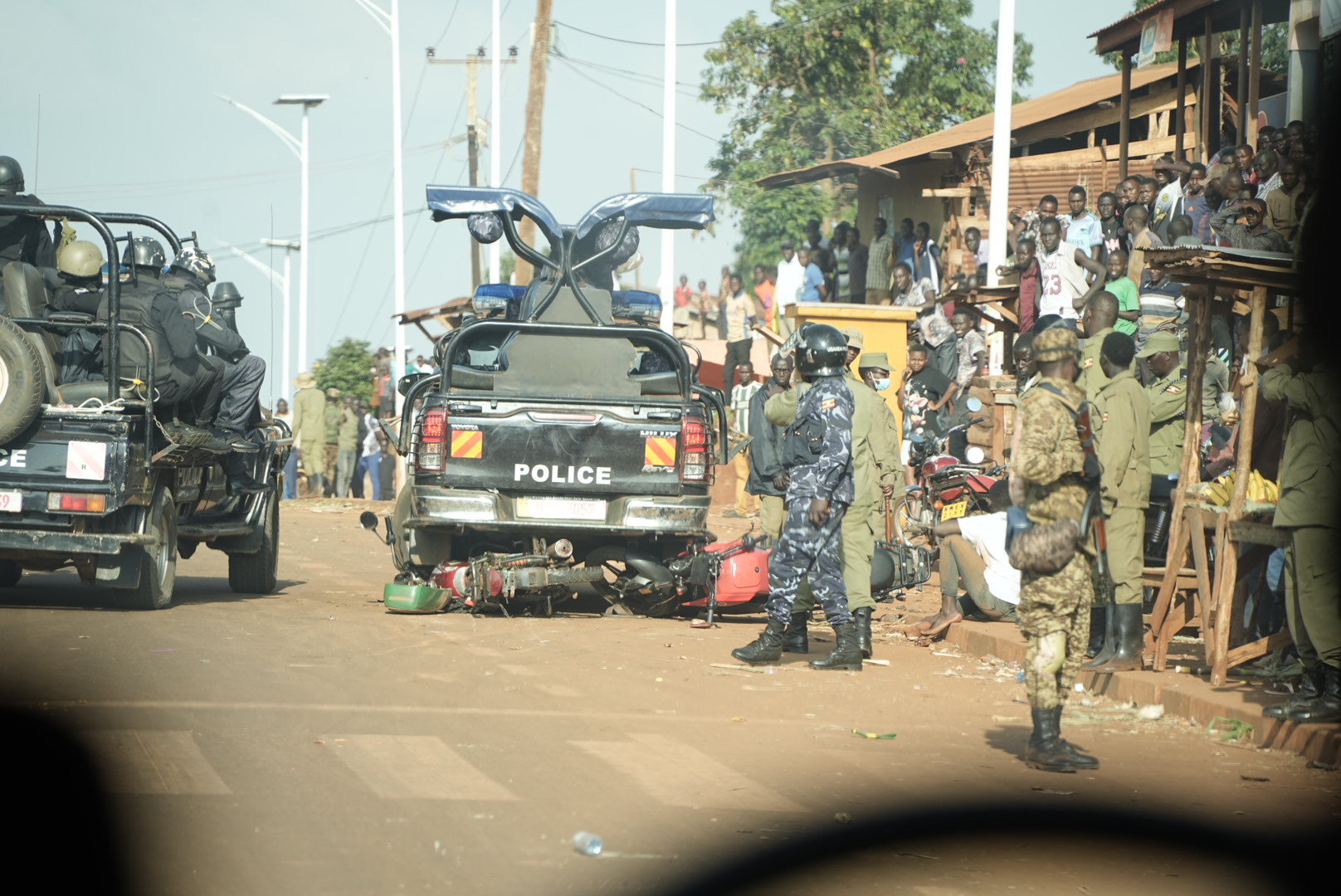
Security / police forces appear to be blocking a road on election day, 15 January 2026 in Uganda.
© SuppliedFor many Ugandans, the 2026 election was about more than a change of leadership. It was a test of democratic credibility, one whose outcome continues to face scrutiny at home, abroad, and the populous diaspora community.