Argentina
Milei’s Reform Agenda Off to a Strong Start in 2026

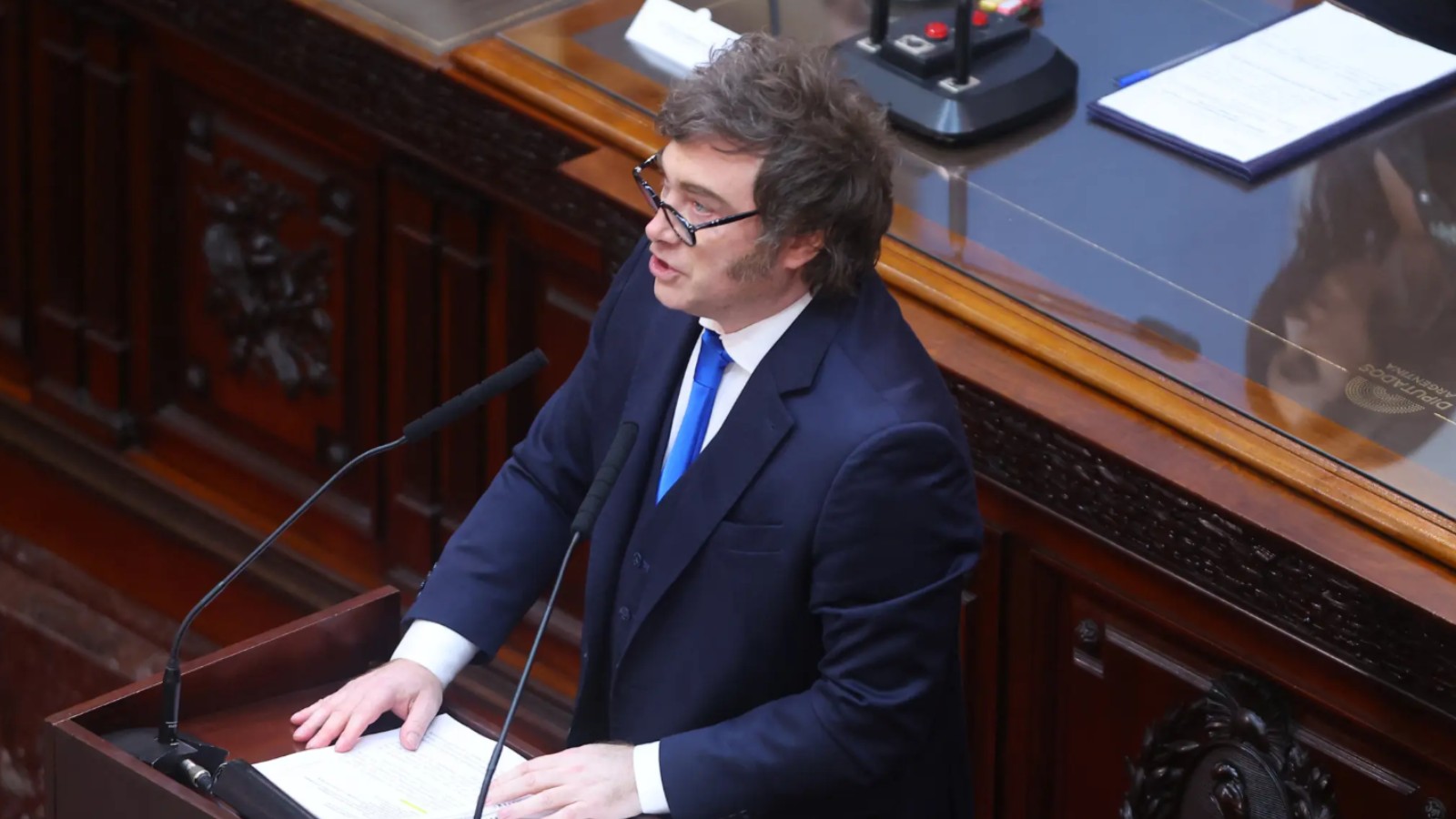
Javier Milei at the opening of the 2026 regular parliamentary session.
Dr. Hans-Dieter Holtzmann tourt im April 2026 durch Deutschland und diskutiert in verschiedenen Bundesländern dazu, ob und was Deutschland vom argentinischen Reformkurs lernen kann. Jetzt anmelden:
Mo 13.04 Berlin / Di 14.04. München / Mi 15.04. Stuttgart / Do 16.04. Hannover
Labor Market Reform Approved to Promote Formal Employment
On February 27, following a marathon session, the Senate, Argentina’s upper house, approved the labor market reform by 42 votes to 28, after the National Assembly, the lower house, had already passed it by 135 votes to 115. This success is significant for the Milei government for two reasons.
First, substantively: Argentina’s official unemployment rate is relatively low at around 7%. However, more than 40% of Argentinians work in the informal sector — some voluntarily, such as self-employed project workers in the booming IT industry, but many in precarious jobs with low wages and no social security coverage. Hiring employees entails not only high costs for businesses, but also considerable bureaucracy and legal uncertainty. As a result, many companies limit hiring and forgo potential new investments.
This is precisely where the labor market reform takes effect: barriers to formal employment are being reduced to facilitate the transition from the shadow economy to the official sector. Employers and employees can now agree on more flexible working arrangements, including up to 12 working hours per day, with compensation managed through working time accounts. The previously strong influence of trade unions will be curtailed, for example by limiting the right to strike in critical infrastructure sectors. Severance payments, which were previously very high and unpredictable, will become more transparent and manageable in the event of restructuring, reducing existential risks for companies.
Contrary to claims by the Peronist opposition and its allies, these measures do not represent a “slave economy,” but rather constitute pragmatic steps to enable more Argentinians to secure permanent employment with regular income and social protection. According to recent surveys, income and employment have now replaced inflation as the primary concern among Argentinians. Milei succeeded in reducing inflation from 211% when he took office in 2023 to 31% last year through a decisive macroeconomic stabilization program.
Second, politically: with the passage of the labor market reform, the Milei administration has demonstrated its ability to secure parliamentary majorities for key reform initiatives. Despite strengthening their position following the clear victory of Milei and his party “La Libertad Avanza” (“Freedom Advances”) in last October’s congressional elections, they still lack an absolute majority. The party holds 95 of 257 seats in the National Assembly and 21 of 72 seats in the Senate. Milei therefore remains dependent on cooperation with other reform-oriented forces in Congress.
The passage of the reform also represents a significant personal success for Patricia Bullrich, former Minister of Security and, since the congressional elections, leader of the La Libertad Avanza caucus in the Senate. It underscores her negotiating skills and ability to build consensus. In recent opinion polls ranking the country’s most popular politicians, she is now tied with Javier Milei at the top.

Argentine National Congress
Argentina Ratifies the EU–Mercosur Agreement
Just one day earlier, on February 26, Argentina’s Senate approved the EU–Mercosur Agreement by a decisive margin of 69 to 3, following the National Assembly’s approval by 203 to 42. Argentina thus became the second Mercosur country after Uruguay — which had ratified the agreement only hours earlier — to approve the deal. Both countries thereby fulfilled the formal requirements enabling the European Commission to announce provisional application of the agreement the following day. As Commission President Ursula von der Leyen stated: “When they are ready, we are ready.”
This allows both regions to benefit in the short term from substantial tariff reductions and the elimination of non-tariff trade barriers, even though final ratification by the European Parliament can only occur after the European Court of Justice issues the opinion it requested in January. Only then will full legal certainty be achieved.
Argentina expects the agreement to improve market access for its agricultural exports to the EU (although quota regulations impose limits) and to facilitate more affordable imports of European goods — including vehicles, machinery, pharmaceuticals, and chemical products. Argentine consumers are therefore likely to benefit from greater product variety at lower prices, while domestic industry can enhance competitiveness through cheaper intermediate imports.
The ratification further underscores Javier Milei’s commitment to economic openness. Promoting free trade is a central pillar of his reform agenda. This is also reflected in the United States–Argentina Agreement on Reciprocal Trade and Investment (ARTI), which Argentina negotiated with the United States within six months and which now awaits ratification in Congress.

Milei during the opening of the congressional sessions, celebrating together with his team.
Milei Declares 2026 the Year of Structural Reform
With the conclusion of the special sessions, the regular parliamentary year has begun. At the traditional opening of Congress on March 1, Milei delivered a combative 90-minute speech. He first highlighted the achievements of his reform agenda in macroeconomic stabilization and security policy, before outlining an ambitious continuation of reforms aimed at “making Argentina the freest country in the world and great again.”
He called on Congress to make 2026 the year of structural reform and announced 90 legislative initiatives to be introduced this year. These range from tax reform to reduce the burden on businesses and citizens, to further deregulation and market liberalization, to education reform emphasizing greater competition and targeted support for disadvantaged children and young people.
The extension of the RIGI investment incentive regime aims to expand investment in the energy and raw materials sectors, which has already reached approximately US$25 billion. In energy policy, Milei seeks to diversify across all available energy sources in order to attract investment in data centers and artificial intelligence through competitively priced energy, thereby creating sustainable employment.
In foreign and security policy, Milei stressed the strategic importance of close cooperation with the United States. The fight against corruption and the strengthening of transparency in public procurement and party financing also featured prominently in his speech. He was clearly responding to the publication of Transparency International’s latest Corruption Perceptions Index, which drew significant attention from both the public and investors. In the 2025 index, Argentina fell from 99th to 104th place — partly due to corruption allegations that Milei addressed only hesitantly last year, including accusations involving close associates, as well as ongoing governance challenges at the provincial and municipal levels.
Advancing the 2026 Reform Agenda
Milei has begun 2026 with notable successes and currently enjoys significantly higher approval ratings than the Peronist opposition. Thanks to progress in stabilizing the economy, he has also regained the confidence of international markets. This is reflected in a marked decline in country risk, from over 2,000 basis points prior to his election in 2023 to around 500 basis points today.
The key challenge now lies in consistently implementing the ambitious reform agenda and ensuring that improvements in macroeconomic indicators translate into tangible gains in the everyday economic conditions of Argentinians. Achieving this will provide the strongest foundation for a favorable starting position in next year’s presidential elections
On March 4, the Baden-Württemberg office of the Friedrich Naumann Foundation for Freedom will host an online event titled “More than a Chainsaw – What Can Germany Learn from Argentina’s Bureaucracy Reduction?” The speakers will include Argentine Secretary of State for Deregulation Alejandro Cacace and Deputy Chairman of the Foundation’s Board of Trustees Michael Link.