Argentina
Javier Milei two years in office – Impressive successes and momentum heading into the new year

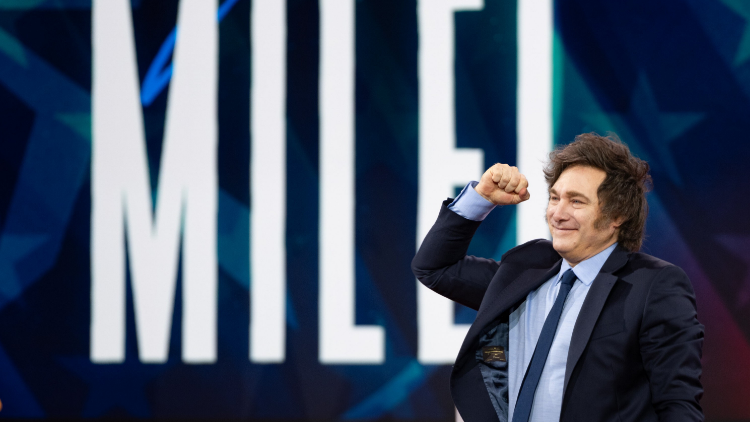
Javier Milei has been President of Argentina for two years.
© picture alliance / NurPhoto | Zach D RobertsOn 10 December, Javier Milei will have been in office as Argentine president for two years. What he has achieved in this short time in overhauling the chronically crisis-ridden country would have been considered impossible by almost anyone two years ago.
Milei has stabilised the Argentine economy, poverty is falling
When Milei took office, he inherited the world's highest inflation rate of 211% from the previous Peronist government. Currently, at 31%, it is at its lowest level since 2018. Forecasts for 2026 predict a further decline to 20% on average.
The budget is showing a surplus for the first time in 14 years, achieved through significant cuts in government spending, in particular by merging ministries and abolishing agencies, reducing subsidies and laying off 56,000 civil servants to date, many of whom had been hired by the previous government at short notice as a welfare measure for loyal party cadres despite empty coffers.
Despite these savings, the Argentine economy is growing this year: the IMF expects 4.5% growth on an annual basis, the highest growth rate in Latin America.
The positive economic development also explains why poverty in Argentina is now actually declining despite the reduction in government spending. According to independent figures published last week by the Catholic University of Argentina (UCA), the poverty rate is at its lowest level since 2018, at 36%. This decline was achieved, among other things, through more targeted assistance for large families, which Milei has even increased compared to the previous Peronist government – focused aid for those who are truly in need instead of aimless, expensive subsidies for everyone. As a result, according to UNICEF, 1.7 million children have been lifted out of poverty.
Argentina attractive for investment again
With the consistent dismantling of regulations and bold liberalisation from the housing market to air transport and the reduction of customs duties and price controls from imported goods to the national drink mate tea, by Deregulation Minister Federico Sturzenegger, Argentinians now pay lower prices and enjoy a better selection, and domestic and foreign companies are investing in the country again.
With the RIGI programme, the Argentine government is promoting large foreign investments of over USD 200 million with 30-year tax, customs and regulatory relief. In the mining sector alone, with its rich deposits of lithium and copper, among other things, investments totalling USD 31 billion have been announced to date. In addition, there are further investment projects in the energy sector, where Argentina has a broad diversification strategy ranging from renewable energies to gas and oil and the expansion of nuclear energy. Just last week, Argentine and German companies agreed to cooperate on the supply of LNG gas to Germany. In addition, with the help of foreign investment, Argentina aims to develop into a hub for artificial intelligence, benefiting from cheap energy, lean regulation and the Argentinians' high affinity for technology.
Broad public support for Milei
Given the impressive economic successes, it is not surprising that Milei enjoys strong support among the population. According to figures published last week by the opinion research institute Opina Argentina, 49% of Argentinians have a positive opinion of Javier Milei – compared to 23% for German Chancellor Friedrich Merz (latest Insa poll). This makes Milei – on a par with the former security minister and new Senate leader Patricia Bullrich – by far the most popular politician in the country.
The Argentine population gave Milei a clear mandate for his reform course in the congressional elections on 26 October. With 41%, his party ‘La Libertad Avanza’ was well ahead of the Peronist ‘Fuerza Patria’ with 32%. With 95 members of parliament, ‘La Libertad Avanza’ has the largest parliamentary group in the National Assembly, after several MPs joined it since the election. This is the first time since 1989 that the Peronists no longer have the largest parliamentary group.
This election victory was by no means a foregone conclusion, as Milei suffered a painful defeat in the provincial elections in Buenos Aires at the beginning of September – a warning shot after repeated allegations of corruption against his close circle, including his sister and key advisor Karina, which he had been too hesitant to address. But in the congressional elections, which determined the future course of the country, Argentinians gave Milei a second chance, mainly because the majority had no desire to see a return to Peronism and its economic failures.
‘Plan for a great Argentina again’
Milei now has a good chance of working with other reformists in Congress – in particular the conservative PRO party of former President Mauricio Macri – to push the 2026 budget and structural reforms central to further economic development (taxes, labour market, pensions, federalism) through Congress.
He has already presented clear ideas for this in his ‘Plan for a Great Argentina Again’: bold reforms, combined with a clear, positive message about why they are necessary so that Argentina can return to its former glory. Aware of the importance of constructive dialogue with other reform forces in Congress, but also with the governors, who are important in federal Argentina, Milei has been presenting himself as statesmanlike, conciliatory and less aggressive in his demeanour since the congressional elections (by his standards).
For the next phase of the reform course, which is now beginning, the Christmas break for MPs will (once again) be shorter this year. Milei has already announced special sessions of Congress until 30 December, possibly even 31 December. Milei – and all political leaders in Argentina – are facing important months of decision-making. The experience of the last two years should give confidence that a reform-oriented economic policy not only works in theory, but also brings concrete results and improvements for the population in practice.
This also provides an important insight for the current challenges in Germany, where hesitancy and blinders to reality prevail instead of bold reforms. Focusing on the essentials and having the courage to do the right thing pays off!