Transatlantic free trade
Transatlantic Trade Conference in Washington, D.C. - "Trade in the Age of Geoeconomics"

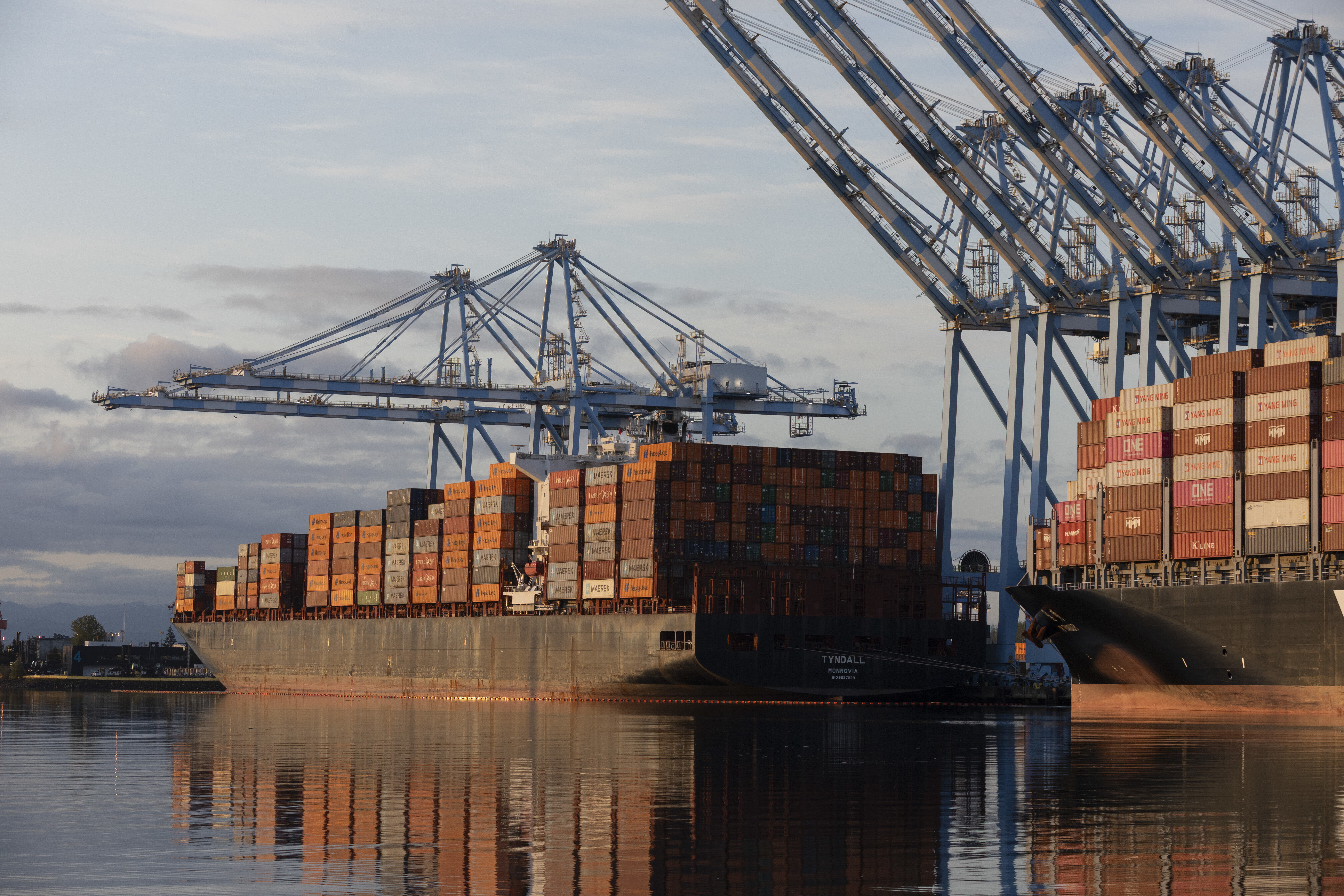
The sun rises over container ships docked in a port in the United States.
© picture alliance / ZUMAPRESS.com | Paul Christian GordonAt the trade conference "Trade in the era of Geo-Economics" in Washington, D.C. on September 9, 2025, Prof. Dr. Karl-Heinz Paqué, Chairman of the Executive Board of the Friedrich Naumann Foundation for Freedom, held the opening address. He warned against protectionism and the politisation of trade and advocated for streamlined agreements, greater European competitiveness, and a reliable, rules-based transatlantic partnership.
"I am very delighted that I can address you on a topic that has always been important for me – as an academic economist, as a politician and more recently as President of the Friedrich Naumann Foundation for Freedom and of Liberal International.
I am also delighted that - after me - we listen to a Canadian voice. Thank you David Paterson for joining us. Europe has a successful trade story with Canada, and I personally feel close to Canada ever since I studied economics at the University of British Columbia in Vancouver in the late 1970s.
I think, this conference with the title “Trade in the Age of Geoeconomics” comes at the right time. My observation and reading of the facts is that we are at a crossroad of globalization. To be sure, we are not experiencing a de-globalization. We are rather entering a new phase or a new period of globalization. Let us call it “the new globalization”. The “new” globalization may be slower than the old globalization, but that is not the main point of change, which is more in terms of “quality” rather than “quantity”.
Let us first briefly look at the old globalization, which began in the 1980s and 1990s. It was essentially driven by market forces. Behind it was, fundamentally, the human pursuit for a better life – literally everywhere: in the traditionally capitalist world with the motor being the United States and Western Europe; in formerly communist Eastern Europe where central planning was thrown away into the dustbin of history; in China and India as well as many other countries of what is now called the Global South that opened up their economies to trade and investment.
Clearly, this globalization has been hugely successful. It lifted many more people out of poverty than development aid. It created a promising global middle class. But globalization was also disruptive – as economic progress always is, a process of “creative destruction” to use Schumpeter’s famous term. After all, international trade follows comparative advantages, sometimes in a merciless way. We have witnessed that globalization leads to the decline of entire industrial sectors notably in the established industrial countries of the West - with serious economic transition and adjustment frictions as well as major political consequences.
That said, however, we must not forget that, in all likelihood, it was the automatization of production processes that worked as the job killer number one in the manufacturing sector. Digitalization and other new technologies had their high price in terms of jobs. Econometric estimates – methodologically questionable as they are – tend to book roughly two thirds of job displacements on the account of technology and only one third of globalization.
Be that as it may, the disruptive forces of globalization – whether real or fictional – are the breeding ground for the revival of protectionism that we witness since the last decade, but most prominently now with the program of Donald Trump’s second term. To be sure, Trump may not be consistent in the sequence of his protectionist moves, which go back and forth in astonishing speed. But the ideology behind it is crisp clear. To catch it, it is best to read former trade representative Robert Lighthizer’s book “NO TRADE IS FREE”, written in 2023 – and well written, I read it with fascination from cover to cover. The message of this book is simple and straight: let us block imports firstly to reduce the perennial American current account deficit, and secondly to regain our industrial strength in the American industrial heartlands, the “rust belt”.
Note that, as an economist, I dare to forecast that Trump will not achieve either of these two aims. To balance the current account, you need a macroeconomic adjustment towards less spending, notably less government spending – and, in this respect, there is no consistent political effort recognizable so far. And to bring back old-style industry to America is even more difficult. In a way, you have to turn back decades of economic history – from sunrise to sunset industries, and for all that matters, this is impossible. Why? Because experience shows: Investment follows trade, not tariffs. Hence trying to make domestic and foreign investors set up plants in the US - and not elsewhere - will not work.
So, in the end, Trump’s protectionism is likely to fail. The problem is that the rest of the world does not really stand tall against Trump’s aggressive bilateralism, which disregards all non-discrimination rules of the World Trade Organization. Take the European Union, which cowardly accepted a 15 percent-US tariff without getting anyting in return – and beyond that promised massive private (!) investment from EU countries in the US. That is certainly not the way to keep globalization going.
But what is it then? In my view, Europe has to do its own homework, which it has not done for more than a decade. The European Union is a heavily overregulated place; and even its internal Common Market works far from perfectly, notably in the trade with services. And, please, remember the sad destiny of the transatlantic trade agreement TTIP during the first Obama administration. It became a victim of the rising skepticism against trade on both sides of the Atlantic. In Germany thousands protested against TTIP fearing that “Chlorine chicken” from the USA would lower consumer protection standards (although German travellers to the US eat excellent chicken there and return home, believe it or not, in good health!). Clearly, we Europeans missed the window of opportunity for more free trade in the time well before Trump.
What to do now? I think Europe has to adopt a strategy of what I call “principled pragmatism”: let us conclude as many bilateral and plurilateral trade agreements with all those countries in the world, which share our liberal values, but let’s keep these agreements as simple as possible so that they do not take long years or even decades to come about. CETA with Canada is a good agreement, and the EU-Mercosur, once finally ratified (hopefully soon) belongs to the same category, though all that took much too long. Of course, let us invite the Americans to join the globalization club whenever they like, but if they want to stay out in the current Trump mood, globalization will go on without them.
That is part of what I call “new globalization”. The other part is a mixture of geostrategy, geopolitics and geoeconomics as the title of this conference suggests. It involves – beyond Trump-style protectionsim – the politization of economic relations. And here we have to turn our attention to Russia and of course China, two thoroughly authoritarian and state capitalist countries.
Let us here focus on China, obviously the greatest geopolitical challenge of the coming decades. With his rise to power in 2012/13, President Xi Jinping has replaced the traditional Deng Xiaoping development strategy. For Deng Xiaoping the economy was a goal to create an affluent Chinese society. Under the regime of Xi Jinping, the economy is no longer a goal as such but an instrument used to become a political superpower.
The most prominent example for this is the silk road initiative. China´s silk road initiative creates economic dependencies in many regions of the world, be it in Asia or Africa, in Latin America and even in Europe. And China does not hesitate to use the dependencies politically. China has already taken the next step of politization: the weaponizing of its economy. China used a ban of rare earth export for Japan in 2010 in a fishing trawler dispute. More recently, China has imposed export controls and restrictions on strategic materials like gallium, germanium, and other rare earths as a retaliatory measure against U.S. tariffs. That has alarmed countries around the world.
Let us be frank: the political burdening of trade also happened in Western democracies, it is not an exclusive monopoly of authoritarian states like China (and Russia). We should not forget: The European Union implemented a supply chain law that demands that suppliers from outside of the European Union have to meet social and environmental standards set by the EU. Even though this may be well intended, the EU supply chain law politicizes trade rather than setting these standards in intergovernmental agreements.
And the current US Administration escalates the politization of trade. I think this is only possible because the political debate on both side of the aisle in Congress sidelined the open trade arguments long before this government came to power. Fortunately, some think tanks in Washington D. C. are strong advocates for open trade. I very much hope their arguments will eventually reach Capitol Hill. The US Constitution clearly defines that Congress is in charge of tariffs.
Let me close with a political statement on transatlantic relations. I do this as a great friend of the United States of America and a long-standing member of the Atlantic Bridge in Germany. Let me make three points.
Firstly, when following a cohesive geostrategy, North America and Europe must be close partners because we have a common interest to contain autocratic China and prevent it from rising to a political superpower challenging our democratic system. China was until a few years ago the most important market for German exports. Now this is – again – the United States. That is a good development. But when tariffs make it more difficult for German business to sell on the US market, where do you think the German companies will turn to?
Secondly, in a cohesive strategy, North America and Europe must be – and remain – close partners in security. Yes, Germany and Europe have neglected their defense in the past and we work on a better burden sharing. The NATO decision that member nations have to spend at least 5% of their GDP annually on defense by 2035 was overdue. It is absolutely right. However, the precondition to reach that very ambitious goal is that the European economies grow faster than in the past. So there is a strong common interest here: America and Europe do not play a zero-sum game in which either of them looses and the other gains. Instead, it is a positive sum game: both either loose or win. Let us make them win.
Thirdly, let me repeat: We Europeans have to do our homework as well. We have to prove that the idea of a common Europe works. We have to make our economies more competitive and resilient. European trade has to diversify. But many political parties are skeptical about open trade agreements. At present, we urgently need the EU-Mercosur trade agreement with Latin America. But the French president has made it clear again and again that he wants to protect his agriculture rather than going on with the agreement. If this continues, the “new globalization” will remain no more than a dream. Even the CETA trade agreement is not yet safe: Nine years after its signing, there are still ten European countries that have not yet ratified it. Note that the previous German government could only ratify CETA because our liberal party, the Free Democrats, pushed hard against the resistance of other coalition parties. To be sure, the provisional application of CETA, which eliminated 98% of tariffs for all sectors, is a big success story. It has been fostering trade between the EU and Canada. We need more CETAs.
Finally, my general message for this conference is to stop politicizing and weaponizing trade. Let us become trade partners again in the sense that trade builds bridges. Let us make trade rules reliable and predictable again. And as a somewhat idealistic German I say: Let us revive a rule based order for international trade."