Argentina
Corruption and Democracy: A Regional Warning and an Opportunity for Reform in Argentina

The Fight Against Corruption in Argentina and Around the World.
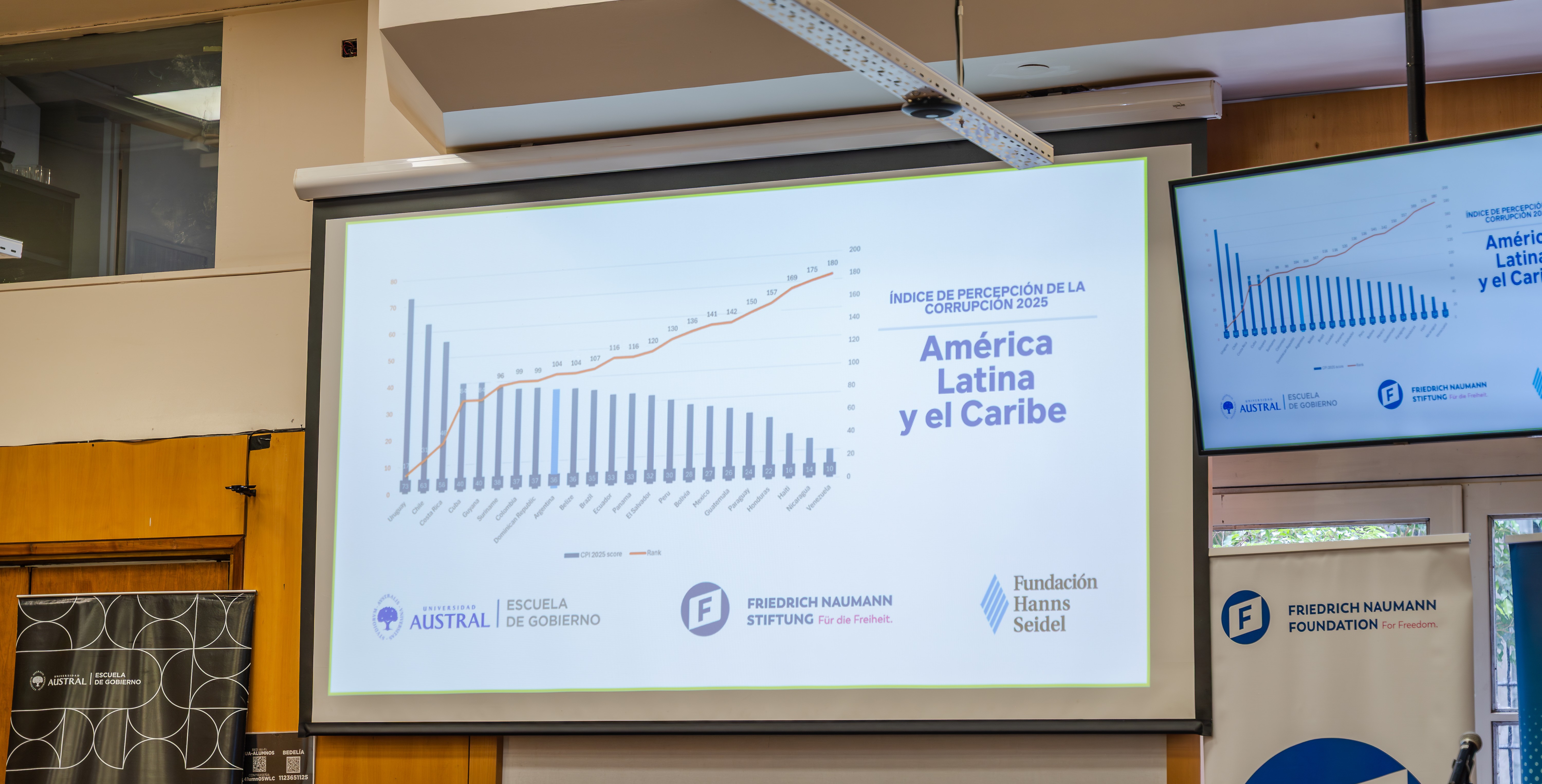
© Universidad AustralTransparency International's Corruption Perceptions Index (CPI) 2025 once again raises a red flag in the Americas. With a regional average of 42 points out of 100, the region remains stagnant, with no structural progress in more than a decade. Twelve of the thirty-three countries have worsened since 2012. Corruption is not an abstract phenomenon. It erodes public trust, weakens democratic institutions, and facilitates the expansion of transnational organized crime.
These results were the starting point for the academic meeting “The fight against corruption in Argentina and the world,” held on February 12 by the Friedrich Naumann Foundation for Freedom in South America, the School of Politics, Government, and International Relations at Austral University, and the Hanns Seidel Foundation. Panelists at the event included Dr. Delia Ferreira Rubio, former president of Transparency International; Konstantin Kuhle, former member of the German Bundestag for the Free Democratic Party (FDP); and Dr. Marcelo Bermolen, director of the Institutional Quality Observatory. The debate made it clear that corruption is not only a legal or administrative problem, but above all a moral and political problem, with direct effects on economic development and democratic quality.

Dr. Delia Ferreira Rubio, former President of Transparency International, participated as a speaker at the event.
© Universidad AustralThe Liberal Perspective
From a liberal perspective, corruption is one of the most serious threats to individual freedom. Where rules are not applied impartially, there is no fair competition or predictability. Therefore, the fight against corruption cannot be separated from the defense of the rule of law, the separation of powers, a free press, and an active civil society.
In South America, the picture is mixed. Uruguay ranks 73rd and is a regional benchmark thanks to its institutional stability, although it faces challenges related to organized crime. Chile has shown a decline from its historical standards, reflecting political tensions and questions about probity.
Brazil ranks 107th this year. The country is undergoing a process of institutional restructuring after years of scandals and polarization, with the challenge of consolidating stable rules and an independent judiciary.
In this regional context, Argentina ranks 104th, below average and far from the countries with the highest institutional quality. The country is undergoing a period of profound economic and political transformation. However, sustainable reforms require strong institutions. The fight against inflation, the attraction of investment, the generation of employment, and international integration depend on clear, predictable rules that are applied without privilege. Corruption, on the other hand, acts as an invisible tax that discourages investment, distorts competition, and erodes social trust.
The consolidation of honest and accountable institutions is a necessary condition for sustainable development and the restoration of public trust.

The CPI should not be understood as a simple ranking, but as a tool for assessing institutional quality and defining reform priorities. In the case of Argentina, this implies strengthening judicial independence, ensuring greater transparency in public procurement, protecting civic space, and ensuring effective controls at all levels of government.
In an international scenario marked by geopolitical tensions and competition between models of governance, transparency and public integrity are not only democratic values: they are strategic advantages. The consolidation of honest and accountable institutions is a necessary condition for sustainable development and the restoration of public trust. Argentina's challenge is to turn this warning into an opportunity for profound and lasting reform.