RUSSIA AND NORTH KOREA
New FNF Study: Partnership between Russia and North Korea


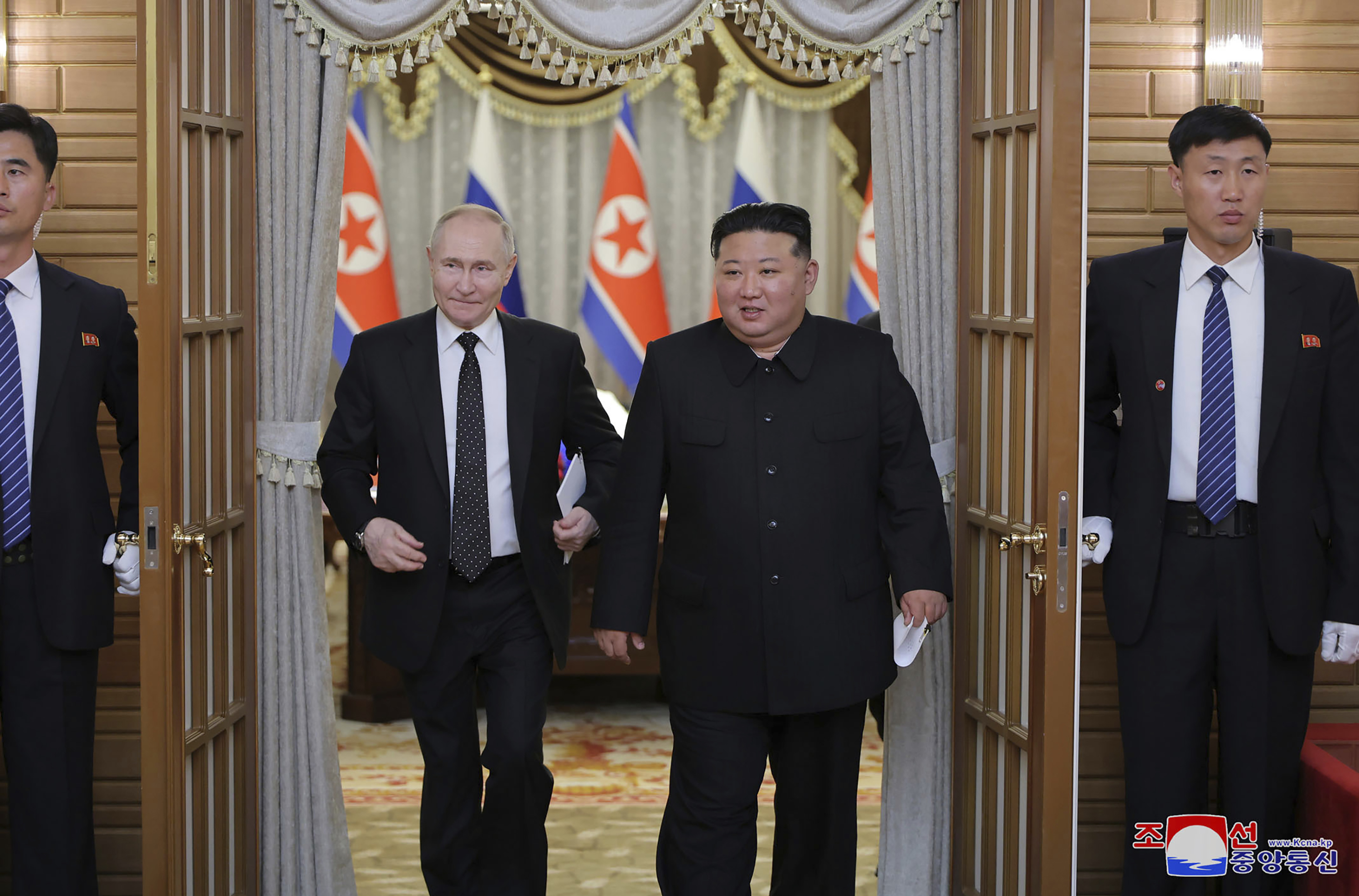
Wladimir Putin and Kim Jong Un.
© picture alliance | 朝鮮通信社Cooperation between Russia and North Korea is intensifying – but it is far from balanced. Moscow’s returns are comparatively limited, according to the new study “Unequal Partnership” commissioned by the Korea Office of the Friedrich Naumann Foundation for Freedom.
A maximum of 1.2 billion US dollars is the estimated value of Russia’s direct compensation to North Korea, the study by Olena Guseinova of Hankuk University of Foreign Studies in Seoul finds. The assistance consists mainly of food and oil, along with a small number of air defense systems, GPS jammers, and possibly fighter aircraft, either as new hardware or as upgrades to the existing fleet. No other significant returns appear to have been provided: economic data indicate no currency inflows. There is also no evidence that Russia has played a direct role in North Korea’s technological modernization.
By contrast, North Korea has provided weapons, ammunition, and troops worth up to 9.8 billion US dollars according to the study – more than one-third of the country’s estimated annual economic output. According to the estimates, this includes 5.7 to 6.7 million artillery shells, 1.05 to 1.24 million mortar shells, 649,640 to 878,300 rockets for multiple rocket launchers (MRL), up to 248 ballistic missiles of the KN-23/24 type, 479 to 794 guns and launchers, as well as around 15,000 dispatched military personnel.
The study is based on a wide range of sources, including intelligence reports, documents, price data from previous North Korean arms sales, media reports, and Russian Telegram channels. Already last year, Guseinova had estimated the value of North Korean arms deliveries in the study “Putin’s Partner” for the Friedrich Naumann Foundation as high as 5.5 Billion US dollars; her work was taken up by numerous think tanks.
Study Author Guseinova sees these findings as an indication of more than just a short-term deal: “North Korea has provided Russia with enormous military support. Yet Moscow seems to be responding only slowly and in a limited way,” she explains. “This may be deliberate: Moscow keeps Pyongyang on the hook and thus cultivates growing dependence.”
Frederic Spohr, head of the Korea Office of the Friedrich Naumann Foundation, comments: “Putin continues to forge his anti-Western alliance. But in the countries that cooperate with Russia, it is almost exclusively the local elite who benefit. The broader population, on the other hand, suffers from these opaque deals.”
Despite extensive cooperation with Russia, North Korea’s economic situation remains poor. Since January 2024, the North Korean won has lost significant value, while inflation has risen sharply. If there have been any financial transfers, they were likely carried out through sanctioned banks and opaque financial vehicles of Russian intermediaries, according to the study. This means the funds remain effectively blocked within the Russian financial system. North Korea thus receives no freely available foreign currency for price stability or imports; only the elite can use the balances for purchases in Russia.
Russian support also proves limited in other areas. New North Korean destroyers of the Choe-Hyon class, for example, do carry Russian Pantsir systems and outwardly resemble Russian frigates, but they are likely neither equipped with functional missile platforms nor engines. A similar picture emerges with the North Korean satellite program: despite a successful launch in November 2023, subsequent setbacks suggest that Russian assistance was at best selective – and not evidence of a lasting technological partnership.
Recommendations for the EU
Guseinova recommends that the European Union significantly deepen its security cooperation with partners in Asia. In particular, closer intelligence cooperation with South Korea and Japan is necessary in order to detect and respond to North Korean arms deliveries to Russia at an early stage.
In addition, the EU needs a coherent diplomatic strategy toward North Korea. While individual member states have already reopened embassies, a coordinated strategy is still lacking. Without a unified presence, the EU risks leaving the diplomatic space entirely to Russia and China. A common approach would significantly strengthen the EU’s ability to observe and exert influence.