Ukraine
Four Years of the Zeitenwende
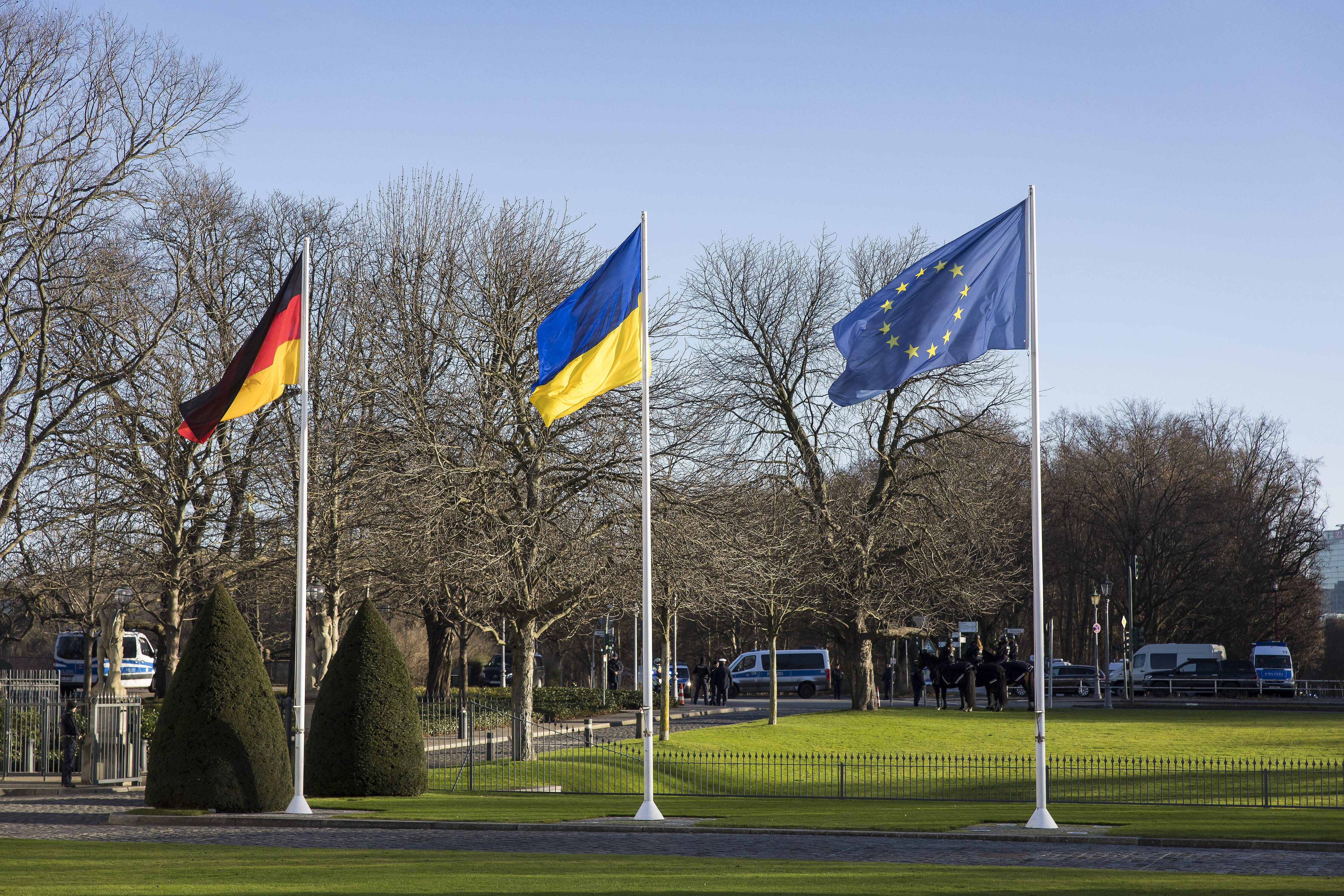
Flags Germany, Ukraine and the European Union
© picture alliance / PIC ONE | Ben Kriemann
World War I lasted four years and three months. Russia’s war against Ukraine has now been going on for almost just as long. It, too, has changed the world—morally and politically.
From the very first day, it was morally clear that almost all European countries stand on Ukraine’s side—against Putin’s Russia, the aggressor. Defending the territorial integrity of a free nation is a core value of the Western liberal order, which is based on the idea of state sovereignty. Without this core value, our entire value system collapses. It is remarkable that the great majority of Europeans apparently share this view and that, for this reason, support for Ukraine very quickly reached something close to a consensus within the European Union and its friendly neighboring countries. Only on the far left and far right of the party spectrum do Putin’s friends gather, supplemented by a few isolated political voices from older advocates of détente who are unwilling to revise their worldview. The obligation to help Ukraine is therefore, in principle, undisputed in Europe—even four years after the war began. That is encouraging.
Politically, however, a great deal has changed since then. More than that: a kind of revolution has taken place in the West. It is an upheaval in geopolitics, ultimately as a consequence of the Ukraine war, directly and indirectly. Three central changes are at the forefront:
First, the United States is no longer among the reliable NATO allies whose military assistance can be counted on in a crisis. Donald Trump has made this clear—most recently with his threat toward Greenland, but earlier already, and far more dramatically, with the (partial) withdrawal of military support for Ukraine and his almost servile willingness to negotiate with Putin, entirely in the spirit of a kind of imperial partnership in the style of the 19th century. Perhaps this will be corrected somewhat at some point after Trump’s departure, but the transatlantic breach of trust—once it has happened—is irreparable in NATO. It means nothing less than the end of the postwar order.
This leads—second—to an alarm signal for rearmament in Europe (and probably in Canada as well). The age of pacifism is over. Even Finland and, above all, Sweden (after 200 years of neutrality!) have joined NATO. More importantly, Europe’s countries are finally setting out to take their defense into their own hands. Suddenly, quantitative targets for military spending are acceptable that used to be considered utopian: 3.5 percent of GDP to finance the armed forces, 5 percent of GDP for defense in the broader sense, by 2035 at the latest—earlier in some countries. This commitment by NATO states would have been unthinkable without Putin’s aggression and Trump’s pressure and disloyalty; the longing for peace and social security in European countries was too strong. How this will be implemented in concrete terms—and with what national gradations depending on distance from Russia—remains to be seen. But there can be no doubt about the fundamental shift in direction.
This leads—third—to an alarm signal for economic reform policy in Europe. It would be naive to believe that such rearmament could be achieved politically without dynamic economic growth. Because the massive reallocation of budget resources from social spending to the military will provoke enormous social conflicts if it is not cushioned by a strong increase in the nations’ economic capacity. This applies above all to Germany, whose industry and economy as a whole are currently suffering—with zero growth and more than three million unemployed. Here, the geopolitical challenge creates an economic necessity for reforms. The era of expanding social policy and going it alone on climate policy is likely definitively over.
In other words: a Zeitenwende—a historic turning point. It will continue—and even more than before—to shape politics in Europe. That Germany must play a decisive leadership role is obvious: it is the EU’s largest country; strategically and economically, with nine direct neighbors, it sits “right in the middle”; geographically, it is the bridge between West and East. It doesn’t get more important than that.