Ukraine
War in Ukraine - Oleh Baturin on the Russian Terror
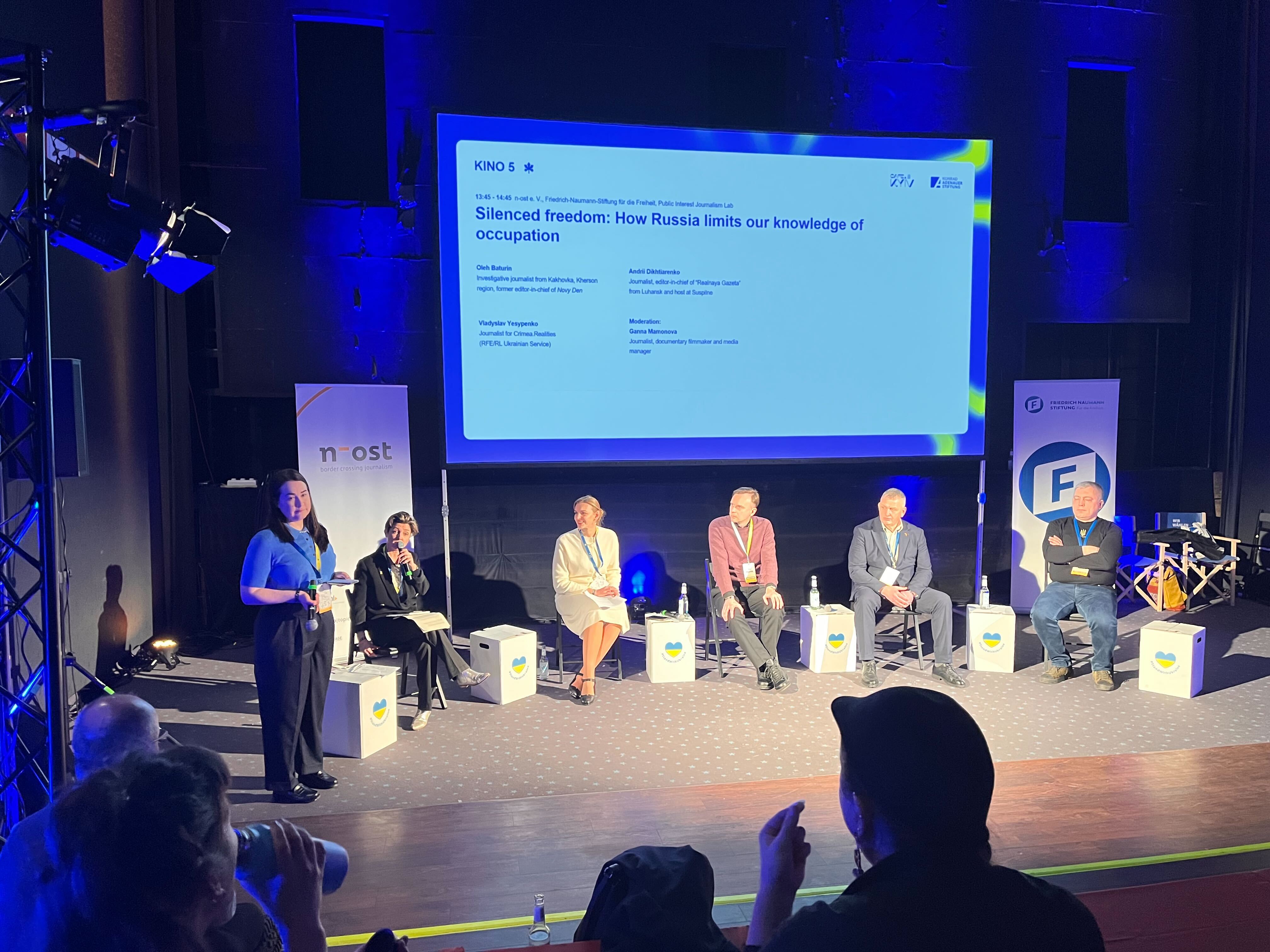
Oleh Baturin in Diskussion beim Cafe Kyiv am 23. Februar 2026
© Peter Cichon / FNFFebruary 24 marks the fourth anniversary of Russia's full-scale invasion of Ukraine. The war has brought immeasurable suffering to the country – millions have been displaced, tortured, and killed, and cities have been destroyed. In an interview with Freiheit.org, Ukrainian journalist Oleh Baturin talks about his time in Russian captivity in Kherson – a city that was taken by the Russian military shortly after the invasion and liberated by Ukraine in November 2022. Since then, it has been subjected to ongoing aerial terror by Russia. Baturin talks about his time in Russian captivity – and why Europe must not look away.
1. You have experienced Russian detention firsthand. What specific effects did interrogation methods, psychological pressure, and information control have – and what does that say about the Russian system of political repression and the treatment of Ukrainian prisoners?
On February 24, 2022, my family and I woke up under Russian occupation. On March 12, 2022, Russian soldiers illegally took me into custody without giving any reasons or charges. The Russians tried not to show their faces and did not tell me their names.
The first day in captivity was the worst. The Russians were angry because I didn't have a cell phone or passport with me. They couldn't quickly establish my identity and had no access to my contacts and correspondence. So they beat and mocked me. I felt like I was in the middle of a terrible movie about Nazi terror during World War II—only in such movies had I seen anything similar to what the Russians were doing now.
During my captivity, I was “interrogated” by various representatives of the occupying power—by local collaborators acting on behalf of the Russian state, by the FSB (Russian secret service), by the Rosgvardia (Russian National Guard), by members of illegal armed formations from the occupied Donetsk region, by Chechens from Kadyrov's circle, and others. Their questions resembled a cruel theater of the absurd: “Are there activists from Belarus in Kherson?” “When did the ‘Great Patriotic War’ begin?” “Why is ‘Victory Day’ in World War II not celebrated in Ukraine?” “Where do the employees of the SBU (Ukrainian secret service) live in Kherson?”
The Russians did not take into account that I live in another city and have no idea who lives where in Kherson.
Citizens from the Netherlands and Spain, who spoke neither Ukrainian nor Russian, were also imprisoned with me. The Russians couldn't communicate with them and therefore mocked them cruelly. The mere fact that they were foreigners was enough “proof” for the Russians that the older Spaniard and the Dutchman were “accomplices of the Nazis.” The Spaniard has been in Russian captivity for almost four years.
The Russians' prisoners have no access to information. They are forbidden from communicating with their families or reading the news. The Russians constantly say that Ukraine has already been destroyed and has surrendered, that no one needs you – neither your family, nor your friends and colleagues, nor your country – and they force the prisoners to sing the anthem of the USSR and old Soviet war songs.
Later, from conversations with other prisoners, I realized that there was a certain system behind the Russians' terror mechanism in the occupied territory: First, they torture, mock, and break you, and only much later do they investigate whether the person has committed any crimes from the occupiers' point of view and whether they can be charged with any offenses, even if these are completely fabricated and exist only in the torturers' fantasy world.

Der Journalist Oleh Baturin
© Oleh Baturin2. In your work, you deal with how Russia uses disinformation as a weapon of war. In particular, the work of journalists in the territories occupied by Russia is severely restricted. How did you experience the systematic control, manipulation, or replacement of information on the ground?
When I was in the occupied zone, I realized that my career as a journalist was over. It is impossible to work as a journalist in a territory controlled by the Russian Federation. If you try to do so anyway, you have to expect to be kidnapped, tortured, “sentenced” to insane prison terms, or killed at any time—just because you are a journalist. I have experienced all of this firsthand.
I witnessed how the Russians in my occupied city cut off the internet connection and the broadcasts of Ukrainian television stations and replaced them with Russian television. In the aftermath, the situation only got worse as the Russians began forcibly confiscating satellite dishes that could receive Ukrainian or foreign television stations and demanded that only those that made it easy to control what people watched be installed.
The ban on messengers, YouTube, and other platforms in the occupied territories proves that the Russians not only want to control what people watch today, but also what they might want to watch tomorrow or in a month's time. Even if it's just a harmless podcast about food or clothing.
3. When you look at Germany and Europe, what Russian narratives do you recognize in the debates here—and why do you think they are catching on here?
The most widespread narrative remains that this is “Putin's war” in Ukraine and that the Russian people are just as much victims of this war as the Ukrainians. But Vladimir Putin didn't kidnap me, he didn't interrogate me, he didn't break my ribs, he didn't rape the woman in the cell next door, and he didn't beat the prisoner of war to death behind the other wall next to me. It was the Russians.
Another widespread narrative is that of the greatness of Russian culture. It is precisely Russian culture that has made it normal for Russians to rape, kill, torture, and hate someone simply because they are Ukrainian or Spanish. A culture cannot be great if, under its influence, people are taught from childhood to pathologically hate other people. Because then that culture embodies evil, and fascination with it means fascination with evil.
Unfortunately, such narratives achieve a certain degree of success in European countries because they “allow” people not to think deeply about what is happening, about the roots of Russians' hatred towards others, and they enable people to remain in their comfort zone by providing simple “answers” to very complex questions.
4. Germany sees itself as a defender of the rule of law and freedom of the press. What concrete steps should Germany take to ensure that people like you—journalists in Russian custody or in occupied territories—do not feel abandoned?
Only Russia itself can release all those who have been abducted, illegally imprisoned, and “convicted” by the Russians. But in order for Russia to do this as quickly as possible, constant pressure must be exerted. Because despite all their grandiose statements, the Russians fear sanctions, and they don't particularly like being a pariah country on the world map.
Countries that consider themselves civilized cannot pretend that nothing has happened when negotiating with representatives of a country where the abduction and rape of children is normal, where the persecution of journalists simply because they are journalists is normal, and where mass murders of civilians at bus stops, train stations, or in cafés are also considered normal.
The Russians always tell their prisoners that nobody needs them, that the whole world has forgotten them. If people in Germany or other countries continue to follow closely what is happening in Ukraine, what Russia is doing there, and write or talk about it, this gives Ukrainians the chance to feel less alone, as if we were left alone with the enemy who wants to destroy us.
Translated from Ukrainian by Peter Cichon, IJMD