PUBLICATION
China’s Repression on German Soil


In Hong Kong protestieren die Menschen.
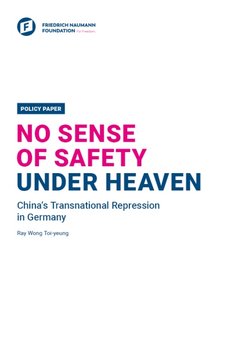
© picture alliance / ZUMA PressChina’s efforts to silence critics far beyond its borders have become a feature of its global reach. A new study commissioned by the Friedrich Naumann Foundation for Freedom warns that Germany - home to one of Europe’s largest Chinese diaspora communities and a key target of Beijing’s influence – is encountering a range of tactics used to influence or deter critics. The study encourages Germany to consider strengthening its legal frameworks and to enhance coordination among relevant institutions.
According to the study “No Sense of Safety Under Heaven: China’s Transnational Repression in Germany”, China orchestrates an extensive system of intimidation abroad, blending official state organs with a network of quasi-state associations and diaspora groups. These range from cultural and educational networks to more opaque entities sometimes referred to as “overseas police stations.” Together, they exert pressure on dissidents, human rights advocates and pro-democracy activists often through subtle coercion, sometimes through direct threats. In the most severe cases, the families of activists face warnings or retaliation inside China, a powerful form of leverage in communities where family ties remain deeply rooted.
The message, the study argues, is unmistakable: No critic of Beijing is beyond reach.
Drawing on case studies, interviews, academic research and official documents, the report maps the drivers, methods and actors behind China’s extraterritorial repression, while assessing its broader implications for Germany’s democracy.
Beyond individual intimidation, the study highlights how these pro-China diaspora networks try to influence local politics. Community groups and lobbyists aligned with Beijing work to shape debates in foreign parliaments, cultivate alliances and strengthen what the author, Ray Wong, calls a “repressive nationalist diaspora.” Such efforts, the study warns, do more than target individuals: they erode basic rights and shift political environments in ways favorable to China’s foreign policy objectives.
The study notes that Germany has an opportunity to further strengthen its resilience in this area. Current legislation does not yet clearly address harassment, coercion or intimidation carried out by non-state actors acting on behalf of a foreign government. As a result, some dissidents living in Germany - including Uyghur, Tibetan, Hong Kong and mainland Chinese activists - may face gaps in protection. Enhancing the legal framework, the study suggests, would help ensure that all individuals on German soil can fully rely on the country’s commitment to safeguarding fundamental rights.
The study acknowledges Germany’s strong emphasis on victim protection and crisis response, but notes that these efforts could be further strengthened through more robust preventive measures. Enhancing legal tools to address foreign-directed surveillance and harassment, it suggests, would help ensure that critics are better protected and that authorities are fully equipped to respond effectively.
The study urges Berlin to adopt a Foreign Influence Transparency and Accountability framework, either as standalone legislation or by expanding the existing Lobby Register Act. Such a system would require individuals and organizations acting on behalf of foreign states to disclose their activities, a step the United States and Australia have already taken.
The author also calls for a central coordinating authority to link intelligence services, law enforcement, foreign policy units and victim support agencies. Such coordination, the study suggests, would enable Germany to respond even more effectively to emerging challenges and align more closely with other democracies that are enhancing their approaches to foreign interference.
Ultimately the study serves as a stark reminder: the battleground over fundamental rights is no longer limited by geography. Taking proactive steps, it suggests, would not only strengthen Germany’s national security but also reinforce the country’s longstanding commitment to human rights and democracy at home.
*Hnin Wint Naing is a regional communication officer of the Southeast and East Asia Office of the Friedrich Naumann Foundation for Freedom.