A City of Coffee
Youth, Choice & Public Life in Amman’s Café Boom

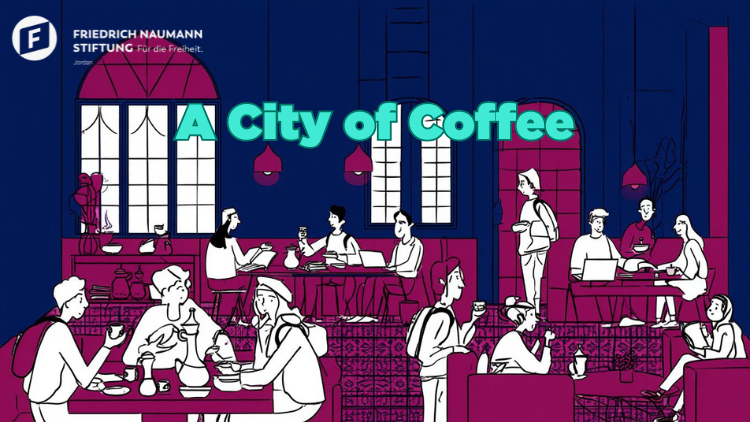
On an early morning in Amman, it feels as if the entire city is moving with a cup of coffee in hand. Cars line up at roadside kiosks. Students carry takeaway cups on their way to class. Cafés open long before offices do, filling quickly with young people who settle in for hours of studying, working, or simply sitting with friends.
For an outside observer — especially a European one — this may resemble familiar café culture. But the story unfolding in Amman has a different texture. It is shaped by Jordan’s social norms, its evolving youth demographics, and the search for shared spaces in a city where public areas are limited and private life remains deeply rooted in tradition.
Jordan’s growing coffee scene is not a political development, but it reflects something meaningful: a quiet shift in how young Jordanians interact, choose, and express themselves in everyday life.
A boom rooted in tradition, shaped by change
Coffee has belonged to Jordanian culture for generations. Arabic coffee — often blended with cardamom — plays a symbolic role in hospitality, family gatherings, and important conversations. It is served at weddings, funerals, and community events. It is a gesture of respect and belonging.
But over the last four decades, coffee transformed from tradition into a multi-layered social landscape. According to market data, Jordan’s total coffee consumption rose steadily from the 1980s and reached one of its highest points in 2021. Another analysis notes that the modern specialty coffee trend gained momentum in Amman around 2015, creating new expectations of taste, design, and atmosphere.
This mirrors global patterns, but in Jordan the shift means something slightly different. It signals how a young population — half the country is under the age of 24 — develops new habits while balancing modern lifestyles with cultural continuity.
Why this boom matters in Jordan more than elsewhere
Café culture may feel ordinary in many places — simply a spot to work, meet, or unwind. In Amman, however, coffee shops carry a broader weight because of the city’s layout and the limited number of shared public spaces.
1. Cafés create accessible public life where it is scarce
While many cities abroad are built around public squares, pedestrian centres, and open parks, Amman expanded quickly and unevenly. It is a car-dependent city with few walkable areas designed for casual gathering.
Cafés step in to fill this absence.
They act as informal social hubs — spaces where people can be around one another without the pressure of private gatherings or formal venues.
2. They offer a comfortable, mixed environment
For many young women and men, cafés feel more balanced and welcoming than other social settings. They provide smoke-free sections, mixed seating, and an atmosphere that encourages long stays — something not always available in more traditional spaces.
3. They function as neutral ground for study and work
With more university students, freelancers, and remote workers, cafés have become essential places to study, collaborate, and focus. Many guides describe them as central to social life in Amman because of their reliable Wi-Fi, comfort, and long opening hours.
This fills a gap that libraries, campuses, or co-working centres often cover elsewhere.
4. They offer individual choice within familiar cultural boundaries
In Jordan, generational change emerges within the framework of tradition. Someone might enjoy a flat white or a cold brew outside, yet still gather at home over Arabic coffee with family. New habits do not erase older ones — they add new layers to daily life.
Local brands and independent cafés: a diverse landscape, not a hierarchy
Amman’s coffee ecosystem is remarkably diverse. It brings together long-standing roasteries rooted in traditional blends, local takeaway brands that line almost every main road, small independent cafés scattered across neighbourhoods, and specialty spots that draw in the laptop-working generation.
Many residents still prefer classic roastery coffee at home, while others explore newer cafés for work, creativity, or connection. No single style or business dominates the scene. Instead, these varied choices form a wider landscape that reflects different social groups, tastes, and daily routines.
The point is not which café is “best.”
The point is that choice itself has expanded — and that expansion subtly shapes everyday life.
This is the quiet liberal dimension: not political, but human.
The quiet liberal dimension: not political, but human
Linking Amman’s café boom to liberal or democratic ideas is not about politics or institutions. It is about the everyday values that appear quietly in ordinary routines:
1. Personal choice
Young Jordanians increasingly decide for themselves how and where they spend their time — whether in modern specialty cafés or long-established roasteries. These small, routine choices reflect a broader sense of openness and individual agency.
2. Dialogue
Cafés invite conversation — not formal debates, but simple, meaningful exchanges about studies, work, challenges, creativity, and personal goals.
This kind of open, comfortable dialogue mirrors the spirit of an inclusive and communicative society.
3. Diversity
The city’s cafés differ in style, price, and atmosphere, drawing in people from various backgrounds. They create natural meeting points where different groups intersect — an essential ingredient of social cohesion.
4. Responsibility and initiative
Many cafés, especially independent ones, are led by young entrepreneurs who identified a need and built something from it. Their efforts reflect initiative, creativity, and self-reliance.
These values exist everywhere, but in Jordan they carry particular significance. They express agency in a young society that respects tradition while steadily embracing new forms of expression and innovation.
A boom that tells much more
The rise of coffee shops in Amman is far more than a lifestyle trend. It reveals how young people carve out their own spaces in a fast-growing city. It shows how routine can nurture openness, how simple conversations can build community, and how everyday habits can signal deeper cultural change.
In Jordan, café culture is not just about convenience.
It offers room for expression in a city with limited shared spaces.
It strengthens connection in a society that is constantly evolving.
It reflects quiet, daily forms of openness that matter more than they seem.
One cup may not change the world.
But in Amman, it can create a space where people meet, listen, understand — and imagine what comes next.