Mozambique
The tale of continued disillusionment of the youth

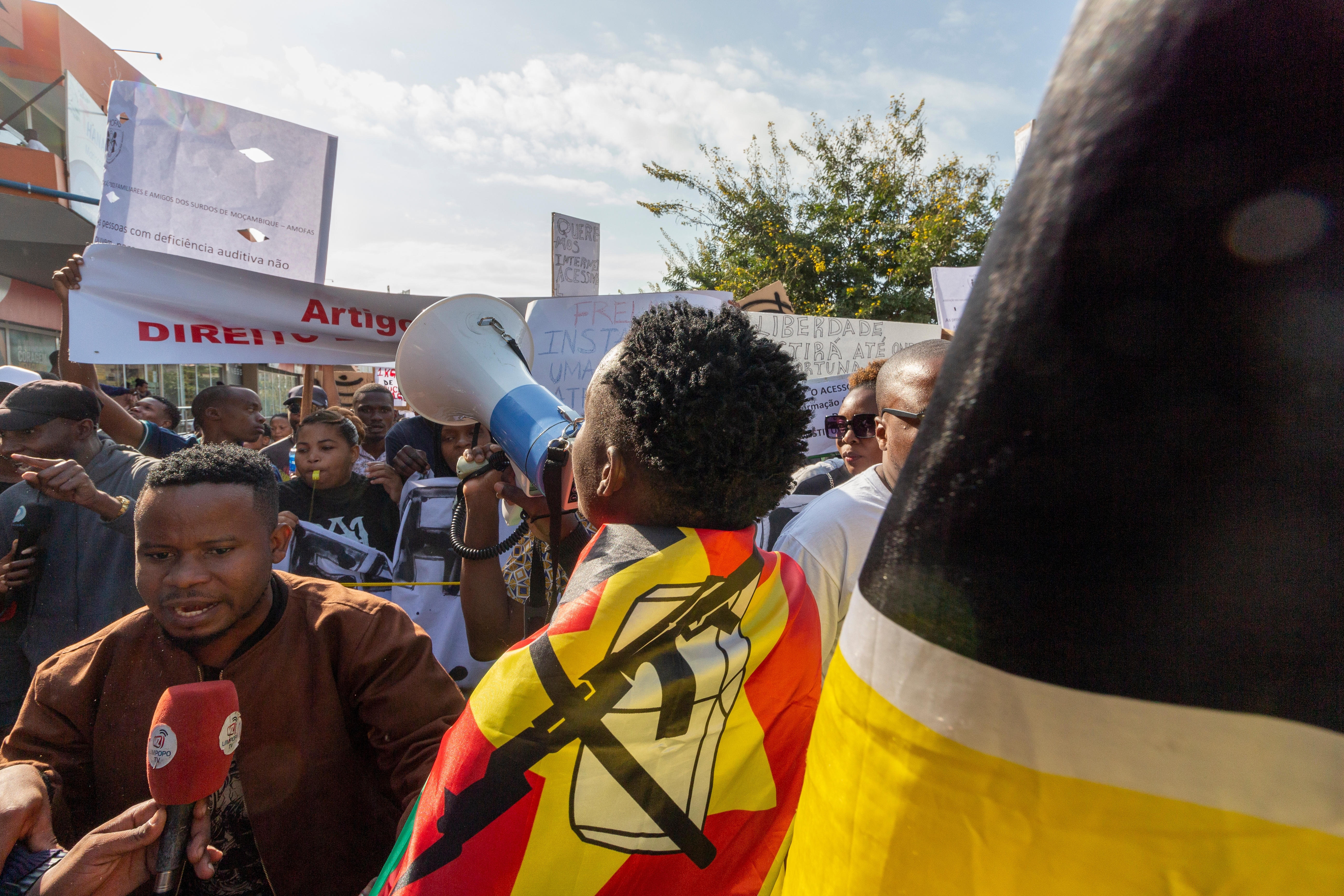
A person dressed in a Mozambican flag addresses the crowd with a megaphone during a demonstration, while participants hold banners in support of their cause
© ShutterstockYoung people are not well represented and are marginalised and excluded from development processes in many African countries. This pushes them to participate in demonstrations as they try to change political systems that are perceived to be incompetent and responsible for the daily suffering of people. These demonstrations have challenged institutions of power, but their influence has failed to extend beyond post-protest governments and development.
Africa has the youngest population in the world, with more than 400 million people aged between 18 and 35. By 2030, it is estimated that 42% of all young people entering the workforce will be African.
In light of the National Youth Policy, an article by the Centro para Democracia e Direitos Humanos (CDD) in Mozambique, published as part of the CDD Juventude series in April 2023 (Issue 56), noted:
“Of the 92.82% of employed young people, the majority belong to urban areas, and in peripheral-urban and rural areas, young people tend to be in less productive activities. An even more significant number of these young people do not have access to basic health services, housing, or funding for youth initiatives. In turn, these factors lead young people to deviant behaviour and involvement in various criminal practices, the incidence of which has been increasing in recent years. The recruitment of young people by violent extremist groups in Cabo Delgado is part of this problem. With few options left, young people who should contribute to building the Mozambican nation end up participating in its destruction.”
There is a continued challenge in implementing and monitoring the effectiveness of programmes designed to address the issues impacting youth. Moreover, young people are still not consulted on matters of governance and inclusivity in government.
According to a study published by EISA (2021) and IMD (2022), “Mozambique has had many reasons to increase the political participation of youth. This is linked to the authoritarian political culture, as well as the restrictions and excessive control of freedom of expression, which have become more acute in recent years.” The same studies suggest that, despite the emergence and opening of new spaces for political participation, such as social networks, the political participation of young people is still limited.
Tension in Mozambique remains highly politically charged. There is a clear problem with manifestos that fail to deliver before implementation even begins, and a continued, desperate cry from the youth to be heard and recognised. In Mozambique, youth are largely excluded from platforms and discussions. Since the protests against the election results in October 2024, it has also become evident that there were no clear or tangible outcomes from these protests. Youth leaders and activists remain heavily surveilled, facing continued cyber threats, particularly targeting youth leadership.
While youth remain organised, the lack of coordination between the various groups prevents the formation of a solid movement with clear objectives and outcomes. This weakens their ability to apply the necessary pressure to bring government entities to the table for dialogue.
It is also apparent that communities and young people still carry trauma from the post-electoral violence, which was inflicted by government armed forces on civilians. There is a lack of safe spaces and forums created by government to discuss social cohesion, nation-building, and healing. This absence is made worse by the continued surveillance of activist activity. The Mozambican government’s impunity — as seen in the lack of progress in investigating the perpetrators of violence and killings — demonstrates a lack of political will to address what took place.
A participant during the workshop stated: “We didn’t achieve the result that was expected from the elections” — the youth feel wronged and cheated. The country has experienced a period of loss at the hands of brutality. Healing remains a critical need among young people, and the government’s apparent refusal to prioritise this only fuels growing resentment.
The recent withdrawal of funding through USAID programmes has created a significant gap in civil society interventions, feeding into the shrinking of democratic spaces in Mozambique and increasing intolerance of differing opinions.
In group work sessions and feedback, the youth emphasised the importance of a strengthened civil society capable of matching and responding to the threats against democratic space. They also highlighted the need for ongoing regional awareness from SADC (Southern African Development Community), not only during election periods.
Alternative political education was viewed as essential for enlightening Mozambican youth and reigniting their interest in engaging with different systems of government. It is important to cultivate political knowledge and theory to engage effectively with governance strategies promoted by various political systems. This education must also reach youth in rural and remote communities.
The need for continued dialogue and engagement between youth and organs of government, particularly the presidency, remains critical. A solid and unified youth movement with a clear strategy and defined outcomes must be prioritised to prevent demonstrations from becoming the only outlet. Most importantly, it is vital that young people no longer feel ignored or undermined.