South Africa
Between Washington and Brics — SA’s strategic squeeze

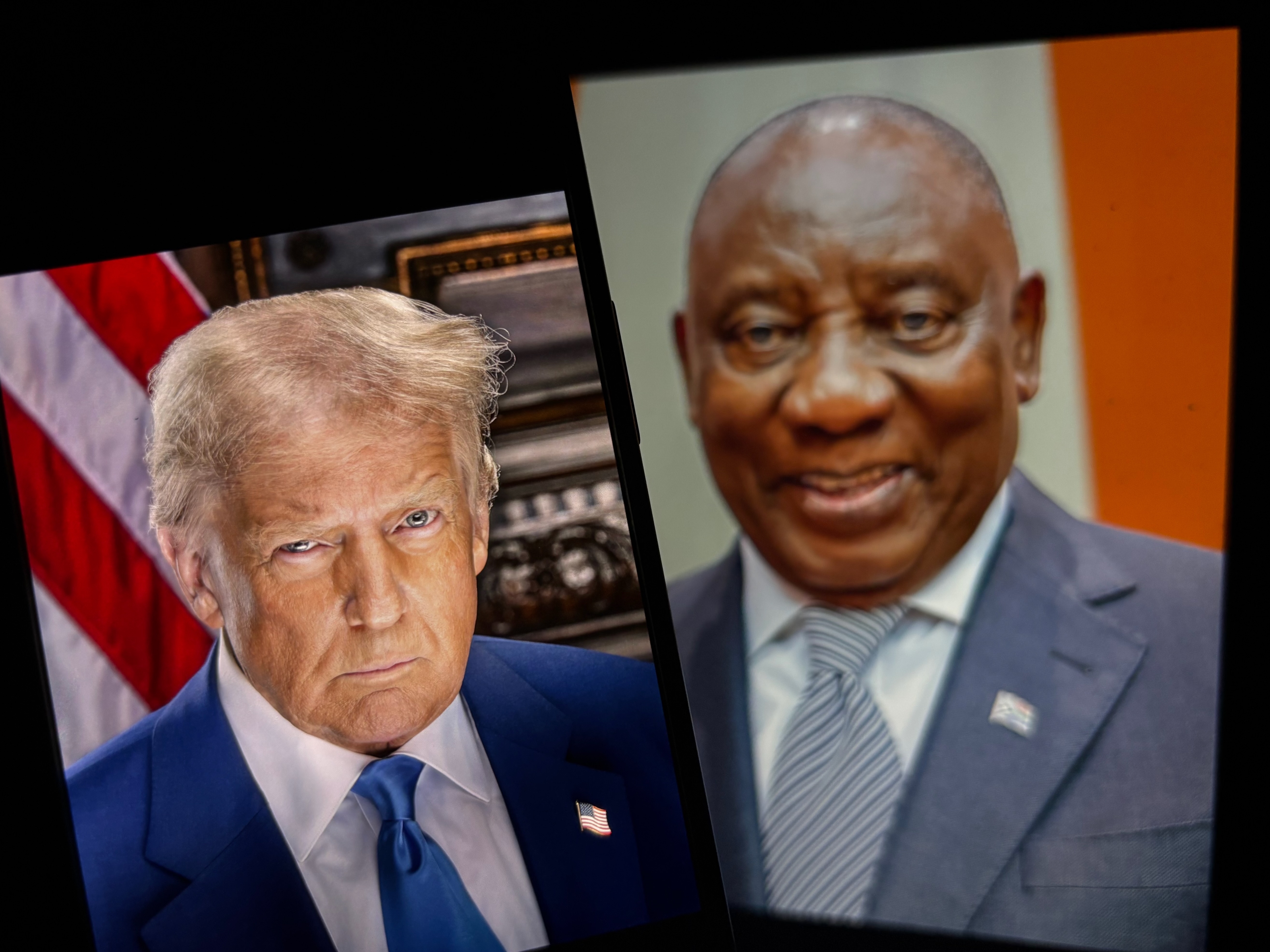
A photo of USA or united states president Donald Trump in the front with South African President Cyril Ramaphosa in the back.
© ShutterstockEarlier this month, when South Africa hosted joint naval exercises under the Brics+ banner, Washington’s response was swift and condemnatory. Critics portrayed the drills as indicative of an ideological shift or a reckless alignment with the US’s adversaries.
However, such interpretations overlook the deeper story. The exercises were less an act of provocation than an indication of the profound changes to the global order and the space for middle powers within it.
The post-war international system was built on the promise of a rules-based order comprising multilateral institutions and predictable norms, with power to be exercised within agreed constraints. This system has been under strain for years, but its erosion accelerated sharply during Donald Trump’s presidency.
Trade has been weaponised through tariffs and sanctions, alliances and diplomacy have been treated in a transactional manner, and multilateralism has been openly disparaged. The result is a world that is defined less by shared rules and values and more by leverage, retaliation and coercion.
This shift was emphasised once again at the World Economic Forum, where political and business leaders spoke with unusual candour about fragmentation, insecurity and the resurgence of hard-edged geopolitics. Rather than signalling a restoration of the old order, it seems Davos has reflected a new consensus: the liberal international system is not being repaired; it is being replaced by something more volatile and unpredictable.
In this environment, the US has sought to reassert its dominance, unsettling both rivals and partners in the process. A pattern of unilateral actions, ranging from sanctions and punitive trade measures to military coercion, has reinforced the perception, particularly in the Global South, that power is increasingly being exercised without restraint. This threatens existing norms and established rules.
South Africa’s deteriorating relationship with Washington must be understood in this context. Over the past year Pretoria has faced an unprecedented number of diplomatic crises, including the expulsion of its ambassador to the US, Washington’s refusal to attend the G20 summit hosted by South Africa, and mounting pressure over trade access.
In an era of transactional diplomacy, the scope for middle powers to pursue a non-aligned or values-based foreign policy has narrowed dramatically. Decisions that once had limited consequences now incur immediate diplomatic and economic costs.
This includes the possible loss of benefits under the African Growth & Opportunity Act (Agoa). Tariffs have hit South African exports of cars and agricultural produce hard, highlighting how economic tools are now routinely used as instruments of foreign policy.
However, it would be misleading to portray South Africa as a passive actor. Pretoria has agency and its foreign policy choices are shaped by history, domestic politics and strategic ambition. But agency does not exist in a vacuum. In an era of transactional diplomacy, the scope for middle powers to pursue a non-aligned or values-based foreign policy has narrowed dramatically. Decisions that once had limited consequences now incur immediate diplomatic and economic costs.
Against this backdrop, South Africa’s participation in the Brics+ naval exercises should be assessed. Brics+ is neither a military alliance nor does it demonstrate strategic unity among its members. Brazil, Indonesia and Ethiopia’s decision to observe rather than participate in the drills highlights the group’s internal diversity and fragmentation. India declined the invitation outright, ostensibly to balance its own interests with the US.
In this regard, Brics+ is best understood as a loose forum that is useful for hedging, signalling and exploring alternatives, rather than as a coherent geopolitical bloc. It is precisely this looseness that makes Brics+ attractive to middle powers. It offers flexibility without formal alignment and optionality without treaty obligations.
The naval exercises themselves were planned months in advance and, according to South Africa, were essential for maritime security and interoperability. Crucially, when Iran’s participation risked escalating geopolitical tension, Pretoria requested its withdrawal — a move that suggests strategic calculation rather than recklessness.
This nuance is often overlooked in Western commentary. While hosting naval exercises with China and Russia is cast as a provocation, similar drills conducted by Nato members are treated as routine. This double standard perpetuates the perception that strategic autonomy is only tolerated when it aligns with Western preferences.
Reducing South Africa’s vulnerability
Of course, there are costs. South Africa’s engagement with Brics+ will undoubtedly worsen tension with Washington. The debate over Agoa access will intensify, and further economic pressure is possible. However, the alternative — strategic dependence on a single partner that has demonstrated a willingness to punish and disengage — also carries risks.
China’s increasing importance as a destination for South African agricultural exports demonstrates the importance of diversification. It’s not about replacing one dominant power with another, but about reducing vulnerability in an increasingly coercive global system.
South Africa’s naval exercises should therefore be viewed as a strategic adaptation rather than an ideological alignment. In an era of shifting global dynamics, middle powers are adopting a more cautious approach, diversifying their strategies to navigate the evolving landscape.
The discomfort these choices provoke, both in Washington and at home, is real. However, discomfort does not equate to recklessness. It is the price of navigating a world in which the certainties of the past have given way to a far more uncertain future.
For South Africa, adaptation to a more fragmented and coercive global order is not only rational but unavoidable. Yet in a context where the US can no longer be assumed to act as a consistently benevolent or stabilising power, hedging through Brics+ alone is insufficient. Pretoria should be more deliberate in cultivating deeper partnerships with those actors that profess a commitment to a rules-based and values-driven international system. In this regard, Germany and the EU stand out as natural, if currently underutilised, strategic counterparts.
At the same time, responsibility does not rest with Pretoria alone. Germany and the EU need to recognise that strategic ambiguity and episodic engagement with Africa are no longer viable. If Europe wishes to remain geopolitically relevant in an era of great-power competition, it must invest in a more robust and credible partnership with African middle powers such as South Africa.
A stronger European–African alignment — grounded in trade, security co-operation and institutional reform — is not a gesture of goodwill, but a strategic necessity for both continents.