G20 South Africa
Youth voices at the G20

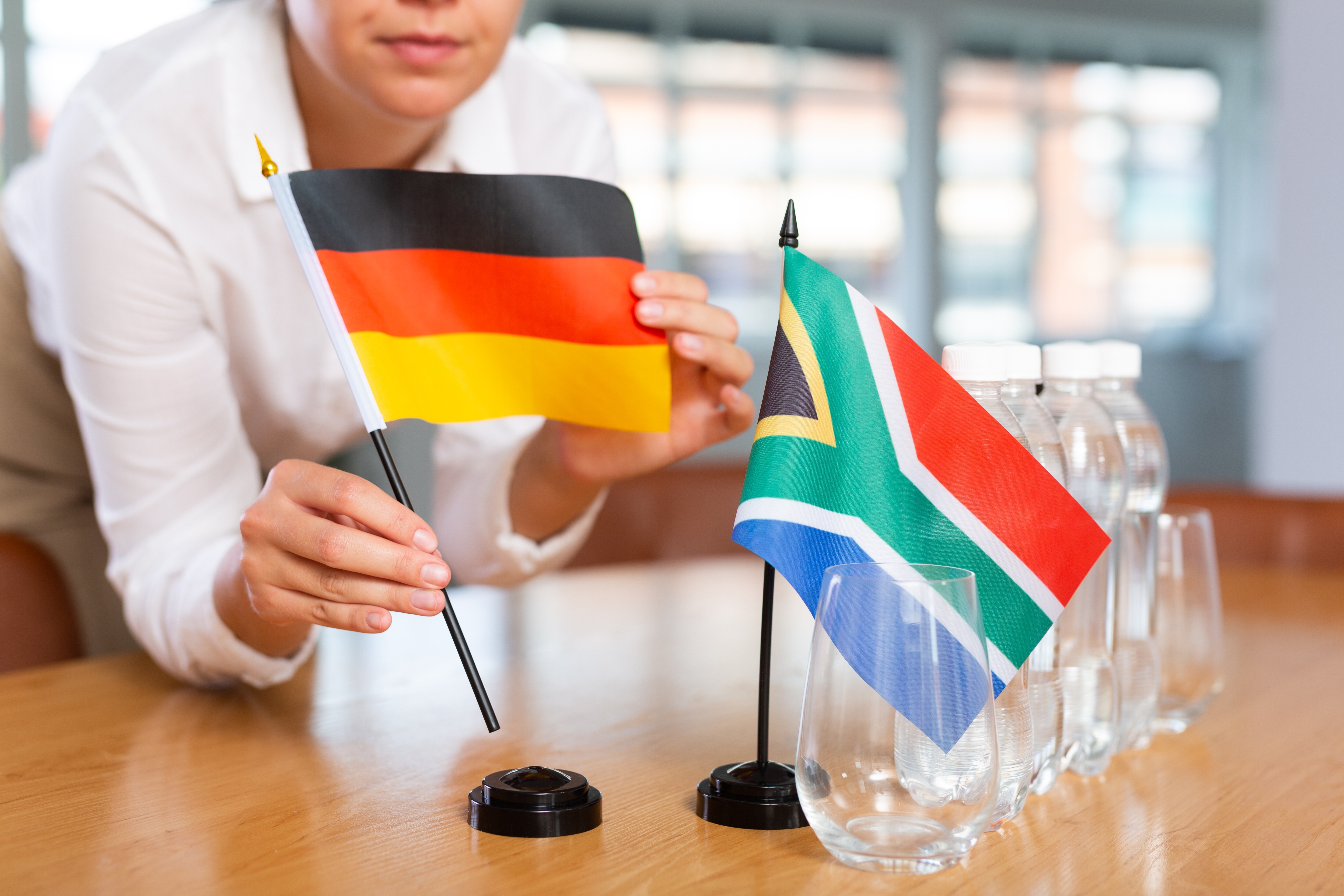
Little flag of South Africa on table with bottles of water and flag of Germany put next to it by positive young woman in meeting room.
© ShutterstockAs South Africa hosts the G20 Summit, young leaders are seizing a rare moment to shape global debates. In this interview, Andrea from the DA Students’ Organisation reflects on what the summit means for South African youth, from strengthening ties with Europe to advancing liberal democracy and ensuring young voices help drive global solutions.
As young South Africans, why do you think it’s significant that the G20 Summit is being hosted in South Africa – the only African representative in the group?
I think that South Africa hosting the G20 Summit is hugely significant. From my perspective as a young South African, it gave us (South Africans, and Africa as a whole) the platform to raise some of our most urgent issues, putting them at the core of the G20 agenda. And ultimately, South Africa did secure international attention and support towards a variety of the issues South Africa, and other African countries alike, face, such as high debt levels, critical minerals usage, disaster response, etc.
What message do you think South Africa’s role as G20 host sends about Africa’s growing influence in shaping global policy and decision-making?
South Africa hosting the G20 sends a clear message that the African continent is stepping into more of an active and influential role in shaping global policy. On the other hand, it also shows that the world is starting to recognise African leadership and perspective, and that without our continent’s perspective, universal challenges like climate change, inequality, economic reform, don’t actually have solutions without our input. I.e. moving from spectators to key players.
From a South African youth perspective, what opportunities does this summit create for strengthening relations between South Africa and Europe – especially countries like Germany?
I believe that the G20 Summit created real opportunities to deepen ties with Europe, especially Germany, in the sense of opening up new avenues for collaboration in education, tech, and entrepreneurship. Allowing young leaders, innovators, students, etc. from both countries to connect and learn from one another. Highlighting mutually beneficial areas, like sustainable development, climate action, youth/exchange programmes, in such a way that drives shared progress. Also, the fact that CwA (Compact with Africa) is co-chaired by SA and Germany, displays a shared interest in the boosting of development and employment – 2 factors that, of course, also directly impact the youth.
Which issues do you believe should be prioritised at this year’s G20 Summit – particularly those affecting young people in South Africa, such as unemployment, digital access, or democratic participation?
I believe that youth unemployment should have been put at the centre, or rather the initiation of ways to create concrete pathways into jobs, entrepreneurship, skills development for the youth, as opposed to more discussions. Of course, digital access is also a game-changer because fi we could encourage leaders to invest in affordable internet and tech for all, this would unlock a huge potential for education and innovation. On democratic participation, there is a growing need for young people to be empowered to have a say in decisions that build South Africa’s future, as active participants and voters. But for the youth to move away from being observers, and rather contributors, there needs to be a push for youth-led forums/Q&As/public feedback platforms, as these would give young South Africans a voice to hold our leaders accountable and enact the change of turning ideas and plans into action.
How do you think South Africa’s political and social relationship with Germany could evolve, especially in areas like education, innovation, the green economy, and youth development?
I think there's a lot of potential for the relationships between SA and Germany to evolve into a more dynamic partnership with practical collaboration. Continuing and deepening the exchanges in education and vocational training will further equip our youth for the modern job market. There is also space to drive sustainable growth and new opportunities by partnering on the green economy and innovation (shared research, investments in renewable resources…). With Germany’s experience and SA’s energy, both countries could co-create solutions on climate action, youth development and skills.
Do you think South Africa and Germany share similar liberal democratic values – like freedom, human rights, and constitutionalism? How can the two countries work together to defend these values globally?
Yes, I think SA and Germany share a strong commitment to liberal democracy (freedom, human rights, constitutionalism), and I think those values underpin both countries’ societies and partnerships. Working together would allow our countries to defend these principles on a global level by joint advocacy for human rights and advocacy in international forums, as well as in supporting democratic reforms where they are under threat! Knowledge exchanges, education programmes also always continue to promote and protect these values.
South Africa hosting the G20 sends a clear message that the African continent is moving from spectators to key players in shaping global policy.

What role should young South Africans play in shaping the outcomes of global platforms such as the G20, and why is youth participation crucial for South Africa’s democratic future?
We should play an active role in shaping the outcomes of global platforms like the G20. We’d be able to contribute fresh ideas, diverse experiences, advocate for policies that address the needs of the youth – unemployment, education & skills, digital inclusion. Youth participation is actually crucial for SA’s democratic future. I believe the youth have built a culture of engagement, strengthened accountability, calling for relevant decisions for current challenges, but what is needed it the proper platforms and empowerment to promote these initiatives, not just an invitation to such global platforms for show.
How can South African youth organisations – such as the DA Students Organisation and DA Youth – collaborate with liberal youth movements abroad to advance democracy, academic freedom, and freedom of expression?
As the “youth wings” of a liberal party, DASO and DA Youth are ideally placed to collaborate with liberal youth movements like FNF or others abroad by championing these shared values. Joint action on open debate and defending rights can be enhanced by more partnerships, education exchanges, global forum participation (all as mentioned before). This would allow us to learn from one another’s experiences and amplify progressive voices, being presented as a united front in the advancement of liberalism.
What do you think are the biggest challenges South African youth face in defending liberal democracy at home – especially against populism, misinformation, and political intolerance?
Just as the question states - the rise of populism, widespread misinformation and political intolerance. Populism is dangerous because it thrives on the emotional appeal (this us vs them mentality), it oversimplifies complex issues and actually also undermines a lot of constitutional values. Misinformation has of course skyrocketed due to social media. But it just increases the spread of falsehoods and division amongst people, making it very difficult to have an informed and constructive debate. Political intolerance threatens the foundation of democracy, it shuts down peaceful dissent and free expression. We lose the ability to solve problems through open, respectful dialogue when diverse voices are silenced and/or attacked. To overcome these challenges, critical thinking needs to be largely promoted, as well as respectful debate with constructive speech, and a strong commitment to protecting the right to freedom, belief, opinion, expression for everyone. I suppose another solution, besides fostering open, respectful debates, would be to increase the circulation of accurate information, and create awareness of the true political landscape in our country – education, combatting misinformation & populism.
In your view, how can South Africa use its position in the G20 to amplify youth concerns, promote innovation, and champion economic reforms that expand opportunity for young people?
SA should use its position as G20 host to put the issues that affect the youth at the centre of discussions and advocate for global policies that prioritise job creation, access to education/skills development, digital access. Regarding economic reform, if SA could encourage “cutting red tape”, promote fair access to funding mechanisms and embrace new industries and development, more young South Africans would be able to meaningfully participate in the economy. SA must drive innovation partnerships, investment in youth-led start ups, skill exchanges.