G20 South Africa
Young perspectives on the summit

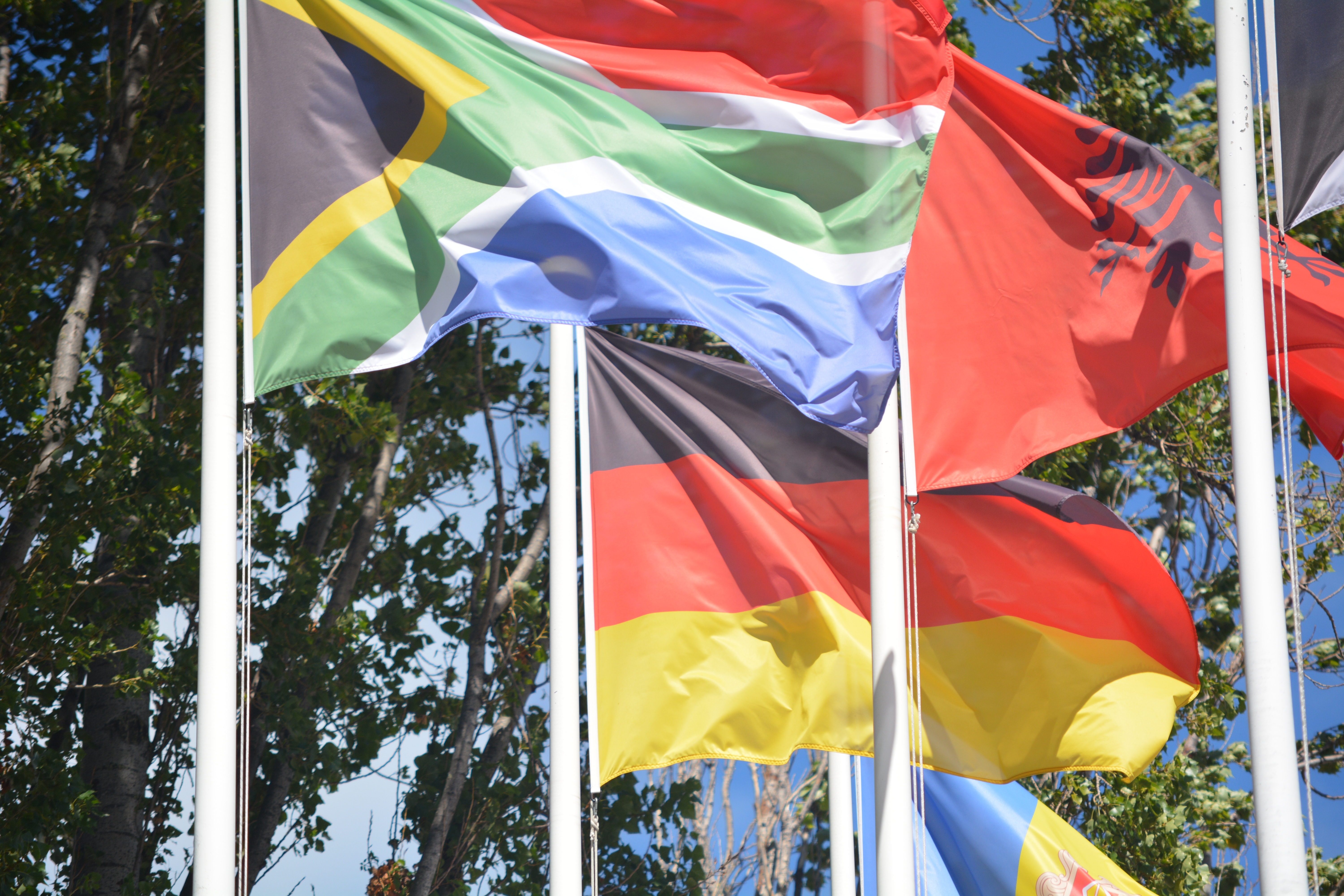
Flags of different countries, including South Africa and Germany, fluttering in the breeze under a bright blue sky. The setting is a public area with trees.
© Shutterstock
In this Liberal Workshop interview, William Sezoe speaks with Jakob Stirnadel of Germany’s Junge Liberale about the G20 Summit in South Africa, Africa’s rising global role, and how young liberals in both countries can strengthen democracy, deepen cooperation, and shape a more inclusive, rules-based international order.
From your perspective as young liberals in Germany, why do you think it’s significant that the G20 Summit is being hosted in South Africa – the only African country in the group?
From our perspective as young liberals in Germany, the fact that the G20 Summit is being hosted in South Africa is of far-reaching global importance. It signals not only a geographical shift but also a conceptual one: a recognition that Africa must be fully integrated into the world’s most influential decision-making bodies. South Africa’s role as the continent’s only G20 member places it at a crucial intersection between African priorities and global governance, and the hosting of the summit amplifies that responsibility. For young liberals, this is a decisive moment that reflects a broader move toward a more equitable distribution of political influence. It acknowledges that the world cannot continue to shape global rules and solutions without including the continent that will define much of this century’s demographic and economic developments. The symbolism of meeting on African soil, therefore, is not merely ceremonial—it is a conscious step toward a future in which Africa’s voice is both heard and sought in shaping international policy.
What message do you think this sends about Africa’s growing global role in shaping international policy?
The message conveyed by hosting the summit in South Africa is that Africa’s global role is expanding rapidly and irreversibly. For decades, Africa was often spoken about rather than spoken with; now, the international community increasingly recognises that the continent is indispensable to solving global challenges. Africa’s population will double by 2050, making its youth the world’s greatest reservoir of talent and potential. Its innovation ecosystems are among the fastest-growing globally, and its natural resources position the continent at the heart of the green and digital transitions. The decision to host the G20 in South Africa acknowledges these realities and underscores the fact that the world cannot meaningfully engage with issues such as energy security, climate adaptation, technological transformation or migration without Africa’s leadership. This marks a shift away from outdated narratives and toward an understanding of Africa as a strategic partner whose contributions are essential to long-term global stability.
In your view, how can this G20 Summit strengthen Africa–Europe relations, especially between South Africa and Germany?
This G20 Summit has the potential to fundamentally strengthen Africa–Europe relations, especially in the partnership between Germany and South Africa. For many years, cooperation between the two continents has been shaped by development dynamics, but the challenges of the 21st century demand a fundamentally different approach—one based on equal partnership, shared strategic interests and long-term investment in mutual prosperity. The summit creates an environment in which both regions can discuss their priorities openly: from energy transformation and climate resilience to digital infrastructure, skilled labour mobility and economic modernisation. Germany and South Africa, in particular, share strong economic ties and complementary strengths. Germany’s technological expertise and South Africa’s regional leadership offer a strong foundation for joint projects in areas such as renewable energy, hydrogen technology, green industry, start-up ecosystems and higher education. For young liberals, this represents a moment in which both countries can move beyond transactional cooperation and instead build a sustainable, future-oriented partnership that benefits societies on both sides.
What issues do you think should be prioritised at this year’s G20 – from a youth and liberal values perspective?
From a youth and liberal values perspective, several issues deserve heightened attention at this G20 Summit. First and foremost is the defence of democratic institutions, which are increasingly under pressure worldwide. Young people in both developed and developing countries see how disinformation, political extremism and declining trust in public institutions undermine democratic stability. Secondly, economic freedom and inclusive growth must be placed front and centre. Many young people feel trapped between rising living costs, limited opportunities and structural barriers; addressing these challenges requires open markets, entrepreneurial freedom and policies that empower individuals rather than entrench dependency. Thirdly, the digital realm is becoming a new arena of both opportunity and vulnerability. Protecting digital rights, ensuring open access to information and bridging the digital divide are essential to safeguarding youth participation in democratic and economic life. Finally, climate innovation must be prioritised—not through protectionist measures, but through technological collaboration and global investment in clean solutions. These priorities reflect the core liberal belief that societies flourish best when individuals are empowered, institutions are accountable and freedoms are protected.
How do you see the relationship between Germany and South Africa evolving, both politically and socially?
The political and social relationship between Germany and South Africa is poised to deepen in the coming years as both countries confront comparable pressures in a rapidly changing world. Politically, they are aligned in their commitment to multilateralism and a rules-based global order—an alignment that has become increasingly valuable as geopolitical tensions rise. Socially, the relationship is strengthened by vibrant academic, cultural and professional exchanges that connect young people directly. These connections play an increasingly important role in shaping societal understanding and building trust. As global dynamics evolve, cooperation will need to expand beyond traditional government channels. Partnerships between cities, universities, tech hubs, youth organisations and civil society will become just as important as diplomatic engagement. The future of German–South African relations therefore lies not only in political agreements but in the bonds formed between people, institutions and private-sector innovators who build shared solutions from the ground up.
The world can’t shape global solutions without Africa — its voice is essential to the future of international politics.

Do you think these two democracies share similar liberal values – such as freedom, rule of law, and human rights – and how can they collaborate to defend them globally?
Germany and South Africa share essential liberal democratic values, including freedom, human dignity, pluralism and the rule of law. These values form the core of their modern political identities and shape their approaches to global cooperation. Yet both countries are confronted with increasing internal and external pressures: rising political polarisation, misinformation campaigns, authoritarian influence and challenges to media independence. This makes their partnership more important than ever. By collaborating at the global level—whether through multilateral institutions, joint initiatives or coordinated diplomatic efforts—Germany and South Africa can act as anchors of liberal democracy. Their cooperation can also support countries undergoing democratic transitions by sharing best practices, strengthening civil society and helping to build institutions that protect individual freedoms. In a time when democratic norms are being challenged in many parts of the world, the shared commitment of these two nations sends a strong message of resilience and solidarity.
What role should young people – in both Germany and South Africa – play in strengthening these shared priorities?
Young people in both Germany and South Africa have a crucial role to play in advancing shared priorities and strengthening democratic values. Their participation is not merely symbolic; it is essential. Young people are often the first to adopt new technologies, challenge outdated norms and develop innovative solutions to social and economic challenges. They bring a level of openness, creativity and optimism that is indispensable for building societies capable of adapting to the future. Through academic exchanges, start-up collaboration, civic engagement and cultural diplomacy, young people can build real connections that transcend political cycles. Their involvement helps ensure that cooperation between both countries remains grounded in the lived experiences and aspirations of the next generation rather than solely in the agendas of existing political elites.
How can liberal youth movements like the Junge Liberale and South African youth organisations cooperate on international issues such as democracy promotion, education, and freedom of expression?
Liberal youth movements such as the Junge Liberale and their South African counterparts are uniquely positioned to strengthen cross-continental cooperation. They can create platforms that allow young people to engage in substantive political dialogue, exchange best practices and jointly advocate for liberal reforms. By organising delegations, hosting youth summits, producing shared policy recommendations and collaborating on democracy-promotion initiatives, these organisations can build a powerful network dedicated to defending freedom and advancing liberal ideas. Such cooperation extends beyond politics: it touches on education, entrepreneurship, digital rights and civic participation. Through sustained partnership, youth organisations can turn individual engagement into collective impact, shaping both national and international policy debates.
What are some of the biggest challenges young people face in ensuring that liberal democracies remain resilient in the face of global populism or disinformation?
The challenges young people face in preserving liberal democracies are substantial. Populist movements exploit economic uncertainty and social frustration to undermine democratic institutions. Disinformation spreads faster than ever, eroding trust in public discourse and creating echo chambers that weaken social cohesion. Authoritarian actors use digital tools to manipulate narratives and destabilise democratic societies. At the same time, economic pressures—high youth unemployment, rising living costs and limited social mobility—make it harder for young citizens to feel that democracy delivers tangible results. To meet these challenges, young liberals must work to strengthen civic education so that democratic values remain understood and appreciated. They must advocate for digital literacy, transparency in political communication and stronger democratic safeguards. And they must push for economic reforms that improve opportunity and mobility. By doing so, young people can help ensure that liberal democracies remain resilient, innovative and capable of addressing the needs of future generations.
All questions answered by Jakob Stirnadel, Head of the Africa Team of the Junge Liberale (Young Liberals). Disclaimer: The comments are those of Stirnadel, and not necessarily that of the Young Liberals.