Lebanon
Interview: Lynn Harfoush after UN Security Council speech

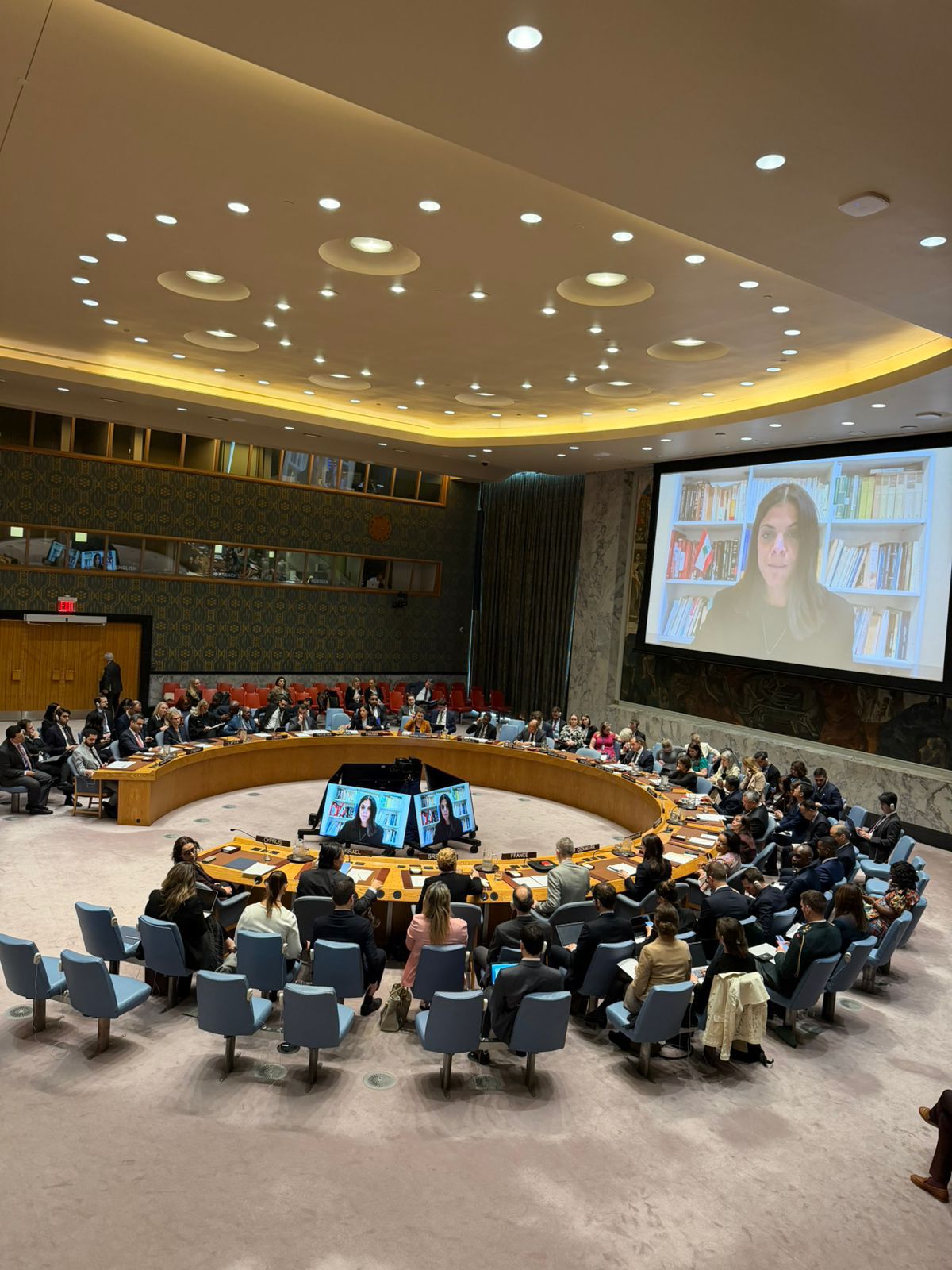
Speech by Lynn Harfoush to the UN Security Council on the situation in Lebanon
© FNFLynn Harfoush currently serves as the General Coordinator at the National Bloc. She is also the founder of "Siyasiyyat", an initiative aimed at supporting women on their political journey. A political activist since 2012, Lynn joined the National Bloc in September 2018, then was elected as a member and secretary of the Executive Committee in 2020. On 11 March, Lynn Harfoush addressed the United Nations Security Council during a session dedicated to the situation in Lebanon.
The National Bloc Party is one of Lebanon’s historic political parties, founded in 1943 by former President Émile Eddé. After a long period of limited political activity, the party has re-emerged in recent years as part of the country’s reform-oriented political landscape. It advocates for state sovereignty, economic reform, institutional accountability, and the strengthening of democratic governance in Lebanon.
The party has partnered with the Friedrich Naumann Foundation for Freedom in Lebanon, cooperating on initiatives that promote political reform, democratic participation, and policy dialogue.
1. In your address to the Security Council, you spoke about growing up in Baalbek and Beirut’s southern suburbs, environments where Hezbollah has long exercised strong influence. How did your personal experiences shape your political engagement and your decision to speak out publicly today?
Growing up in Baalbek and later in Beirut’s southern suburbs meant growing up in an environment where Hezbollah was not just present but dominant in everyday life. Like most people in my community, I initially saw them through the lens that was presented to us. As protectors and as a resistance movement.
But living inside that environment also meant witnessing its consequences. Over time, I saw how political power, ideology, and weapons began shaping every aspect of our lives: our security, our future, even our ability to speak freely.
That experience shaped my political engagement. It pushed me to believe that Lebanon deserves a state where decisions of war and peace are taken by institutions accountable to citizens, not by armed groups who answer to external orders.
Speaking publicly at the UN Security Council comes from that conviction. I know the language and the fears inside those communities, and I believe it is important that voices from within them speak honestly about what many people quietly feel. Hezbollah is one of the parties that holds the tightest grip on its community and thus very rarely do opposition voices rise. It has been my battle for the past 15 years to break from that grip and show people that they can too.
2. You described how your perception of Hezbollah evolved after the 2006 war, when your neighbourhood in Dahieh was destroyed and you began to question the narrative of “divine victory.” What led you to reassess the role of Hezbollah at that moment?
There were two turning points. The first, my return to our neighborhood when I felt Hezbollah was claiming victories over our wreckage. I saw their discrepancy in dealing with people, and I saw them alienate us from the rest of the country and make us fear other communities, and I understood that this excess of power was not to serve our interests nor fight Israel. But to maintain dominance over the community.
The other turning point was when I went to Lebanon’s only public university to pursue my studies because I couldn’t afford to go to a private one. And I walked in to find yellow flags and pictures of Hezbollah and Amal leaders all around the university, and I felt invaded. They were radicalizing the public university of Lebanon, and I felt it’s a grip on education and youth and every opportunity of freedom we had.
3. You warned that Hezbollah has again drawn Lebanon into a war that many Lebanese did not choose. How would you describe the atmosphere in Lebanon today, particularly for civilians who are facing displacement and renewed insecurity?
There is a big split within the Lebanese community. The split is obvious between those who refuse to be kept hostages of Hezbollah’s adventures, and the others who believe that Israeli aggression is unstoppable and the government cannot face it, and thus stick to Hezbollah’s “resistance”.
This creates an internal dynamic that harms co-existence, but Hezbollah has built an entire echo chamber that emphasizes their narrative, and thus are able to keep their community’s support, despite some anger and frustrations in the first two days of this war on how they were displaced in the middle of the night.
4. In your speech, you argued that Lebanon’s crisis is fundamentally a crisis of sovereignty and state authority. What would it take, in practical terms, for the Lebanese state to reassert control over security and political decision-making?
The state should simply return to applying the Constitution to the letter, especially regarding the decision-making process by majority when necessary, and stop using the excuse of the supposed “consensus,” which contradicts our democratic system and has brought the country nothing but paralysis and calamities, because it often ends with everyone yielding to the blackmail of the Speaker of Parliament, Nabih Berri.
On the other hand, it should start acting like an actual state and begin implementing the decisions it has already taken itself, such as the decision to disarm Hezbollah and prohibit its security and military activities. If the argument that the army cannot - or will not - enforce the law by force is valid, then what about the public prosecutors? What is preventing them so far from taking action to prosecute the leaders of the banned militia?
Why, for example, the diplomatic relations with Iran have not yet been severed, given that it has been proven to support armed groups that are banned and operating outside the law? What do international treaties say about this matter? Let’s just apply them to Iran. Enforce the law. Nothing more.
5. You were also critical of the way the international community has dealt with Hezbollah over the years. What do you believe external actors should do differently today if they want to contribute to stability in Lebanon?
As I mentioned in my speech, we should stop looking for stability. Instead, we should seek solutions. Ones that are based on justice, laws, and common sense. Because common sense in our country is not common.
As for the external actors, especially the ones that consider themselves to be friends of Lebanon, they must stop dealing with Hezbollah in the way they did in the past. They even used to lecture us about the need to accept coexistence with the militia, to overlook its crimes, and to accept its terms under the pretext of preserving stability, and of course their own interests. And this is the result.
In parallel, Israel’s aggression in Lebanon should stop imminently: Residential areas are being attacked daily. Around 1 million Lebanese are now displaced, their villages destroyed. Around 600 people were killed in 10 days. And now, we’re hearing about an imminent Israeli invasion that would do even more harm, and escalade the tensions. A big pressure should be put on Israel to stop all this, and to positively approach the diplomatic initiative launched by the Lebanese government.
6. Despite the ongoing conflict, you ended your speech with a call for peace and a future in which Lebanon can move beyond cycles of war. What would a realistic path toward such a future look like?
A realistic path toward peace requires addressing the root causes of the conflict, not just managing its consequences.
First, Lebanon must restore full state authority and ensure that armed groups no longer operate outside national institutions.
Second, diplomatic efforts must aim at ending the repeated cycles of escalation along the Lebanese-Israeli border. The initiative recently put forward by Lebanese authorities, which includes ending Israeli violations, securing withdrawal from Lebanese territory, and addressing the question of Hezbollah’s weapons - points toward such a framework.
Finally, peace must be based on justice and dignity for civilians. Lebanese people want what people everywhere want: security, opportunity, and a future for their children.
The real aspiration of most Lebanese is not perpetual resistance or endless war. It is simply the ability to live normal lives in a stable and sovereign country.

Lynn Harfoush
© FNF