Economic Freedom
Unleashing Potential: How Economic Freedom Strengthens Civil Society in Indonesia

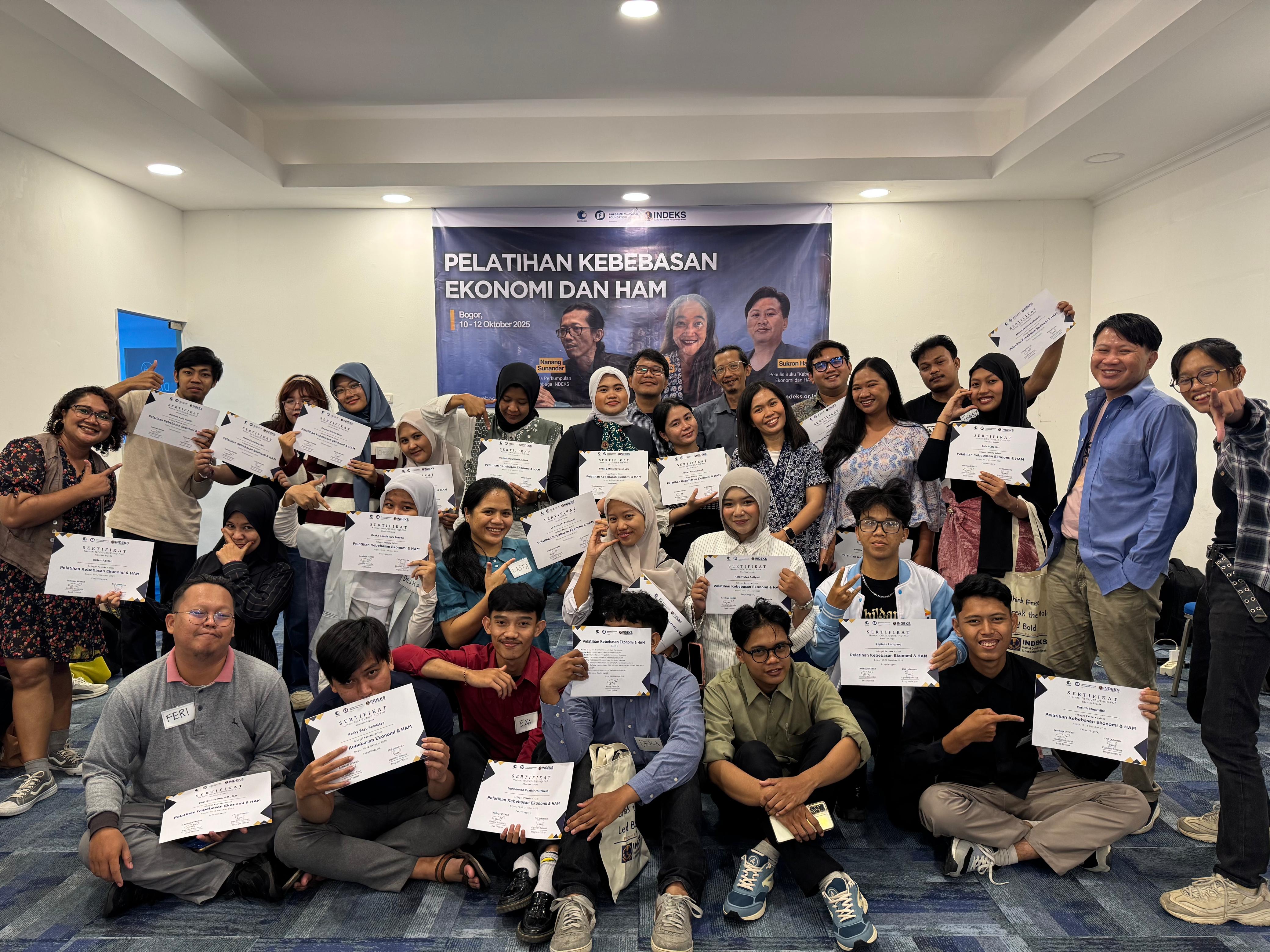
Group Photo of Participants in one of INDEKS events in Bogor
This article was written by Dedi Irawan, a team member of one of FNF Indonesia’s partner organizations, the Institute for Democracy and Prosperity (INDEKS). It reflects on their ongoing work in promoting the ideas of economic freedom in Indonesia.
Economic freedom has proven to be not merely an engine of growth but a driving force that empowers citizens to innovate, collaborate, and collectively shape their own future
In global discourse, economic freedom is often understood as the fundamental right of every individual to control their own labor and property. In an economically free society, individuals have the liberty to work, produce, consume, and invest according to their own choices, with government intervention kept to a minimum and limited only to what is necessary to protect that very freedom. This concept is grounded in the principles of individual empowerment, non-discrimination, and open competition.
In Indonesia, this understanding is not merely an academic subject but has also become a tangible movement championed by institutions such as the Institute for Democracy and Prosperity (INDEKS). Through various training sessions and dissemination programs, INDEKS emphasizes that economic freedom is not just a tool for macroeconomic growth, but also an instrument of Human Rights (HAM) capable of empowering the most grassroots layers of society, particularly Micro, Small, and Medium Enterprises (MSMEs).

Dedi Irawan (INDEKS Program Staff) is presenting the main ideas of John Locke on Property Rights at the economic freedom and human rights training in Ambon 2025, accompanied by an analysis of the text and context in Indonesia
The State of Indonesia's Economic Freedom: Between Potential and Challenges
INDEKS's analysis of data from provinces across Indonesia uncovers significant disparities. Provinces with stronger economic hubs and progressive regulations, such as those in Java and Sumatra, tend to have a more conducive business climate compared to regions in Eastern Indonesia.
The main challenges still stem from three key pillars:
- Rule of Law: Weak protection of property rights, including Intellectual Property Rights (IPR), poses a major obstacle for MSMEs to develop and innovate securely. Coupled with Judicial Effectiveness and Government Integrity, this creates legal uncertainty that can erode the confidence of both investors and business actors.
- Regulatory Efficiency: Convoluted bureaucracy and complex licensing procedures remain common complaints.
- Open Markets: Policies such as the Domestic Component Level (Tingkat Komponen Dalam Negeri or TKDN) in certain sectors, although well-intentioned, are often perceived as hindering the inflow of much-needed foreign direct investment.
Notwithstanding these difficulties, a positive development merits acknowledgment. Indonesia's Open Unemployment Rate as of February 2025 was successfully reduced to 4.76% (The Institution of Statistics Indonesia, BPS). However, it is a paradox that, in reality, especially the younger generation, finds it difficult to find job opportunities.
The achievement is inseparable from the vital role of the informal sector and MSMEs, which act as the primary buffer for national employment.
MSMEs are the heart of the Indonesian economy, yet they are also the most vulnerable to unclear regulations and weak legal protection. Education and advocacy on economic freedom are key to transforming this vulnerability into resilience–a mission consistently pursued by INDEKS and FNF Indonesia.
When a micro-entrepreneur understands their property rights and is encouraged to register their IPR, they not only protect their creations and trademarks but also build assets that can be used as collateral to access financing. When licensing bureaucracy is simplified, the energy and capital that administrative processes would otherwise drain can be redirected towards product innovation, marketing, and business expansion.
The training organized by INDEKS, supported by the Friedrich-Naumann-Stiftung für die Freiheit (FNF), emphasizes these practical aspects. They do not merely convey theory but also equip MSME actors with the knowledge to confront real challenges, such as how to address discriminatory regulations or leverage existing spaces of freedom. This aligns with Isaiah Berlin's principle of positive freedom, where freedom is not solely about the absence of intervention (negative freedom) but also about the presence of capacity and institutions that enable individuals to take control of their lives and futures.
Economic Freedom and Civil Society: A Symbiotic Mutualism
It is crucial to understand that economic freedom and civil political freedom are two sides of the same coin, interconnected and mutually reinforcing. The Freedom in the World 2025 report from Freedom House underscores this symbiotic relationship while highlighting the challenges Indonesia faces. Indonesia's freedom status remains in the "Partly Free" category, continuing a trend of stagnation in recent years.
This trend reflects the complex challenges facing Indonesian democracy, ranging from systemic corruption and the enduring influence of the military in political life to discriminatory regulations that constrain minority groups. Furthermore, civil society organizations and press freedom continue to face various pressures, particularly when addressing sensitive issues.
Within this context, Indonesia's improvement in economic freedom presents an encouraging development. This progress offers a glimmer of hope; focusing on fundamental economic rights, such as property rights protection and regulatory simplification, can catalyze the strengthening of the overall ecosystem of freedom. A more independent and dynamic private sector, born from economic freedom, will create the necessary material foundation for civil society to more effectively advocate for political accountability and the protection of civil liberties. This marks the beginning of a virtuous cycle where progress in one area sparks advancement in another, moving Indonesia toward a freer and more prosperous society.
A strong civil society–comprising NGOs, communities, business associations, and independent media plays a dual role. First, it functions as a "watchdog" that monitors policy implementation, pushes for accountability, and fights the corruption that is a primary enemy of both economic and political freedom. Second, it acts as an "enabler" that provides education, mentoring, and builds networks for MSMEs to grow.
In this context, economic freedom strengthens civil society by providing financial independence. Prosperous MSMEs and self-reliant businesses are less susceptible to being dictated by specific political interests. They become independent economic actors whose voices are critical and constructive in building good governance. Conversely, a dynamic civil society will continue to push for the expansion of economic freedom by advocating for regulatory reform and ensuring the protection of citizens' economic rights.
Conclusion: A Nuanced Path Forward
The increase in Indonesia's economic freedom score in 2025 is good news that deserves appreciation, but it is not the end of the journey. Indonesia's ranking, which remains below Singapore, Malaysia, and Brunei in the ASEAN region, is a reminder that there is still much homework to be done.
Indonesia's potential to become a new, inclusive, and sustainable economic power is immense. The key to realizing this lies in a collective commitment to strengthening the pillars of economic freedom: the rule of law, regulatory efficiency, and open markets. The government, business actors, academics, and especially civil society must synergize.
Therefore, by empowering every individual, particularly MSME actors, with the rights and tools to control their own economic future, we are not only creating jobs and reducing unemployment but also building a more independent, innovative, and resilient society–a civil society that is truly strong and sovereign.
The opinions expressed in this article are the author's own and do not necessarily reflect the views of FNF Indonesia.