International Academy for Leadership
Coalitions that Last: Lessons in Liberal Partnership from Gummersbach

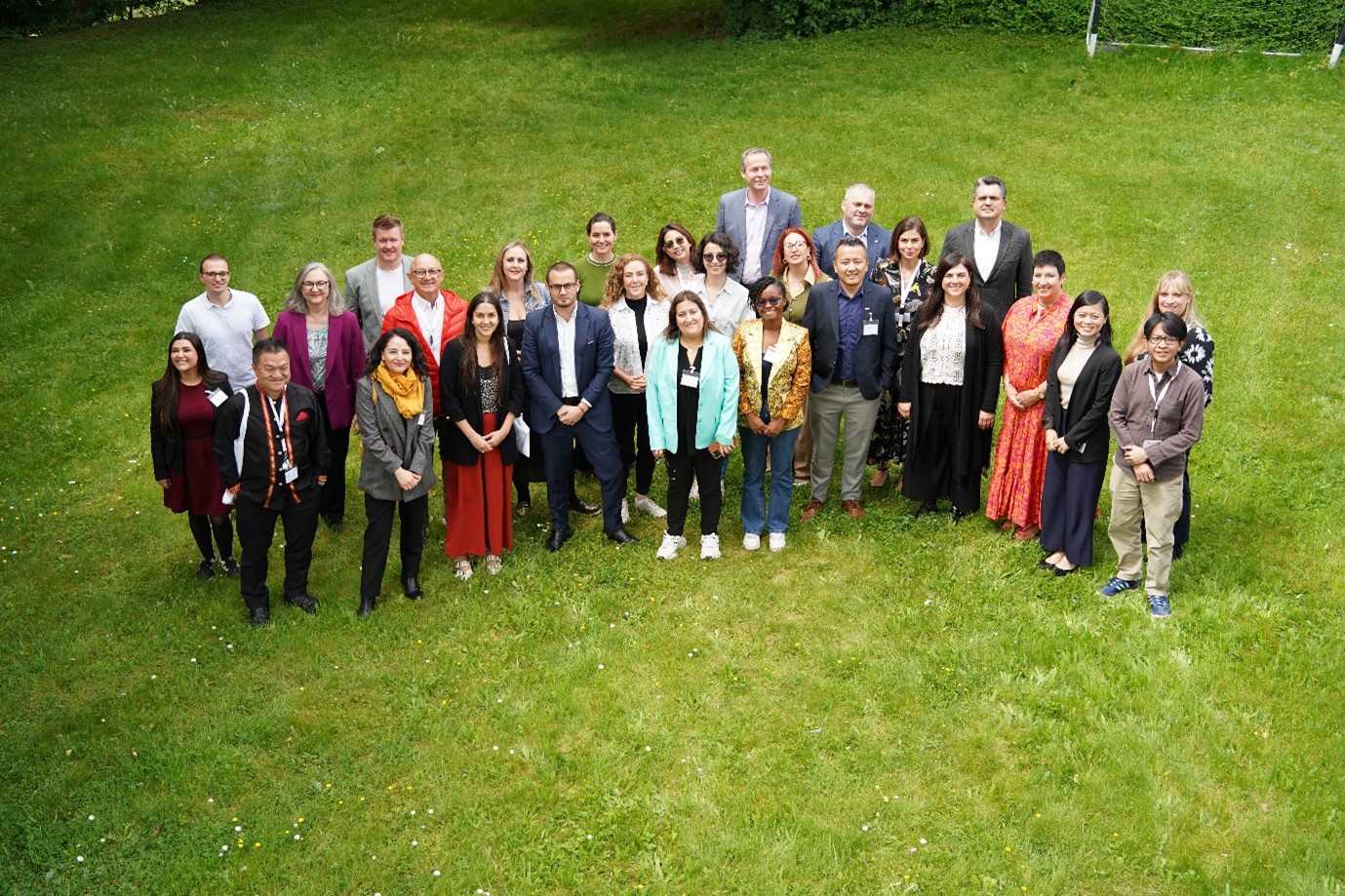
A group photo of the seminar cohort, May 2025
In May 2025, I had the opportunity to join a unique gathering of liberal thinkers, political practitioners, and think tank and civil society leaders at the International Academy for Leadership (IAF) in Gummersbach, Germany. Hosted by the Friedrich Naumann Stiftung für die Freiheit (FNF), the week-long seminar on Coalition Building and Strategic Partnerships brought together participants from more than 20 countries—from Chile to Georgia, from Malaysia to Côte d'Ivoire.
Our learning was guided by two outstanding facilitators. Penny Tainton, a seasoned political strategist from South Africa, brought decades of experience in post-election coalition design, government leadership training, and adaptive governance. Rainer Heufers, a public policy expert and founder of the Center for Indonesian Policy Studies (CIPS), offered deep insights into strategic planning, facilitation, and the practicalities of think tank and party partnerships. Together, they created an environment that was both intellectually challenging and personally transformative.
This diversity, both geographic and professional, created an atmosphere of vibrant exchange. Despite our different contexts, we were united by liberal values: a belief in individual freedom, democratic institutions, and the power of dialogue to build bridges across differences. As we explored the practical and philosophical dimensions of coalition work, it became clear that effective partnerships require more than shared interests—they require shared responsibility.
In hindsight, it almost feels like a noncoincidence that our introductory note into the program opens with a quote from Bernice Johnson Reagon, “Coalition work is not work done in your home.” Indeed, as our seminar revealed, building coalitions means stepping outside of ideological comfort zones, navigating uncertainty, and learning to lead with humility and purpose.
From Shared Values to Shared Strategy
Coalition-building begins with clarity—both of purpose and of principles. One of the most resonant sessions early in the seminar focused on aligning around our “shared values.” Participants were encouraged to reflect not only on what their organizations stood for, but also what they stood against. In liberal coalitions, this clarity helps partners navigate the inevitable trade-offs without losing sight of core identity.
However, as our discussions revealed, coalitions are rarely formed on ideological alignment alone. Many are driven by power motives—strategic necessities to gain office, pass legislation, or prevent more illiberal forces from rising. Both approaches—principled and pragmatic—have their place. But acknowledging the tension between them is crucial. As noted in one of the sessions, the real challenge for liberals is to “stay recognisably liberal, while also being an effective coalition partner.” Therefore, as we learned from the story of FDP’s abandoned coalition and its subsequent defeat in the last Germany election, it is important to find compromises early on; otherwise, there is no reason to hold a coalition together.
To move from values to action, we explored strategic tools for assessing partner compatibility. This included stakeholder mapping, identifying mutual interests, and defining governance structures that balance influence. During the “Give & Gain” workshop, we charted out what each organization brings to a coalition—not just in resources, but in reputation, networks, and political capital.
Leadership Beyond the Ego
Coalitions need leaders—but not always the kind that politics is accustomed to. In her session on Leadership in Coalitions and Partnerships, Penny Tainton introduced us to Daniel Goleman’s six leadership styles: visionary, democratic, affiliative, coaching, commanding, and pacesetting. The most effective leaders, she emphasized, are not those who stick to one style, but those who adapt fluidly to context.
This idea of adaptive leadership became a central theme. Drawing from the work of Ronald Heifetz, we examined the difference between technical and adaptive challenges. Coalitions often mistake complex, value-laden problems for technical ones—trying to fix things with rules and checklists rather than dialogue and experimentation.
We were reminded that leadership in coalitions is not about control, but about creating space—space for disagreement, space for dissent, and space for voices that are often unheard. Especially in a world marked by volatility, uncertainty, complexity, and ambiguity (VUCA), leaders must “get on the balcony,” observe the larger system, and foster collective problem-solving.

Unconference: A participatory exercise in co-designing a conference session.
Learning from Real-World Practitioners
Throughout the week, we benefited not only from theoretical insights and group exercises, but also from real-world experience. Guest speakers brought depth and nuance to our discussions:
- Torsten Herbst, a senior figure in Germany’s FDP, recounted his first-hand account of FDP’s experience in the last election, and lessons learned for political coalitions. As a former Bundestag whip and Budget Committee member, his remarks illuminated the balance between party strategy and pragmatic compromise.
- Sietse Wijnsma, a veteran liberal advisor in the European Parliament and current Head of Unit in the ALDE/Renew Europe group, offered a continental perspective. He shared how complex coalitions function at the EU level—where procedural consensus often masks deep ideological negotiation.
- Aneta Vainė, Vice President of the Lithuanian Free Market Institute, highlighted how think tanks contribute to coalition dynamics through ideas, credibility, and public trust. Her experience in economic education and values-based messaging was especially relevant for civil society partners.
- Alexander Hammond, founder of the Initiative for African Trade and Prosperity and a program manager at the Rising Tide Foundation, underscored the importance of liberal coalitions in global development and trade advocacy. His work spans continents and brought an inspiring globalist lens to our discussions
Their contributions reminded us that coalitions are not confined to political parties—they include think tanks, NGOs, multilateral actors, and private sector allies. Learning to collaborate across these boundaries is essential for 21st-century liberalism.
Negotiating with Empathy and Intention
One of the seminar’s most practical contributions came from our deep dive into negotiation theory. In coalitions, negotiation is not a one-time event—it is an ongoing process of balancing needs, interests, and egos.
We learned to distinguish between positional and interest-based negotiation. While positional bargaining focuses on what each party wants, interest-based negotiation explores why they want it. This shift opens the door to creative solutions and more durable agreements.
Essential tools such as BATNA (Best Alternative to a Negotiated Agreement), WATNA (Worst Alternative), and ZOPA (Zone of Possible Agreement) were unpacked in detail. These concepts, while technical, helped us frame negotiations not as contests to be won, but as conversations to be navigated.
A simulation exercise on digital rights policy brought these theories to life. Playing different stakeholder roles—from NGOs to political parties—we negotiated a values-based “Digital Responsibility Pact.” The scenario mirrored real-world coalition challenges: differing priorities, mistrust, political risk, and trade-offs. It forced us to confront our assumptions and seek principled compromises.

Co-pitching an open session
Coalition Work Is Hard—But Worth It
Throughout the week, a recurring theme emerged: coalition work is messy, slow, and often thankless. It demands emotional intelligence, institutional trust, and the patience to build consensus in an age of polarization.
It also requires internal discipline. Many coalitions falter not because of external opposition, but due to poor communication, unclear expectations, and unresolved conflict within. Strong coalitions are built on shared governance, regular dialogue, and mechanisms for dispute resolution.
Most importantly, sustainable coalitions are rooted in mutual respect. Ideological differences may persist, but partners must believe in each other’s integrity and commitment. As one participant said, “We don’t need to agree on everything—but we need to believe we’re walking in the same direction.”
Lessons for Liberal Movements
Liberal movements worldwide are increasingly operating in fragmented political landscapes. Whether in multiparty democracies or authoritarian-leaning regimes, the ability to form alliances—across parties, with NGOs, and even with the private sector—is essential.
From Gummersbach to Jakarta, five key lessons for an effective coalition are worth taking home:
- Start with Values, But Build with Strategy: Define what matters most to your organization—but also what you're willing to compromise on.
- Embrace Adaptive Leadership: Be ready to shift styles, reframe problems, and support others to lead.
- Negotiate with Empathy: Understand your partners' fears and motivations. Seek mutual gain, not dominance.
- Prioritize Process Over Speed: Strong coalitions take time to grow. Rushed agreements often crumble.
- Make Trust a Priority: Shared trust is more valuable than shared ideology. Without it, even the best-designed coalitions will fail.

The team pitching for a session on the ecosystem of a healthy partnership/coalition
As the seminar drew to a close and we shared a final meal—dressed in formal, casual, or traditional attire—it was clear that we had not just learned about coalitions. We had practiced being one. Across borders and languages, we built relationships that will outlast the week in Gummersbach.
Coalition work may not be comfortable, but it is essential. For liberals seeking to build freer, fairer societies, it is the hard path worth walking.