CEPA
EU-Indonesia Free Trade Agreement: Blueprint for Resilient Trade

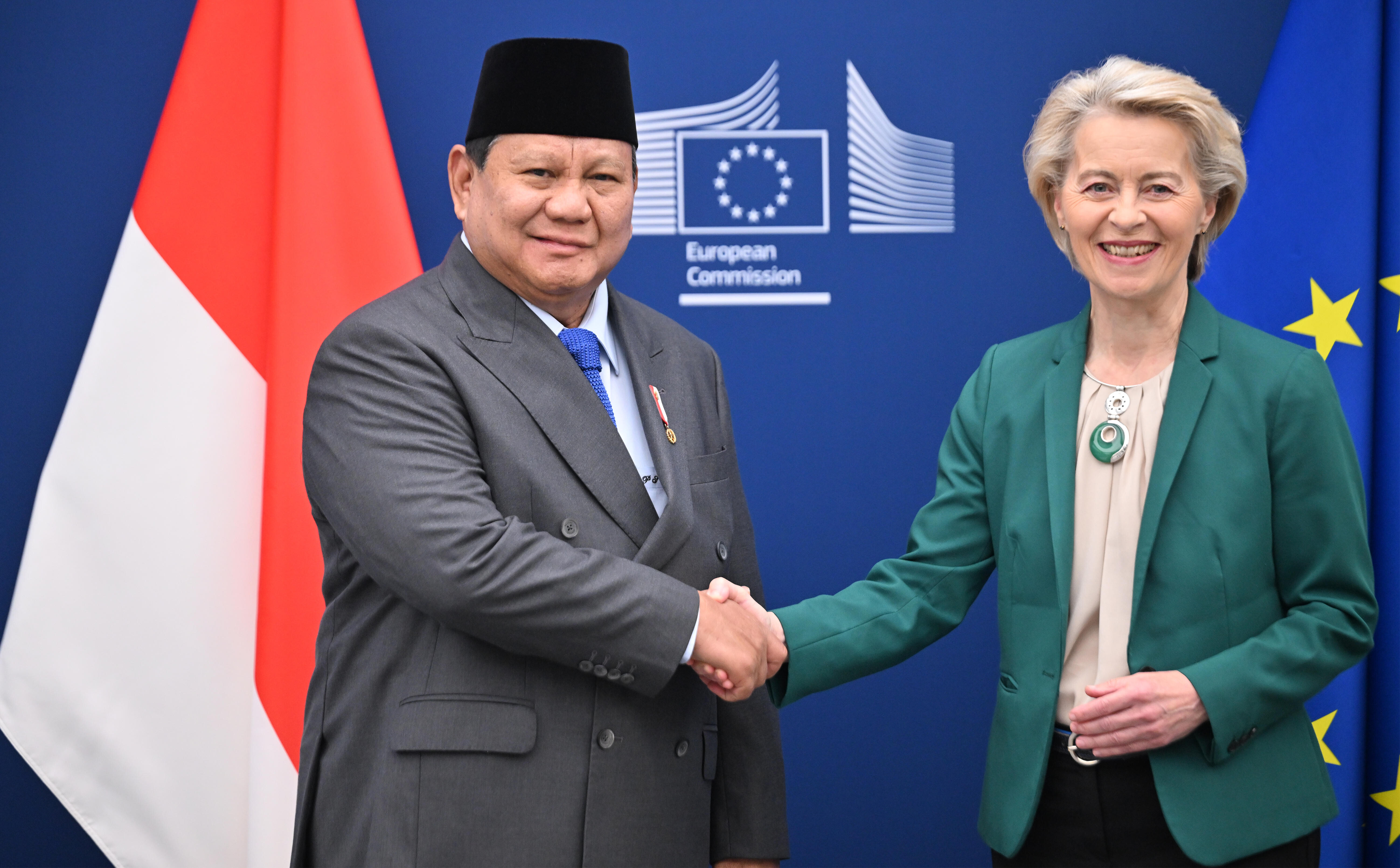
Indonesia and the EU are creating new opportunities for business and sustainability with their free trade agreement.
© picture alliance / Anadolu | Dursun AydemirAfter more than 9 years of negotiation, a finalized free trade agreement is good news in a world where geopolitics is reshaping trade and Europe needs to diversify its supply chains. As Southeast Asia’s largest economy, Indonesia offers the EU unprecedented access to vital resources, a youthful and tech-savvy population, as well as a rapidly growing market.
On 23 September, Indonesia and the European Union formally signed the Indonesia–EU Comprehensive Economic Partnership Agreement (IEU-CEPA), marking a significant milestone in bilateral trade relations. As a major pact between the EU and Southeast Asia’s biggest economy, IEU‑CEPA matters beyond its signatories. Globally, it could establish templates for aligning advanced and emerging economies on standards for data, sustainability, and investment protection as supply chains shift in response to geopolitical and climate policy changes.
Although the IEU-CEPA agreement has been signed, it will not take immediate effect. The pact still requires ratification by Indonesia’s legislature, the European Parliament and the Council of the EU, followed by detailed action plans and regulatory preparations to ensure full implementation by 2027. Once implemented, it would anchor Indonesia in higher‑value manufacturing and services while giving European firms a diversified, rules-based foothold in the Indo-Pacific. It could boost trade, unlock cleaner industry and infrastructure investment, and reduce policy risk - helping partners de‑risk, not decouple - in a contested global economy.
Trade agreements rarely occupy the headlines for long. They’re negotiated in windowless rooms, written in dense prose, and riddled with acronyms. IEU‑CEPA is no exception: nine years in the making, with talks launched in 2016 amid tensions over palm oil market access and deforestation rules. Momentum later accelerated as the Trump administration’s aggressive tariff policy jolted global supply chains, pushing both sides to expedite the process. What began as a narrow dispute over palm oil, biodiesel trade barriers, and the EU’s deforestation regulations, evolved into a broader, standards-heavy negotiation that now pairs tariff cuts with modern “plumbing”, rules of origin, services, investment protection, and sustainability. It folds in capacity‑building so firms and smallholders can actually comply. While it promises headline wins, such as eliminating most tariffs, its true significance lies in this operating system for smoother, cleaner, and more predictable trade.
Start with the simple part. Under the proposed terms, the EU would make over 98 percent of Indonesian tariff lines duty-free upon entry into force. Indonesia would eliminate tariffs on around 80 percent of EU tariff lines, phasing down the remainder over several years. These figures are big but typical of modern deals. The politics live in the exceptions: Indonesia is expected to keep protections for sensitive agricultural products like rice and sugar, while the EU will likely preserve safeguards for items such as beef and dairy. These carve-outs aren’t betrayals; they are the lubrication that keeps the gears of trade diplomacy turning.
Beyond the Border: Standards, Services, and Friction Costs
With tariffs having fallen worldwide, non-tariff barriers - standards, licensing, data rules - now dominate the terrain. The IEU-CEPA agreement pairs tariff cuts with regulatory cooperation and service openings. Indonesia has offered significant new access in finance, telecommunications, and transport, while the EU is offering broader access to its public procurement markets. That sounds abstract until you picture a European logistics company trying to operate in a Javanese port city, or an Indonesian engineering firm bidding for a public contract in Europe. The gain from a one-point tariff cut is modest compared to the gain from operating, hiring, and getting paid without arbitrary friction.
Rules of origin are where theory meets the factory floor, and this chapter remains a key unresolved issue in the talks. A key goal is to strike a flexible balance. For example, proposals under discussion aim for roughly 40 percent regional value content for most industrial goods and include provisions for "cumulation," which would allow materials from other ASEAN countries to count toward a product's origin. In plain English, a shoe assembled in Indonesia with Vietnamese fabric could still qualify for preferential treatment. This matters because supply chains are messy, adaptive networks. Rules that let firms source sensibly without losing preferences are crucial. For a small Indonesian furniture maker or a European SME, simplified electronic documentation and self-certification - also part of the proposal - can determine whether they export at all.
Capital, Courts, and Public Goods
Investment is the quiet engine of trade. The IEU-CEPA proposes to upgrade dispute settlement by replacing Indonesia's older bilateral investment treaties with the EU's permanent Investment Court System (ICS), which features an appellate mechanism. While this model is the EU's standard, it represents a significant shift in legal architecture. The goal is to lower the invisible tax of uncertainty for long-term investors, whether it's a European firm weighing a factory in Central Java or an Indonesian healthcare provider eyeing expansion in Europe.
The chapter on Trade and Sustainable Development (TSD) is designed to answer skeptics but is also one of the most contentious areas of negotiation. The EU is pushing for binding commitments on labor rights, environmental protection, and climate action. However, this has been met with resistance from Indonesia, which is wary of these clauses being used as a form of "green protectionism." A major point of friction is the EU’s Deforestation-Free Regulation (EUDR), which requires commodities like palm oil and coffee to be traceable and not linked to recent deforestation. Indonesian producers, especially smallholders, face significant costs to comply. The compromise within CEPA potentially involves the EU providing technical assistance and funding to help build the necessary traceability systems, turning a point of conflict into a platform for cooperation.
Raw Materials, Procurement, and IP: Design over Dogma
Raw materials are another predictable source of friction. Indonesia has used export restrictions on nickel ore to build a domestic processing industry - a policy that directly conflicts with the EU's need for raw material access. This issue is so contentious that it is already the subject of a WTO dispute, where the EU won an initial ruling that Indonesia has since appealed. While the CEPA aims to bring such debates into a rules-based forum, it cannot easily resolve a conflict that is already being litigated elsewhere. This backdrop makes the raw materials chapter particularly sensitive.
Public procurement is under-sung but potent. The proposal to open parts of government purchasing aims to deliver savings and quality gains. Intellectual property provisions are also on the table, with the EU emphasizing geographical indications, while Indonesia seeks to maintain public health safeguards for access to medicine. The inclusion of structured regulatory dialogues aims to create early warning channels to resolve frictions before they escalate.
Growth, Risks, and the Strategic Frame
What kind of growth could be expected? Gravity models suggest a substantial boost in bilateral trade is plausible if the deal is finalized, potentially in the range of 15 to 30 percent within a few years. If the deal is ratified, its success should be measured by mundane questions: Does an Indonesian SME find it easier to sell rubber products into the EU? Does a European maritime services provider navigate Indonesian licensing more predictably? Does a battery materials plant in Sulawesi secure EU investment because it can document both origin and emissions?
Strategically, the agreement aligns with the current moment. For Europe, it is a key part of its Indo-Pacific strategy and efforts to diversify supply chains. For Indonesia, it offers a chance to anchor its industrialization to a high-standard market. In a world where geopolitics and climate policy are reshaping trade, a finalized deal will channel those forces constructively. By investing in the humdrum - committees, documentation, and clear rules - as well as the high-minded, the IEU-CEPA has a chance to deliver quieter borders and better-measured externalities. In a world that is too often exciting for the wrong reasons, that would be a valuable result.
Poltak Hotradero, long-time economist at the Indonesia Stock Exchange (IDX), currently serves as Business Development Advisor. He is a frequent speaker on Indonesia’s capital markets, digital banking, trade and ASEAN connectivity.