South Sudan
People resolve to make peace their priority

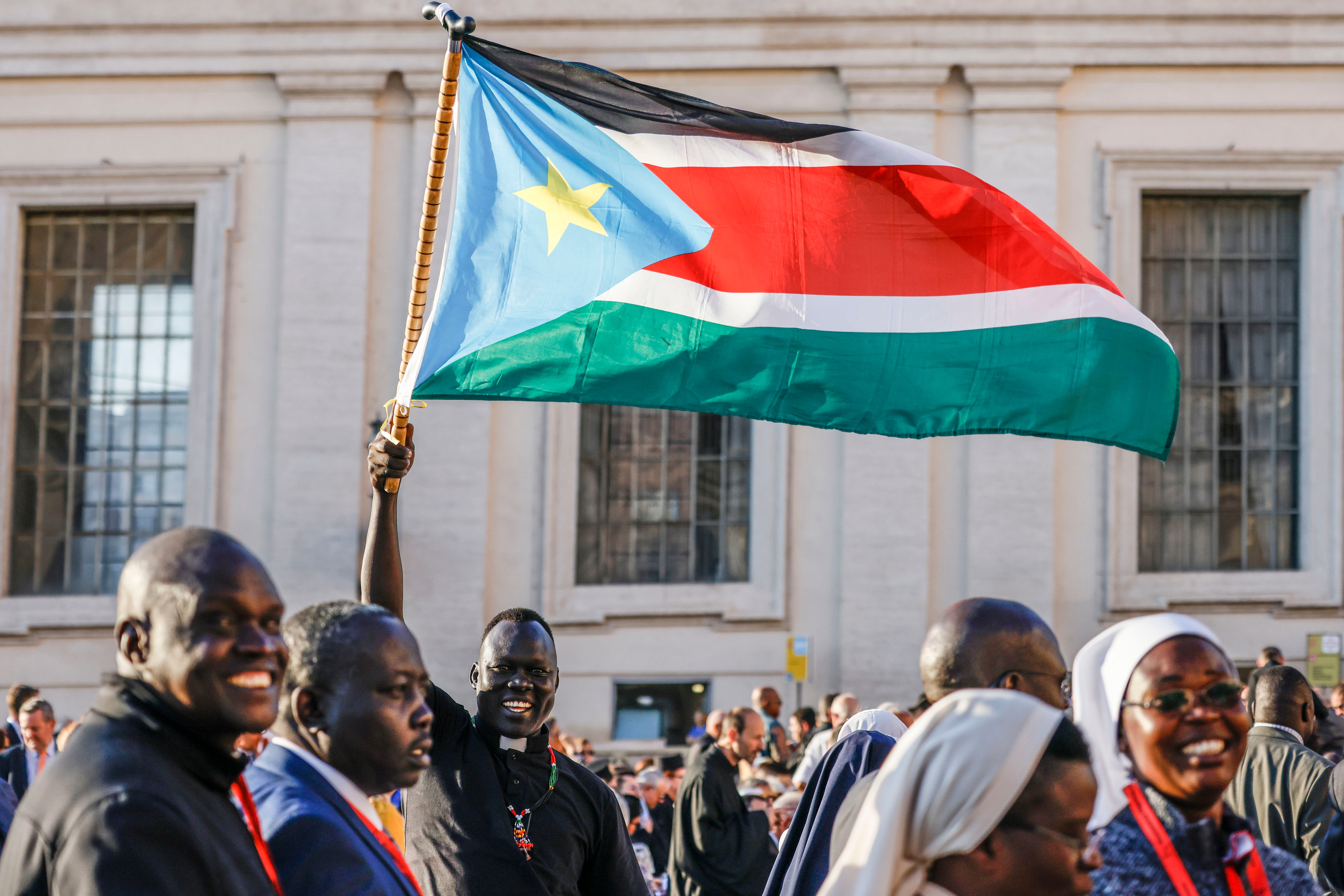
A priest waving a South Sudanese flag waits for the start of a consistory in St. Peter Square.
© Shutterstock
The Home Grown Peace Initiative for South Sudan (HGPI-SS) seeks to make peace inevitable, imminent, and possible by involving every South Sudanese citizen. Civil society organisations, ordinary people, the diaspora, and some political actors have come together in response to a clarion call issued by South Sudanese Democratic Engagement Monitoring and Observation Programme (SSuDEMOP) on behalf of the Technical Secretariat for HGPI-SS.
Founded in 2009, SSuDEMOP has been active in promoting democratic processes, conflict mitigation, and women-led coalitions in constitution-making. It advocates gender equality and consults widely with stakeholders on national issues.
At the core of South Sudan’s prolonged conflict lies immense human suffering and loss of life. Since independence in July 2011, the country has experienced continuous instability, beginning with ethnic clashes in Jonglei State and later escalating into full-scale conflict in 2012. Political negotiations and government-led interventions have struggled to secure lasting peace. HGPI-SS now aims to reclaim this process for the people themselves.
To understand how this new initiative intends to transform peacebuilding through civic leadership, I spoke with Lorna Merekaje, Secretary-General of SSuDEMOP and Head of the Technical Secretariat for HGPI-SS. Throughout her career, she has championed civic participation, from the IGAD-led peace negotiations in Addis Ababa (2014–2015) to the Citizen-Led Taskforce on COVID-19 in 2020.
Lorna, many peace efforts in South Sudan have failed to deliver lasting results. What makes the Home Grown Peace Initiative different, and why is civic engagement central to it? Is this just another campaign?
What makes HGPI-SS different is that it has been initiated by citizens from all walks of life. Regardless of our socio-economic background, political affiliation, ethnicity, or where we live, what unites us is that we are South Sudanese. We are saying: “Let us join hands and work together in unity to restore peace and stability in our beloved country.” This is peace that political actors, whether in Juba or abroad, have so far failed to deliver.
This initiative is led by citizens and faith-based leaders. How will this composition help overcome the barriers that undermined past peace processes?
From the outset, we asked faith-based leaders to guide us, and they have responded positively. Many have even joined citizens directly on our WhatsApp platform, which brings together South Sudanese volunteers for peace. Their humility in engaging with ordinary people in this way is deeply encouraging. It shows a willingness to build peace collectively, rather than dictate it from above.
Ordinary South Sudanese have experienced deep fatigue from failed ceasefires and broken promises. With HGPI-SS being homegrown, does this mean external actors such as regional bodies or international partners will not be involved?
This initiative is by the people and for the people. Past peace processes were largely initiated and driven by international bodies such as Intergovernmental Authority on Development (IGAD), who set the agenda and directed the process. While we appreciate their support, the unfortunate reality is that our political leaders often detached themselves from these agreements and treated implementation as though it were a favour to the international community, while excluding citizens. This time, the process is citizen-led. We will set the agenda and invite the international community to support us in ways that we determine.
SSuDEMOP has launched a campaign to gather support and e-signatures. How will you reach South Sudanese who lack internet access or are not active on social media?
HGPI-SS recognises that every citizen has a role to play in achieving peace. We therefore use a multi-faceted approach to communication. Alongside social media, we are working through radio broadcasts, word-of-mouth networks, and faith institutions such as churches. Volunteers are also spreading the message in their own communities, ensuring that even those offline are included.
What lessons from past initiatives are informing HGPI-SS?
One of the most important lessons is the power of volunteers. With the Citizens’ Taskforce on COVID-19, we saw how citizens could turn ideas into reality. It became clear that ordinary people are not the ones driving division, negative narratives imposed by political actors are. That is why one of HGPI-SS’s core principles is “Do No Harm”. Volunteers remind us that when citizens lead, progress is possible.
Ethnic divisions and tribalism have fuelled much of South Sudan’s conflict. Can peace become the unifying factor that strengthens social cohesion?
Yes. Peace, coupled with access to accurate information about our rights and how destructive illegitimate politics can be, is the only option for us. Education and awareness will be central to the process, helping people to see that unity is possible.
Armed forces have often been central to the conflict. How will they be engaged in this process, and is peace truly the ultimate victory sought?
The armed forces are part of society too. They know the devastating consequences of violence. We believe that, in time, all South Sudanese will embrace the principle of non-violence, which lies at the heart of HGPI-SS. True peace will always be the ultimate victory.
Is peace really possible? Can HGPI-SS deliver the hope South Sudanese have longed for?
We believe peace is possible, and we are optimistic that HGPI-SS offers the best path forward for our country.
The recent arrest of Vice-President Riek Machar has raised tensions. How does this affect peace efforts, and can civil society still prevail?
The arrest has caused anxiety and risks worsening the fragile situation. It could derail the Revitalised Agreement on the Resolution of the Conflict in South Sudan (R-ARCSS). HGPI-SS and civil society continue to insist on dialogue, because our history has been defined by conflict and atrocities in which all sides have been involved. Dialogue is the best remedy, while the Hybrid Court mandated by the R-ARCSS must be established urgently. Ignoring such agreements sets a dangerous precedent. Our guiding principle remains Do No Harm.
Interview by: Masechaba Masemola waMdaka, Regional Programme Officer, FNF sub-Saharan Africa