Ambassadors of Freedom
Germany’s Niklas Wagner on liberalism, youth activism, and South Africa’s lasting impact

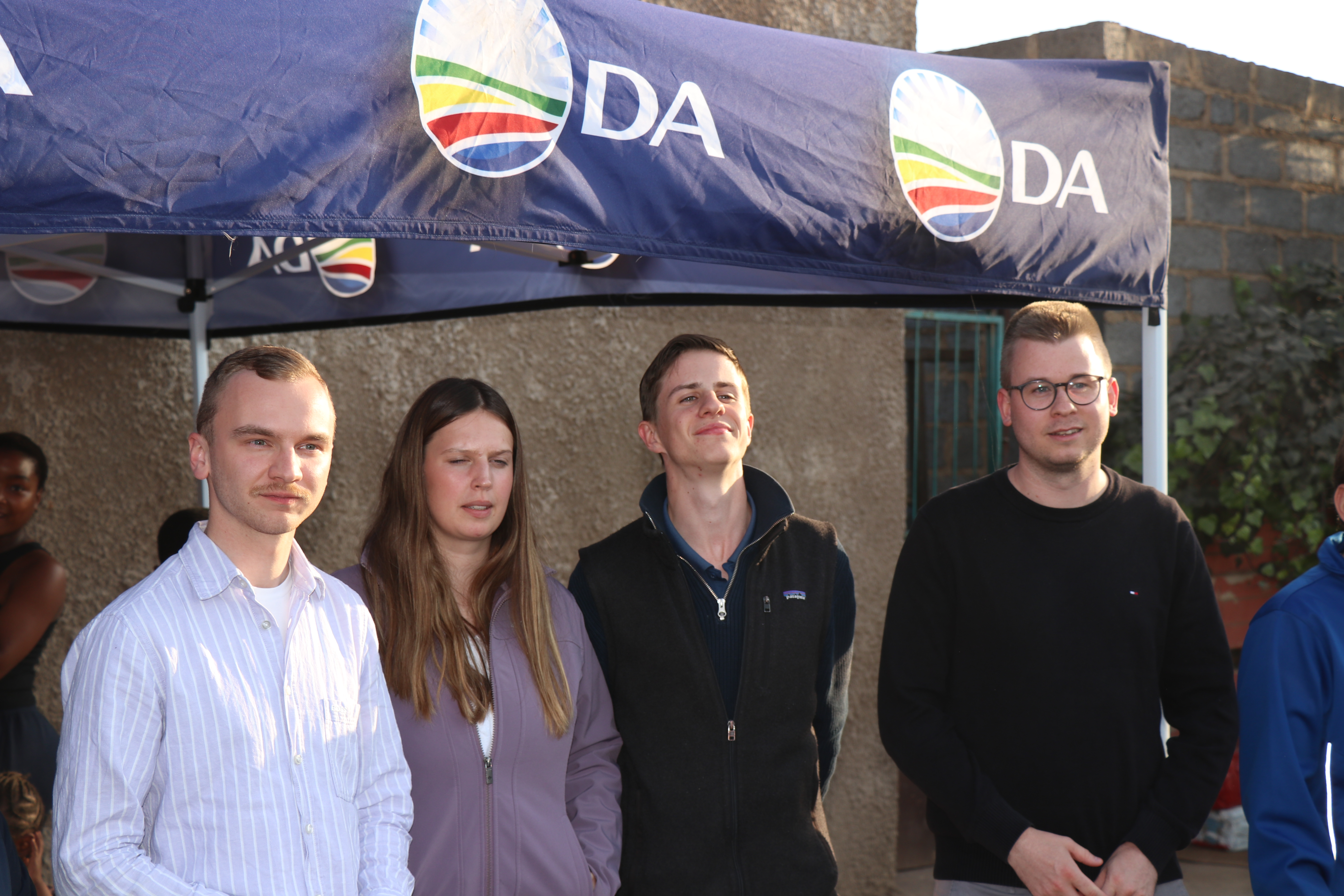
The Junge Liberale JuLis join DA GPL in Tembisa, east of Johannesburg for 67 minutes of service, honouring Mandela Day on 18 July 2025
© Friedrich Naumann Foundation for FreedomIn an era marked by democratic uncertainty and shifting political landscapes, fostering connections between young liberal leaders across continents has never been more vital. It’s this belief that brought the Friedrich Naumann Foundation for Freedom’s South Africa office together with the Junge Liberale (JuLis), the youth wing of Germany’s Free Democratic Party (FDP), for a unique international exchange.
As part of a recent study tour hosted by the Foundation, four young JuLis travelled to South Africa to engage with local political youth leaders, particularly from the Democratic Alliance Youth and the Democratic Alliance Student Organisation (DASO). Through workshops, debates and collaborative sessions, the programme explored the challenges and opportunities facing liberal democracies and aimed to strengthen a global network of young changemakers.
Among the delegation was Niklas Wagner, a 23-year-old member of the JuLis Federal Executive Board, responsible for press and public relations. Wagner is currently completing a Master’s degree in Business Administration at the University of Greifswald and is widely regarded as one of Germany’s rising liberal voices. His own political journey, shaped by childhood in former East Germany and early engagement in local youth councils, has been deeply influenced by liberal values and the drive to promote freedom across borders.
Following his time in Johannesburg, we spoke with Wagner about what drew him to liberal politics, how the South African experience reshaped his views, and why international solidarity is essential for the future of youth activism.

The Julis pose with Democratic Alliance Gauteng members in the east of Johannesburg on Mandela Day, 18 July 2025.
© Friedrich Naumann Foundation for Freedom
The Julis engaging with the Democractic Alliance and the Tembisa community in Johannesburg.
© Friedrich Naumann Foundation for Freedom
Niklas Wagner (right) and Mats-Ole Maretzke walking in the Ekurhuleni, east of Johannesburg followed by Democratic Alliance Gauteng members.
© Friedrich Naumann Foundation for Freedom
Niklas Wagner (left) and Mats-Ole Maretzke are hugged by a local community member in Tembisa, Johannesburg.
© Friedrich Naumann Foundation for Freedom
The Julis meet with Federal Chairperson of the Democratic Alliance, Helen Zille at Nkululeko House in Johanneburg.
© Friedrich Naumann Foundation for Freedom
Julis meet with Democratic Alliance Gauteng and DA Youth at Nkululeko House in Johannesburg.
© Friedrich Naumann Foundation for Freedom
Democractic Alliance Gauteng Leader, Solly Msimanga addresses virtually the Julis and DA Youth.
© Friedrich Naumann Foundation for Freedom
Julis meet with the FNF Africa regional team in Johannesburg
© Friedrich Naumann Foundation for Freedom
Niklas Wagner (right) with fellow Julis at the Friedrich Naumann Foundation for Freedom's Sub-Saharan Africa regional office in Johannesburg.
© Friedrich Naumann Foundation for Freedom
Niklas Wagner speaks with a colleague at the Friedrich Naumann Foundation for Freedom's Sub-Saharan Africa regional office in Johannesburg.
© Friedrich Naumann Foundation for FreedomWhat drew you to take part in the Friedrich Naumann Foundation’s youth exchange visit to South Africa?
My interest in South Africa actually began before the trip. A few years ago, I took part in a seminar hosted by the Media Academy of the Scholarship Foundation, where I met a fellow scholar who had lived in South Africa. They spoke with such passion about the country’s complex political landscape and its impressive levels of press freedom, a rarity on the continent. That conversation stuck with me. So when the opportunity arose to visit South Africa with the Friedrich Naumann Foundation and fellow JuLis, I knew it would be a chance to deepen that curiosity and connect with liberal-minded peers facing different, yet familiar challenges.
What were your expectations coming to South Africa, and how did reality compare?
I came without rigid expectations. I was mostly curious about how a young democracy is navigating today’s global challenges. What I found were strong parallels to East Germany, the ambition to move forward despite historical and structural obstacles. What impressed me most was the professionalism and resilience I saw in South Africa’s political youth. There’s a sense of urgency and determination that left a lasting impression.
During your visit, you engaged with the DA Youth and DASO. What stood out to you about their approach to politics?
Young people everywhere share a desire to shape their futures, that’s a powerful common thread. What stood out to me in South Africa was how grounded politics is in daily life. There’s a strong spirit of engagement, even if the institutional channels are more fragmented or harder to access than in Germany. But the passion, drive, and commitment to liberal values were inspiring. It reminded me that meaningful political work doesn’t always begin in parliament, it often starts in communities.
Is there a lesson or strategy from South Africa’s political youth that you’d like to share with your JuLis colleagues in Germany?
Absolutely. In Germany, we tend to approach issues through data, reports, and polling. That’s important, of course. But what I saw in South Africa was the value of personal engagement, of being present in communities, listening directly to people’s experiences, and understanding the human side of politics. That’s something we should take to heart and practise more deliberately.
In what ways do you think international liberal youth partnerships, like this one, can respond to the challenges facing liberal democracies today?
They play a crucial role. Liberalism depends on openness, across borders, cultures, and ideas. Today’s geopolitical climate can feel isolating, and media narratives often overlook the everyday victories and struggles of fellow liberals elsewhere. Exchanges like this tour show that we don’t always have to reinvent the wheel. We can learn from each other, adapt ideas to our own contexts, and build a shared sense of purpose. That’s how liberalism stays relevant, and practical.
Let’s step back a bit. Growing up in East Germany, what shaped your political worldview?
People in my hometown often carry a conflicted relationship with politics. The legacy of a planned, unfree state still lingers. In my family, politics wasn’t something we ever spoke about. That silence, that absence, became a motivation. I didn’t want to live in a world where political expression could be repressed. That’s what ultimately drew me to liberal politics.
What inspired you to join Junge Liberale and become active in youth politics?
There wasn’t a single turning point, it was more of a process. The 2019 European elections were the first I could vote in, and I took the time to really understand the parties’ values. I connected most with the FDP’s principles. But simply voting didn’t feel like enough. I wanted to contribute. That’s when I joined the JuLis and got involved with Greifswald’s Youth Advisory Council.
The German liberal movement has had its challenges. What lessons might resonate with young South African liberals facing their own uphill battles?
We’re still processing some of our recent electoral setbacks. One clear lesson is that liberal politics must remain credible and future-oriented. At times, we’ve strayed too far from our core values in pursuit of short-term gains. To any young activist, I’d say: be honest, stay optimistic, and hold firm to your convictions. That’s how you build lasting credibility.
What’s your broader vision for how young liberals around the world can work together more effectively?
We need to show, not just say, that freedom brings opportunity. For young people, that means the freedom to travel, study, build businesses, and live authentically. We should be tearing down barriers, not creating new ones. Liberalism has the tools to do that, but only if we become true ambassadors of freedom, not just in our speeches, but in our actions.
In a time when liberal democracies face growing pressure, relationships like the one forged between German and South African youth leaders are more than symbolic. They are essential. They offer a chance to share lessons, amplify values, and co-create solutions in a globalised world.
As Wagner returns to Germany, he does so not only with a deeper understanding of South Africa, but with a renewed belief in the power of solidarity, dialogue, and liberal cooperation across continents. In his words: “It’s not about exporting solutions. It’s about learning together, and becoming stronger, together.”