United Nations
On the United Nations' 80th Birthday


General Assembly Hall at UN Headquarters.
© UN Photo/Manuel EliasEighty years ago, a new world order was created. Fifty-one Heads of State and Government made a decision. Henceforth, peace was to be prioritized over war, and international law was to prevail over lawlessness. International relations were to be characterized by cooperation rather than confrontation.
Prohibition on the Use of Force
The founding of the United Nations was a direct response to the crimes of the Second World War. Aggression was to be definitively banned as a means of interaction between states. "Never again" quickly became a political demand. The atrocities of the Second World War were not to be repeated. This is enshrined in the Prohibition on the Use of Force in Article 2, the centrepiece of the UN Charter, which entered into force on October 24, 1945.
The World of 1945
The crimes and suffering of millions of victims of two world wars shaped the world in 1945. It was marked by colonialism, inequality, and racial discrimination. Over the decades, the UN offered many countries a platform to make their voices heard. It has always been an opportunity—especially for smaller countries. "One country, one vote" remains the fair voting principle in the General Assembly to this day.
Conversely, the Security Council, with its five permanent members and their veto power, is a long-outdated relic of the past. Due precisely to the deadlock in the Security Council, the United Nations has been unable to prevent wars in its 80-year history that have caused crimes against humanity and genocide.
Terrorism and humanitarian crises have led to migration and forced displacement worldwide. Millions of people still live stateless in refugee camps today, without the prospect of ever leading a different life.
It is easy to solely blame the world organization for not having intervened in time to stop armed conflicts, suffering, and terror. When, in fact, it is always the political will of individuals to issue orders for annihilation, displacement, and destruction.
The UN Charter turns 80 - A Reminder of a Vision
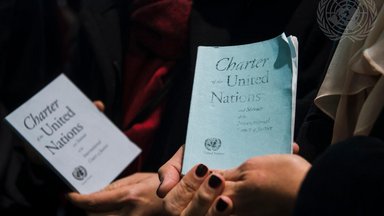
On June 26, 1945, the UN Charter was signed by 51 states.
Eighty years later, 193 nations have committed themselves to its international legal obligations. The Charter's foundational ideas, however, seem to have drifted far from present-day realities. A timely reminder.
Achievements of the United Nations
Throughout its history, the United Nations has prevented wars. However, wars and armed conflicts are listed and researched in statistics, while those that were prevented are not. Thus, it is difficult to point to a success statistics on this eightieth birthday of the United Nations.
Yet, numerous achievements can be demonstrated with regard to human rights. For example, a body of international law now exists, which enshrines the rights of women, children, indigenous peoples, persons with disabilities, and others globally. Instruments for monitoring human rights have been created. Countries must face questions from representatives of other countries and their own civil society in the UN Human Rights Council. The International Criminal Court was established and has institutionalized legal accountability for war crimes and crimes against humanity.
The World of Today
Today, the United Nations is at risk of financial instability and thus unable to fulfill the multitude of its functional tasks for the benefit of humanity. The situation is compounded by increasing polarization. Societies are divided, even in democratic countries.
Power dynamics have changed in a very short time. Individual Heads of State of powerful nations rely on confrontation instead of international cooperation. They, as well as the owners of technology companies, determine and shape world events. The latter have control over algorithms and thus influence access to information for people worldwide. Through the latest Artificial Intelligence tools, tech companies collect the most private details of users, which harbors the danger of the "transparent citizen" and is a gateway to a lack of freedom. Liberal democracies are in great danger of gradually disappearing entirely.
Yet, they are a successful political model for a life of freedom in an open society. Liberal democracies are the guarantors of peace, security, and human rights. These elementary goals and values of the UN Charter are as valid today as they were 80 years ago. They cannot be defended solely through rearmament and securing borders.
Gen Z Survey: Committed to Human Rights, Worried about Democracy
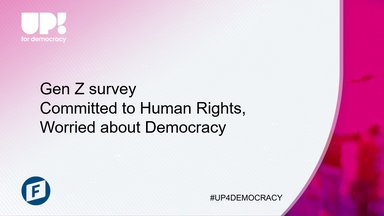
What does Gen Z associate with the topic of human rights? Are they satisfied with the state of democracy? The transatlantic survey conducted by the Human Rights Hub of the Friedrich Naumann Foundation in Geneva on the occasion of Human Rights Day provides answers.
Hope in Gen Z
There is hope. Today's youth have recognized the values of the UN Charter for peaceful coexistence. Generation Z is protesting in the streets worldwide: in Nepal, Indonesia, the Philippines, Madagascar, and Serbia. A generation is demanding freedom of expression, security, and access to free elections, education, and work.
To this day, October 24 is celebrated as United Nations Day. A symbol for peaceful coexistence.
The responsibility for the UN Charter rests primarily with Heads of State and Government representatives. Yet all of us must remember its values and goals and fight for them. We bear the responsibility for our coexistence today and towards future generations.