Asia
“Freedom is borderless”


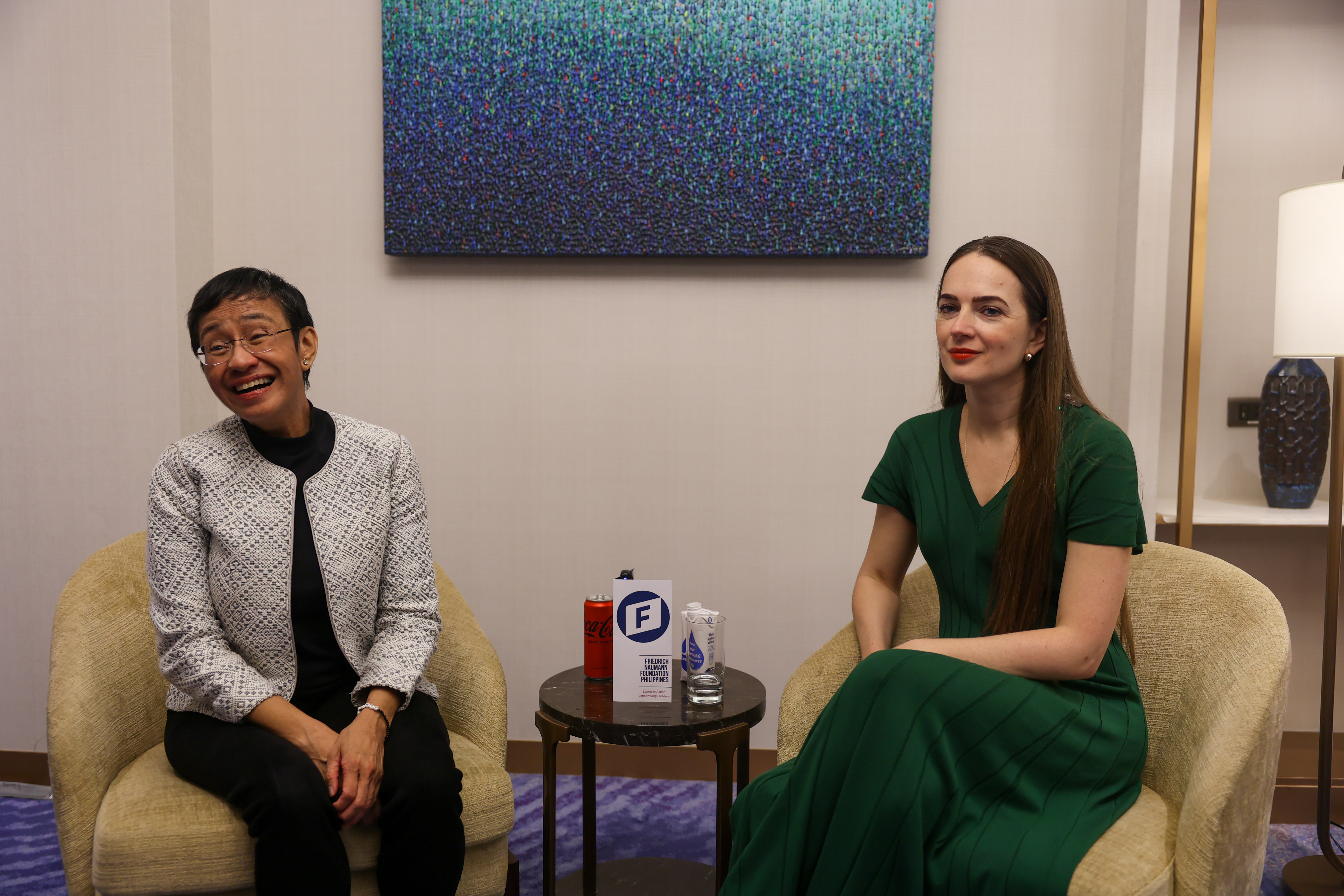
Maria Ressa and Oleksandra Matviichuk in FNF interview
© Friedrich Naumann Foundation for FreedomDuring her visits to the Philippines, Taiwan and Thailand, Oleksandra Matviichuk, the Ukrainian human rights lawyer and 2022 Nobel Peace Prize laureate, delivered a message she believes lies at the heart of her country’s resistance to Russia’s invasion: freedom, she said, belongs to no single nation.
“Freedom doesn’t have national borders,” she said in an exclusive interview with the Friedrich Naumann Foundation for Freedom during her visit. “Your fight is our fight because you’re fighting for something which has no limitation and national borders.”
Matviichuk, who heads the Center for Civil Liberties recognized for documenting war crimes, abuse of power and human rights abuses, has emerged as one of Ukraine’s most prominent voices abroad. Throughout her trip, she emphasized what she calls the “extraordinary power of ordinary people,” crediting Ukraine’s resilience to citizens who refused to accept that their individual efforts were insignificant.
At Rappler’s Social Good Summit in Manila on November 16, she underscored that point. “It’s this belief of ordinary people that their efforts matter,” she told the audience, arguing that civic determination has been essential for Ukraine’s survival under nearly three years of full-scale war. “When you can’t rely on the legal instruments, you can still rely on people. We get used to thinking though the categories of states and interstate organizations, but ordinary people have a much greater impact than they can even imagine.”
Her message carried particular weight in Taiwan, where concerns about Chinese military pressure have intensified debate on national defense, international alliance and democratic resilience. Speaking at an event on the resilience of democracy in Taipei on November 19, Matviichuk encouraged Taiwanese citizens to recognize their agency in shaping the country’s future. “The future is not unclear or pre-written,” she said. “This means that we have a chance to fight for our future.”

Ms. Matviichuk with Vice President of Taiwan Bi-khim Hsiao (third from right).
© Presidential Office TaiwanMatviichuk, accompanied by Moritz Kleine-Brockhoff, Regional Director of the foundation’s Southeast and East Asia office, also met with Taiwan’s vice president, Bi-khim Hsiao, who praised her long-standing efforts to safeguard human rights and drew parallels between the threats facing Taiwan and Ukraine. Democracies, Hsiao said, “should assist one another to jointly strengthen the power to resist aggression.”
The Ukrainian activist, in turn, expressed respect for Taiwan’s readiness and resolve, comparing it to Ukraine’s own culture of civic mobilization. She commended the “perseverance, courage and tenacity” of the Taiwanese people, stressing that democratic societies must work together as they confront rising authoritarianism around the world.
In her remarks throughout her visits, Matviichuk repeatedly warned against complacency. Freedom, she said, can no longer be viewed as a given. It demands active protection from each generation if it is to be preserved for the next.
Photos of Matviichuk's trip to the Philippines, Taiwan and Thailand

Oleksandra Matviichuk at the panel on War against Ukraine at ISIS Thailand
© Friedrich Naumann Foundation for Freedom
Oleksandra Matviichuk speaking at FCCT Club of Thailand
© Friedrich Naumann Foundation for Freedom
FCCT Club of Thailand on November 21 2025
© Friedrich Naumann Foundation for Freedom
Oleksandra Matviichuk, Maria Ressa, Thekla Ebbert and FNF Philippines
© Friedrich Naumann Foundation for Freedom
Public Forum: Panelists for Ukraine and Taiwan Experience Sharing
© Friedrich Naumann Foundation for Freedom
Group Picture at Rappler's Social Good Summit in the Philippines
© Friedrich Naumann Foundation for Freedom
FNF Global Innovation Hub and Panelists
© Friedrich Naumann Foundation for Freedom
Matviichuk speaking at Rappler's Social Good Summit in the Philippines
© Friedrich Naumann Foundation for Freedom
Ms. Matviichuk with Minister of Foreign Affairs Taiwan, Lin Chia-lung (center).
© MOFA Taiwan
Oleksandra Matviichuk speaking at the panel in Taipei
© Friedrich Naumann Foundation for Freedom Taiwan
Moritz Kleine-Brockhoff Speaking at Public Forum: Ukraine and Taiwan Experiences - The Resilience of Democracy
© Friedrich Naumann Foundation for Freedom
Oleksandra Matviichuk meeting partners of FNF Thailand
© Friedrich Naumann Foundation for Freedom
Oleksandra Matviichuk, FNF Thailand, FNF Sotheast and East Asia and partners in Thailand
© Friedrich Naumann Foundation for Freedom
Jonathan Head moderating at FCCT Club of Thailand
© Friedrich Naumann Foundation for Freedom
Oleksandra Matviichuk delivering keynote at ISIS Thailand
© Friedrich Naumann Foundation for Freedom
Oleksandra Matviichuk and Leila de Lima at the panel on Duterte's Crime against Humanity
© Friedrich Naumann Foundation for Freedom
Senator Kiko Panginilan meeting Oleksandra Matviichuk in the Philippines
© Friedrich Naumann Foundation for FreedomWatch an exclusive interview with Maria Ressa and Oleksandra Matviichuk.
At the Foreign Correspondents’ Club of Thailand, she spoke with journalists about how the war in Ukraine could shape the emerging global order. Accountability, she stressed, must be nonnegotiable. “Justice is a human right, and injustice is not a privilege,” she said, warning that without consequences for aggression, major powers may believe they can act with impunity.
Matviichuk also addressed Southeast Asia’s guiding principle of non-interference, noting the region’s reluctance to take strong positions on the war in Ukraine. At a public event hosted by the Institute of Security and International Studies (ISIS) at Chulalongkorn University, she offered a sharp clarification: “Non-interference is not non-indifference.” Modern warfare, she said, extends far beyond physical borders, encompassing disinformation and the manipulation of truth, tactics she accused Russia of deploying globally.
In meetings with partners in Thailand on Nov. 22, she shared her technical expertise in documenting crimes against humanity and war crimes. “I am documenting not just evidence, but human pain,” she said. “When the war is over, these records will tell the truth of what happened.”
Across Asia, Matviichuk’s call resonated with audiences struggling with democratic pressure, geopolitical uncertainty and the vulnerabilities of open societies. Her message, simple, urgent, and insistent, is that the defense of freedom is a shared responsibility, wherever the threat may appear. “Freedom is borderless. So is human solidarity.” And with that, she urged societies across the region to stand together against injustice and impunity wherever they arise.
*Hnin Wint Naing is the Regional Communication Officer of the Southeast and East Asia Office of the Friedrich Naumann Foundation for Freedom. Yawei Chou is the Program Manager of Global Innovation Hub in Taipei.
Media Coverage:
https://www.rti.org.tw/news?uid=3&pid=176256
https://www.president.gov.tw/News/39631
https://www.cna.com.tw/news/aipl/202511190197.aspx
https://udn.com/news/story/7314/9149833
https://news.ltn.com.tw/news/politics/breakingnews/5251235
https://www.cna.com.tw/news/aipl/202511190382.aspx
https://news.ltn.com.tw/news/politics/breakingnews/5251977
https://focustaiwan.tw/politics/202511200010
https://www.taipeitimes.com/News/taiwan/archives/2025/11/21/2003847585
https://www.rti.org.tw/de/news?uid=3&pid=176580 https://www.rti.org.tw/de/news?uid=3&pid=176351
https://www.rappler.com/video/hold-the-line-maria-ressa-interview/interview-oleksandra-matviichuk-ukraine-freedom
https://www.rappler.com/moveph/social-good-summit/keep-communities-alive-breakout-session-2025/
https://www.bangkokpost.com/world/3142671/down-to-brutal-basics-in-wartorn-ukraine
https://www.youtube.com/watch?v=Sy1-RFCcSy8
https://www.channelnewsasia.com/watch/nobel-peace-prize-winner-oleksand…