PHILIPPINES
“The Ukraine War, its Solution and Their Implications for the Philippines” – A Panel Discussion

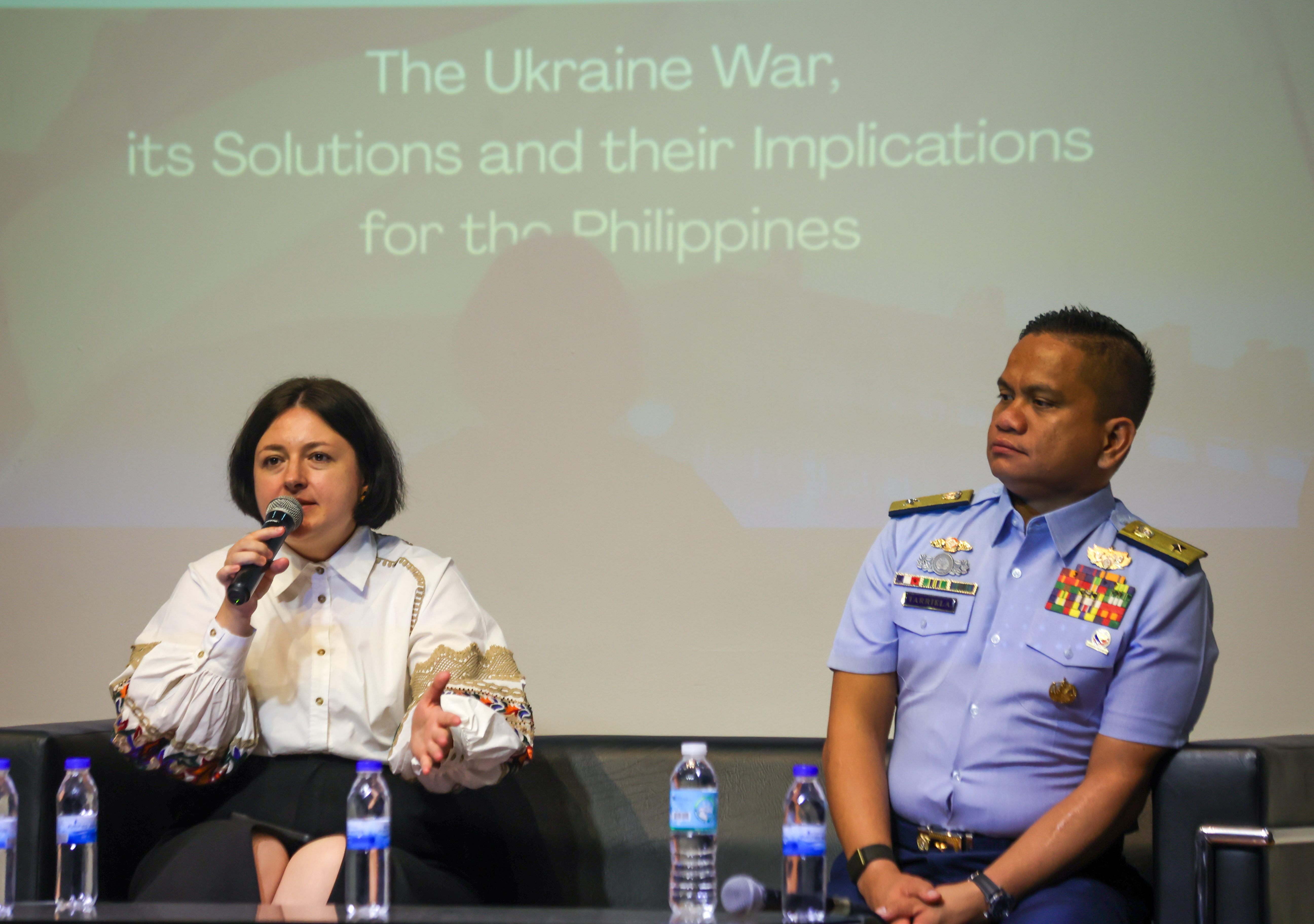
Yulia Fediiv, Ambassador of Ukraine to the Philippines and Commodore Jay Tristan Tarriela, Spokesperson for the West Philippine Sea of the Philippine Coast Guard during the event's panel discussion.
The event “The Ukraine War, its Solution and Their Implications for the Philippines – A Panel Discussion” was organized by the Friedrich-Naumann-Foundation Philippines on 29 August 2025 at the University of Santo Tomas in Manila. The panel featured Her Excellency Yulia Fediiv, Ambassador of Ukraine to the Philippines; Commodore Jay Tristan Tarriela, Spokesperson for the West Philippine Sea of the Philippine Coast Guard; and Professor Dennis Coronacion, Chair of the Department of Political Science at the University of Santo Tomas.
It was attended by about 175 participants and aims to to help young Filipino students interested in international relations and national politics understand how a war in Europe can affect a distant nation in Asia and how resolving such a war could influence both the Philippines and the conflict in the West Philippine Sea.

Resource persons, organizers, facilitators, and attendees posed for a photo after the successful panel discussion.
© USTIntroduction: The War in Ukraine
The ongoing war in Ukraine began in 2014 when Russia´s illegal annexation of Crimea and escalated in February 2022, when Russia launched its full-scale invasion of Ukraine. This attack on a sovereign state constituted a serious violation of international law and tremendously disrupted global economy. Consequently, not only European nations, which condemned Russia´s action, but also nations that seem geographically distant, such as the Philippines, have likewise been politically, socially and economically affected. Furthermore, any prospective solution of the Ukraine War will have significant implications for the island nation in today´s interconnected world.
This article examines the impact of both the war in Ukraine and its potential solution on the Philippines while also considering the West Philippine Sea dispute. It highlights the parallels between Ukraine and the Philippines both facing major-power aggressors and violations on their sovereignty and place these challenges within a broader global context.
Impact on the Philippines: political, social and economic
The full-scale Russian invasion of Ukraine in 2022 has highlighted the growing weakness of the United Nations and international law in today´s increasingly unstable world. In this world where global norms and rules are being disregarded, major powers such as the United States, Russia and China tend to dictate global affairs according to their own interests. It seems that, in this unstable environment, states with greater military and economic power dominate smaller and middle-power states.
China, in particular, has been preparing for a potential attack on Taiwan for years. With this background, it has expanded its presence in the South China Sea, also claiming territories in the West Philippine Sea. It is located within the larger South China Sea and belongs to the Philippines exclusive economic zone of 200-nautical-miles (EEZ). These efforts are primarily aimed at securing control over major trade routes, and secondary, the world´s richest fishing grounds and a potentially significant source of untapped oil and gas. Despite having no legal basis, China continues to insist on its so-called “Nine-Dash Line” claim, while simultaneously not constructing but also extending its naval facilities on artificial islands in the West Philippine Sea.
In 2016, the Philippines brought this case before the Permanent Court of Arbitration in The Hague, which ruled that China´s claims are violating the United Nations Convention on the Law of the Sea (UNCLOS). However, Beijing has been rejecting the decision, refusing to accept international law and global norms. Since then, the Philippines has implemented several political measures and initiatives in order to defend its sovereignty and safeguard its maritime territories in the West Philippine Sea.
From a social perspective, the dispute has raised public awareness of foreign policy and the understanding of international law. While a significant portion of Philippine society remains disengaged from politics, there has been a growing recognition of the importance of sovereignty issues, particularly among those communities directly affected by Chinese aggression, such as fishermen.
Economically, the Philippines has faced serious challenges. The country heavily reliant on fuel imports, was hit hard by rising global energy prices caused both by the sanctions on Russia and limited global supply. Before the Ukraine War, Russia was the Philippines´ third-largest oil supplier. Following Russia´s invasion, however, the government condemned Moscow´s actions, aligned itself with the international community in support of Ukraine´s sovereignty, and ceased oil imports from Russia. Consequently, the island nation has been facing high inflation, driven by higher production costs, elevated retail prices and increased living expenses for households in recent years.
Impact of a Solution on the Philippines: Best- and Worst-Case Scenarios
The impact of a potential solution of the war in Ukraine on the Philippines might be different depending on a Best- and Worst-Case scenario. In both cases, the Philippines´ economy would first of all benefit from a recovery in global markets, leading to more stable energy prices and reduced inflation.
From the political and social perspective, a best-case scenario where the Ukraine’s sovereignty is preserved and international law reaffirmed, China would be warned and the Philippines´ position in this maritime dispute be strengthened reinforcing its calls for respect of the 2016 UNCLOS ruling.
In contrast to that, a worst-case scenario in which the aggressor, Russia, is rewarded for the violation of international law, China would feel even more welcome to pursue its own expansionist claims in the West Philippine Sea, undermining the Philippines´ territorial rights and sovereignty. Moreover, the solution of the Ukraine War could reshape global geopolitics. As Europe becomes more capable of defending itself, the United States is likely to shift their strategic focus toward the Indo-Pacific. That potential geostrategic shift could strengthen security partnerships while simultaneously intensifying tensions in the West Philippine Sea and pull the country more directly into the escalating rivalry between the U.S. and China.
All these political developments will shape public sentiment within the Philippines ‘society, particularly the relevance and effectiveness of international law in protecting national sovereignty and ensuring the security of Philippine people.

Map showing the area in the South China Sea which roughly correspond to the "West Philippine Sea"
© Wikimedia CommonsThe West Philippine Sea: Disputed?
“Is the West Philippine Sea disputed?”- Commodore Tarriela asks a group of students. “I don´t know…, maybe…, yes…, surely yes…” the students reply.
The commodore clearly states that: “The West Philippine Sea is not disputed, because it belongs to the Philippines!”
This exchange shows how limited public awareness of the issue remains. When asked where the West Philippine Sea is located, many students could not even answer. So, how can the Philippines defend its own territories and sovereignty, if its own citizens are not even aware of what they are supposed to defend?
More than year ago, Secretary of National Defense Gilberto Teodoro announced a defense concept for the Philippines, called the “Comprehensive Archipelagic Defense Concept (CADC). It notes that as an archipelagic country, the Philippines´land mass is limited while the population is increasing. As a result, the nation needs resources to expand exponentially. Since the early 21st century, the Philippine governments have been surveying and planning to exploit the natural gas and oil deposits in the West Philippine Sea inside its EEZ. Unfortunately, according to Secretary Teodoro:
“The country’s resources in its maritime territory are illegally and unilaterally encroached upon by China using a distorted ten-dash line, which nobody in the world accepts or recognizes since this would open up a rewriting of international law.”
For more than a decade, China has expanded its dominance in the South China Sea by constructing artificial islands and miliatry feature outside its legal territory. This has created conflicts not only with the Philippines but also with Vietnam, Indonesia, Malaysia and Brunei, all of which have overlapping claims in the South China Sea.
For years, the Philippines has been silent and remained passive on China´s expansion in the West Philippine Sea. It was President Benigno “Noynoy” Aquino (2010-2016) who changed this foreign policy drastically, taking a stronger stance filing an international arbitration case against China.
But, it was President Rodrigo Duterte (2016-2022) who downgraded the Philippines´partnership with its oldest partner, the United States, and pursued close ties to China and Russia. However, in his last year in office he shifted back toward a limited balancing policy when China failed to deliver its promises and expanded its naval presence in the West Philippine Sea. So, the violation of the Philippines teritorial rights didn’t decrease when President Duterte was president, showcasing that his foreign policy shift just weakened the Philippines position.
In contrast, President Ferdinand “Bongbong” Marcos Jr., in office since 2022, has revived close alignment with the United States and welcomed an increased U.S. military presence. Additionally, he has deepened Philippines´ties with like-minded nations such as Japan, Australia, India and Germany in order to strengthen deterrence against China. Over the past year, the government has also pursued an “assertive transparency strategy” by proactively publicizing incidents with China, inviting media coverage and releasing evidence that is then amplified through strategic communications. This approach didn’t only raised awareness within Philippine society but has also drawn international attention to Chinese actions which disrupt peace and violate international law. Particularly, in March 2025 the G7 countries condmned China´s actions to change the status quo, harassing philippine vessels, and reaffirmed their full support for the UNCLOS. At the same time, however, increased publicity has fueled disinformation campaigns which often echo Beijing’s narrative that Manila is responsible for escalation.
Maritime incidents in the West Philippine Sea between Philippine and Chinese vessels have doubled since President Marcos Jr. came into office in 2022. That indicates that the foreign policy shift from the Duterte to the Marcos Jr. administration, openly resisting Chinese provocations, has stengthend Manila´s position in the dispute, but also increased the risk of escalation.
China continues to provocate by ramming and blocking Philippine vessels, brandishing bladed weapons, swarming fishing boats, deploying its largest coast guard ship inside the Philippine EEZ, blocking resupply missions, leaving crews malnourished, aiming weapons systems at Philippine ships and releasing its new “ten-dash line” map which is an extended version of the pevious “nine-dash line”. These actions are testing the limits of the Philippine government´s tolerance and probing how far Manila might go in responding at the risk of an escalation.
At the same time, the Philippines has recently intensified cooperation and coordination within ASEAN, where countries such as Indonesia and Vietnam have tremendeously increased their defense spendings. Altough, ASEAN´s progress toward a Code of Conduct to commonly react on Chinese maritime aggression has been very slow due to the influence of closely Beijing-aligned states such as Laos or Cambodia, advances have been achieved in recent years. Recent summits and agreements indicate not just a shift in Asia’s security architecture but also the Philippines’ growing role within it. Bilateral partnerships, as those with Vietnamm show how essential alliances and partnerships are for middle-power nations facing and deterring aggressive behaviour from major-powers

Commodore Jay Tristan Tarriela, Spokesperson for the West Philippine Sea of the Philippine Coast Guard coversing with the students on the West Philippine Sea Disputes.
© USTKey Takeaways from the Panel Discussion
1. Global conflicts reach Manila’s shores
The Ukraine War and the tensions in the West Philippine Sea may seem geographically distant, but for the Philippines they are deeply linked. The war in Europe has shown how conflicts hit Manila’s economy through energy and food price shocks, while also influencing the availability of Western security resources. Meanwhile, the Philippines faces direct challenges in the West Philippine Sea, where Chinese pressure is testing maritime sovereignty and regional stability.
From a global perspective, the West Philippine Sea dispute seems to be a part of the broader U.S.-China rivalry, particularly in the context of a possible war over Taiwan. Military presence of the United States has already increased under current President Marcos Jr. and could grow even more if the Ukraine War is solved shifting Washington´s focus more to the Indo-Pacific. These dynamic and dependence on U.S. military support seem to drag the Philippines deeper into the major-power conflict.
However, it is interdependence rather than dependence which describes the relationship between these old partners the best. President Donald Trump even called the Philippines “the most prime piece of real estate from a military standpoint” highlighting its crucial strategic location as part of the “First Island Chain” that stretches from Japan through Taiwan and the Philippines to Borneo in order to complicate China´s access to the wider pacific. The United States currently dominating the Pacific remains determined to limit China´s naval expansion, a strategy shaped by lessons from the historic Japanese attack on Pearl Harbor in World War II.
2. The defense of international law is at stake.
The Philippines’ case before the Permanent Court of Arbitration in The Hague in 2016 was a landmark: The tribunal ruled that China’s “nine-dash line” had no legal basis and that its activities violated UNCLOS. Yet Beijing rejected the decision, refusing to accept international law and global norms. Today, we see a similar challenge in Europe, where Russia’s war in Ukraine openly violates international law. In both Europe and the Indo-Pacific, the test is the same: Whether smaller states can rely on international law against coercion. The Ukraine War’s outcome will shape the credibility of international norms and influence China’s future actions. A just resolution based on law strengthens Manila’s position, while rewarding aggression, rewarding Russia, undermines it, with serious global consequences also affecting the Philippines.
Commodore Tarriela warned in 2024: “Simply condemning China’s aggressive behavior through public statements may not be enough… The international community must explore alternative measures to compel China to adhere to international law.”
Given this background, possible measures could include sanctions or tarrifs against Beijing. From a global perspective, however, compelling major-powers to comply with international law requires a broader solution. The credibility of the old liberal world order has been severely shaken. The problem is that no state is willing to take the initiative to create a new world order which includes every state as it is. As a result, a vacuum of leadership, disorder and the absence of such a framework lead to global norms which are neglected.
In this environment of disorder, where international law is being violated by major powers, it is of even greater importance to defend international law. What would be the alternative? Its anarchy, chaos and even more disorder leading to escalating crises and wars. Both Ukraine and the Philippines remain committed and stand fully behind international law and are willing to uphold it. If these nations do not stand up, who else will?
3. Ukraine is a Wake-Up Call for the Philippines
The war in Ukraine serves as a wake-up call for the Philippines, demonstrating how territorial disputes can quickly escalate into a full-scale conflict. It also warns that silence and tolerance of aggression risk the loss of sovereign territory. The war in Ukraine did not begin in 2022 with Russia’s invasion, but in 2014 with the annexation of Crimea when the lack of response and tolerance of aggression allowed a sovereign nation to lose part of its land because the world feared escalation.
Ukraine provides evidence that negotiating with major-power nations and giving up territories in the hope of maintaining peace is an illusion only inviting to further aggression. The “Budapest Memorandum of 1994”, which guaranteed Ukraine´s security in exchange for giving up its nuclear weapons, evidently proves the dangers of trusting security assurances without credible deterrence and the distrust when negotiating with a major-power. Had Ukraine retained nuclear weapons, Russia might have been deterred from annexing Crimea in 2014 or launching its full-scale invasion in 2022. Therefore, the lesson is clear: Smaller power must fight for their integrity, sovereignty and political independence when facing provocative, aggressive major-powers.
For the Philippines, this means to stop fearing China and, foremost, to be prepared politically, economically but also socially to resist pressure from China. It is better to be overprepared rather than to be unprepared. National unity and resilience can only be given, if the Philippine citizens are aware of what they are defending. The Ukraine War highlights the importance of public support and morale in order to resist the aggression. Patriotism, preparednes and a societal mindset on all levels that acknowledges the possibility of war will strengthen the Philippines position against China´s growign assertiveness.
The Philippines is not alone in this effort. The Philippines´ strategy of strengthening both regional alliances within ASEAN and external partnerships with like-minded states reinforce its overall deterrence. Alliances and partnerships not within the region but all over the world essentially help to defend international law and maintain peace through strength. Ukraine, Eastern European nations and the Philippines are facing similar struggles by defending sovereignty, building resilience and strengthen alliances. Because of these parallels, their dialogues and partnerships should intensify in order to learn from each other. Furthermore, the Philippine government should continue its “assertive transparency strategy” documenting and recording evidences of violations ofinternational law to win moral support and empathy from the international community.
At the same time, the Philippines is currently diversifying its economy in its energy, shipbuilding, IT and defense sectors to reduce its dependence from China and cooperate more closely with like-minded partners. With growth rates above 5% in the post-pandemic years from 2021-2023, the Philippines has been one of the fastest growing developed countries worldwide. Moreover, it is part of the world´s biggest freemarket zone which includes 15 states. The country is rich in natural resources and, in terms of gold, copper, nickel and chromium reserves, one of the world´s leading countries. Altough, the value of the country's untapped mineral resources was estimated at approximately US$840 billion in 2017 by the Philippine Mines and Geosciences Bureau (MGB), which would place the Philippines among the world's five largest resource-producing countries, mining´s share of GDP remains very low at 0,5% (as of the end of 2023). A sector which shows potential for the Philippines future economic growth.
Combined with the already strong post-pandemic economic rates, experts now see the Philippines as one of Asia’s most promising emerging markets. With this in mind, speaking from political and economic perspective the Philippines are currently on the path of becoming a regional power with a leading role, particularly within ASEAN strengthening its position when facing China.
4. External strength comes from internal stability.
On the one hand, corruption, associated social issues and poverty are factors which prevent a large part of the Philippine population from feeling genuinely represented and included in political decision -making. If people struggle daily to earn enough money to buy food and provide for their families, it is understandable that they have little or no motivation to pay attention to what is happening beyond their lives. These internal problems have to be solved in order to prepare society and the Philippine state as a whole to deter future provocations and aggression from China.
On the other hand, the peace process in Mindanao, which has ended decades of conflict between the Philippine government and the Moro Islamic Liberation Front, and the establishment of the Bangsamoro autonomous region mark a breakthrough after decades of conflict. The upcoming elections in October will reinforce this progress and internal stability. For years, the Philippine Armed Forces focused their attention and resources to domestic insurgencies in Mindanao and had not given any importance to maritime security. Now, with greater domestic stability, the Philippines has the momentum to focus on defending its seas.