International Relations
Security through Synergy: Analyzing the Philippine-German Defense Cooperation Agreement through the Lens of Liberalism

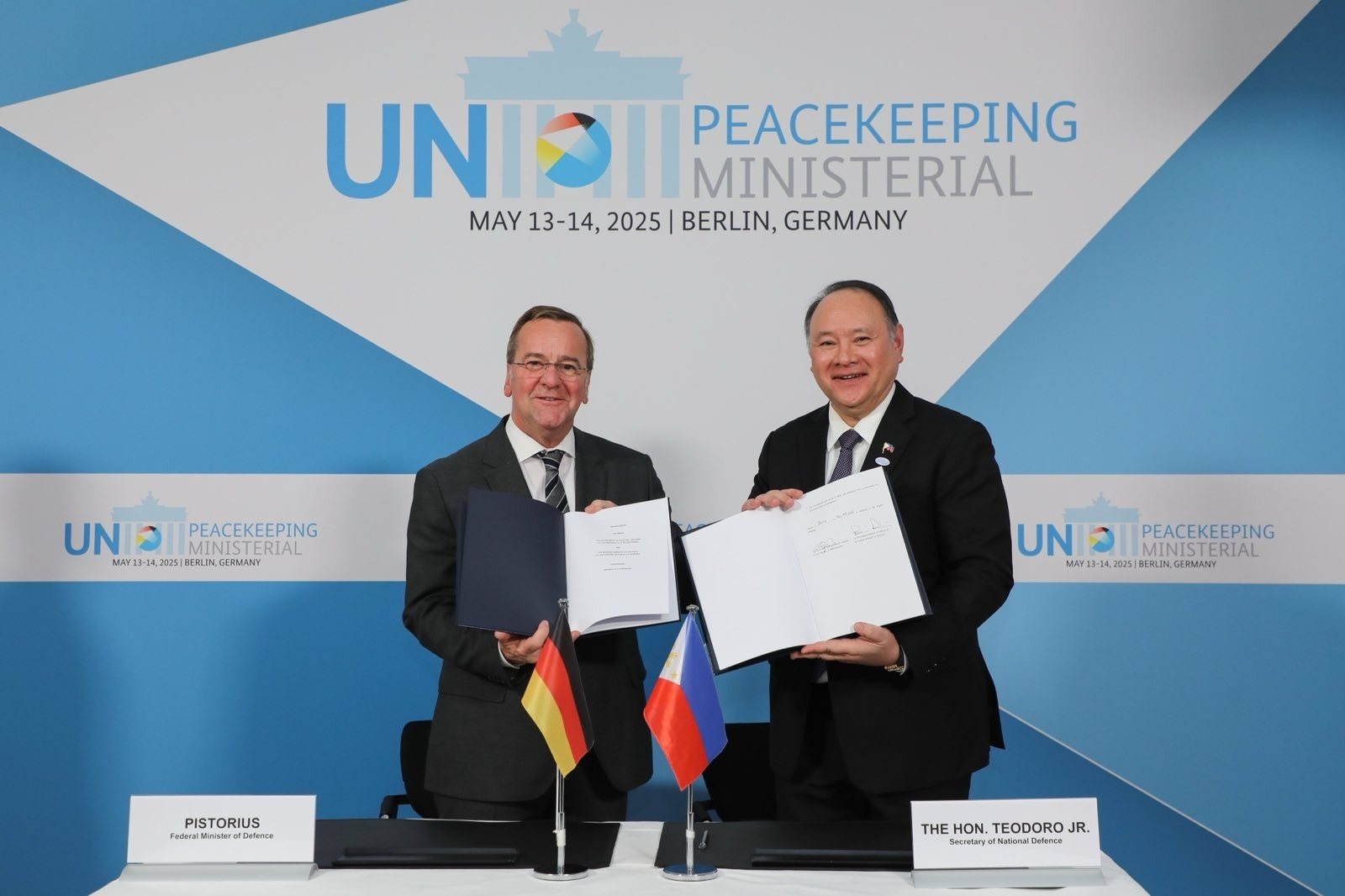
IN THE PHOTO: German Federal Defense Minister Boris Pistorius (left) and Philippine Department of National Defense Secretary Gilberto Teodoro Jr. (right) pose with the newly signed agreement
© Philippine Department of National DefenseOn May 14, 2025, the Republic of the Philippines and the Federal Republic of Germany entered an arrangement concerning cooperation to advance their bilateral relationship in the field of defense. To mark the momentous occasion, Philippine Department of National Defense Secretary Gilberto Teodoro Jr. and German Federal Defense Minister Boris Pistorius signed the pact in Berlin, Germany.
It builds on the 1974 Administrative Agreement concerning the Training of Armed Forces of the Philippines (AFP) personnel in Germany. In particular, it expands cooperation between the states’ defense and military establishments in the fields of cybersecurity, defense armaments, logistics, and United Nations (UN) peacekeeping.
The signing follows the celebration of significant milestones between the Philippines and Germany in 2024, including the 70th anniversary of the establishment of diplomatic relations and the visit of Defense Minister Pistorius to the Philippines, during which Secretary Teodoro and Minister Pistorius agreed to pursue an overarching framework to advance a bilateral defense partnership.
The Security Situation: The International, the Multilateral, and the Unconventional
The arrangement has been hailed as a part of a broader strategy of the Philippines to bolster its position amid renewed tensions in the longstanding South China Sea dispute.
This vital body of water has long been a flashpoint for territorial conflicts, with China claiming nearly the entire sea despite overlapping claims by Brunei, Malaysia, Vietnam, and the Philippines. In 2016, a ruling by the Permanent Court of Arbitration in The Hague upheld the latter’s maritime entitlements and declared China’s 9-dash claim over the sea legally unfounded. However, Beijing has continued to reject this decision. By 2024, violent confrontations in the waters had become more frequent.

IN THE PHOTO: The China Coast Guard maneuvers in front of a Philippine government supply ship in an attempt to block its way to Scarborough Shoal, off Zambales province, Philippines on September 19, 2023.
© Michael Varcas/The Philippine Star
Responding to these escalating tensions, the Philippines has taken proactive steps to diversify its defense partnerships beyond its traditional ally: the United States of America. Key documents, such as a Mutual Defense Treaty, a Visiting Forces Agreement, and an Enhanced Defense Cooperation Agreement, have sustained the long-standing relationship.
In addition to the new pact with Germany, the Philippines has recently signed defense sector agreements with New Zealand and Japan. There are expectations of a similar pact with Canada soon, and negotiations with France for a visiting forces agreement are already underway. Even in the associated field of defense equipment collaboration, the Philippines recently struck a deal with India to establish stable defense supply chains. Together, these bilateral agreements signal a collective desire to enhance both parties’ defence capabilities, enable joint operations, and promote common security interests between seemingly non-traditional pairings separated by oceans and landmasses.
At a multilateral level, the country also explores solutions to the issue alongside its neighbors as a founding member of the Association of Southeast Asian Nations (ASEAN). In particular, the Philippines regularly participates in the ASEAN Defence Ministers’ Meeting (ADMM), the highest defence consultative and cooperative mechanism of the regional organization, as well as ADMM-Plus, its extended version, which provides a platform for ASEAN and eight of its Dialogue Partners to discuss matters of security and defense cooperation. As a testament to this commitment, the Philippine Navy (PN) and the Department of National Defense (DND) hosted the 21st ADMM-Plus Experts’ Working Group (EWG) on Maritime Security, alongside the Japan Ministry of Defense and the Japan Maritime Self-Defense Force, in November 2024. The event brought together defense leaders from ASEAN and Plus member states, including Australia, China, India, Japan, New Zealand, South Korea, Russia, and the United States.
Bringing their strategy closer to the issue, the Philippines has even recently sought deepened cooperation with Vietnam – a seemingly unconventional move due to overlapping claims in the Spratly Islands. Despite direct involvement in the issue, both nations signed Letters of Intent (LOIs) in August 2024 to deepen cooperation in disaster response, military medicine, and maritime security. By setting aside their own territorial differences, the Philippines and Vietnam appear to be uniting in a pragmatic alliance aimed at countering a perceived common challenge to regional stability: China’s increasingly assertive actions in the shared waters.
Overall, this strategic diversification – from international partners to unconventional neighbors – suggests that the Philippines may be gradually building a robust network of global defense alliances to improve the defense of its interests amidst the perceived rise of security threats.
Liberalism in Action
This shift in the Philippines’ security approach appears to reflect deeper principles held by the liberal school of international relations.
First, these agreements seemingly sustain the liberal conviction that international relations can be cooperative rather than conflictual. Even amidst rising maritime tensions, they may demonstrate that working within international institutions and frameworks can provide mutually beneficial opportunities to mitigate the anarchic structure of the global system and address the costs (material or otherwise) associated with common security challenges. In the case of the Philippines and Germany, the forging of ties with countries outside their traditional spheres of influence appears to signal a clear commitment to not only diversifying their security options but also to participating in a broader liberal international order that prioritizes diplomacy, law, and interdependence over unilateral action.
Liberalism, as both a political and social philosophy, also promotes freedom as one of its core principles. Similarly, the aforementioned bilateral agreements stand firmly in defense of the Philippines’ maritime rights, which are legally enshrined in the 1982 UN Convention on the Law of the Sea. Looking to the future, pacts like the one recently signed between the Philippines and Germany thus represent a collective effort to ensure that sovereign states retain the freedom to manage their territories autonomously, responsibly explore the seas, and sustainably utilize the maritime resources to which they are legally entitled for generations to come.
Kyra Nicole Abastillas served as an intern at the Friedrich Naumann Foundation Philippines during the mid-year of 2025.