PHILIPPINES
From Salons to Shelves: Reclaiming the Library as a Liberal Space

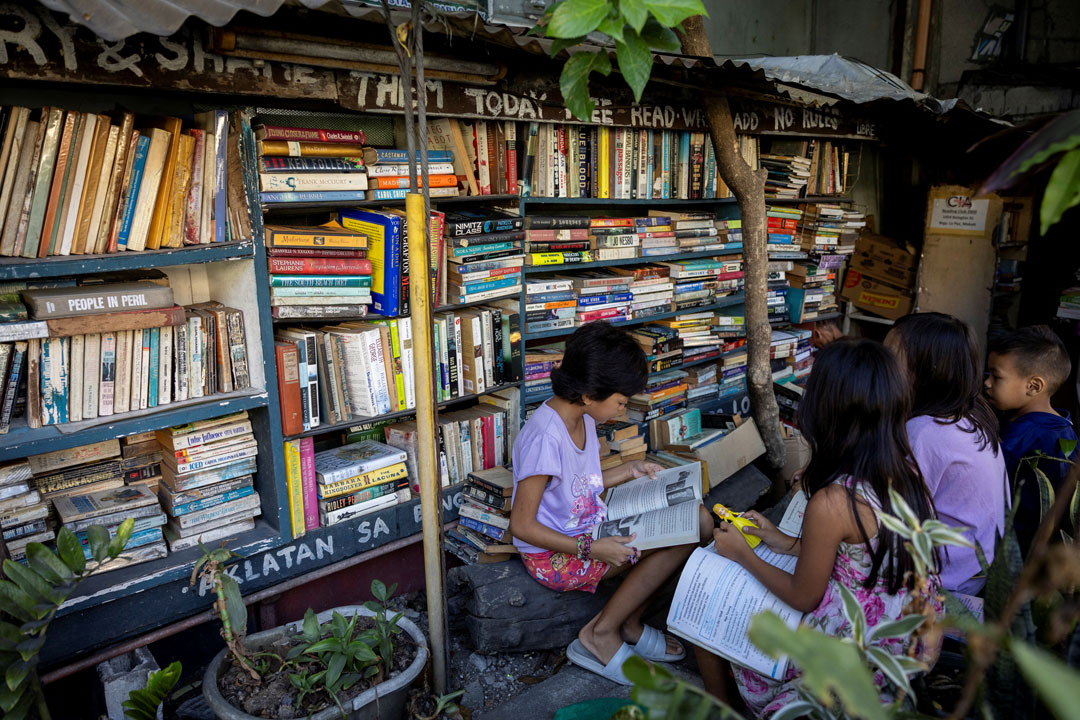
Hernando Guanlao's communal library in Makati, Metro Manila, Philippines.
© ReutersDemocracy will not survive when 9 out of 10 Filipino children can’t read properly. In the Philippines, this is not just a rhetorical statement. A 2022 World Bank report found that 91% of 10-year-olds in the country cannot read and understand a simple story.
Much has been said about the failures of our basic education system, but one piece of the learning crisis is often ignored: Only 4% of local government units (LGUs) have functioning public libraries, despite a law requiring every LGU to establish one. That is just 1,721 libraries across over 44,000 barangays and LGUs nationwide.
While affluent democracies take public libraries for granted, they remain a luxury for most Filipinos. This lack of reading infrastructure has serious consequences. At a time of disinformation, algorithmic distraction, and digital inequality, the country is raising a generation of citizens ill-equipped to discern truth from propaganda.
A liberal democracy only thrives when its citizenry can think for themselves. Two things need to be emphasized here: One, “freedom” is never abstract. Two, spaces are not neutral. They encourage specific values and behavior.
The liberal ideals of freedom and rights, which past thinkers labored to define, are no mere buzzwords. They were never intended to remain in theory and speeches. These ideals must be embedded in institutions and physical spaces—places that foster inquiry and reflexivity. Libraries uphold certain values over others: access over exclusion, inquiry over blind obedience, rationality over superstition, and learning over indoctrination. Public library, in other words, is a liberal ideal in brick and mortar. It is freedom made tangible.

In the Salon of Madame Geoffrin in 1755
© Painting by Anicet Charles Gabriel Lemonnier (1812)Liberal thinkers have long recognized this. As demands for democratic freedoms grew, so too did the institution of the library. During the Enlightenment, intellectuals built literary salons as hubs for exchanging ideas on science, art, and literature. Salons such as those of Madame Geoffrin gathered thinkers like Montesquieu, Rousseau, Voltaire, and Diderot to discuss secular ideas, and many welcomed women at a time when they were excluded from universities. Though limited to the well-connected and wealthy, the ideas exchanged within salons escaped their walls, undermining absolutist authority and preparing the intellectual climate for the democratic revolutions that swept across Europe.
In the 19th century, liberals further democratized these spaces across the transatlantic. They championed the creation of public libraries to promote mass literacy and counter dogma and authoritarianism. In the United States, industrialist and liberal thinker Andrew Carnegie, who had personally experienced the transformative power of books, funded the construction of over 2,500 public libraries, benefiting millions.
Today, public libraries are no longer just “book depositories”. They are civic infrastructure built to support freedom of inquiry and civic cohesion. Despite the arrival of digital technologies, millions of Filipinos remain disconnected. As of 2024, half of the country’s total households remain without home internet access.
Libraries, in this context, are a great equalizer. Modern public libraries continue to evolve, expanding beyond books to offer free Wi-Fi, study rooms, digital literacy training, and community services. Public libraries are also sites of civic memory and resistance. For instance, the Bantayog ng mga Bayani Library and Museum archives the horrors of the Marcos dictatorship and stands as a literal bulwark against historical revisionism.
Building public libraries is not only a cultural and political imperative, but also an economic one. Libraries are among the most valuable public investments a nation can make, because they develop its most critical resource: its people. By fostering both literacy and civic awareness, libraries help shape a generation of highly skilled Filipinos equipped to navigate the challenges of a knowledge economy. It is dangerous to think that digital devices and digitization are neutral or can replace libraries. Much of today’s technology is engineered not to deepen thinking, but to fragment attention and amplify disinformation.
Liberals should neither dismiss poor reading habits as mere laziness nor regard public libraries as relics of a bygone era. Readers are not born—they are made. They are shaped by institutions, nurtured by an ecosystem of accessible spaces for inquiry, reflection, and growth. Public libraries are indispensable pillars of the democratic infrastructure.
If you agree with this, you might wonder how your LGU can establish or improve a functioning public library. The answer lies in citizen demand, and recent news offers a blueprint. In June 2025, the Cebu City Public Library reinstated its 24/7 library policy. Its leaders attributed the decision to a student who took to social media to ask for a late-night study space. On the other hand, Naga City’s Raul S. Roco Library now operates seven days a week with extended hours, from 8:00 a.m. to 10:00 p.m. These cases demonstrate a simple truth: when citizens demand access to reading spaces, responsive governance follows.
Liberal democracy doesn’t end at the ballot box. It is sustained by spaces where people learn to think, reflect, and question. A democracy that is serious about its survival must not make libraries a luxury, but the norm.
Cesar Ilao III is Research and Communications Consultant at the Foundation for Economic Freedom in Quezon City.