IAF, Liberalism
Rejuvenating Liberalism Amidst Populist Dominance

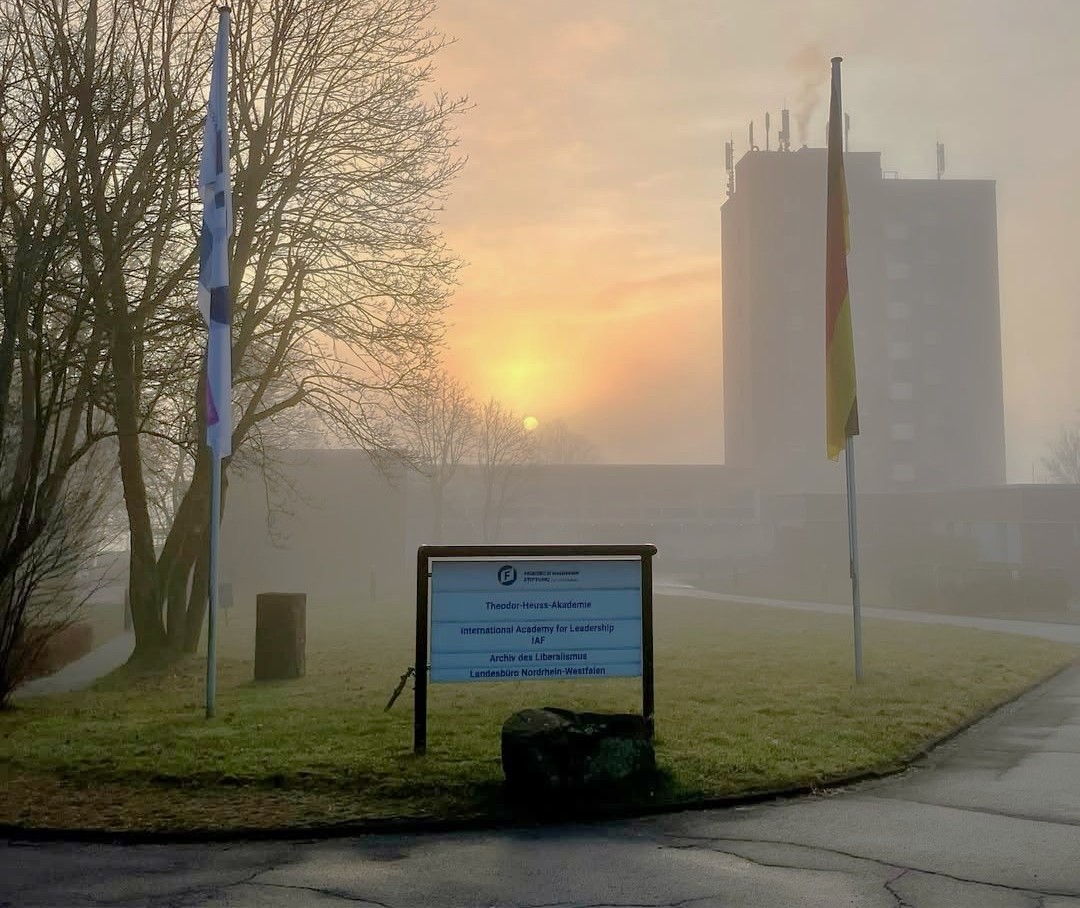
Misty morning in front of the Theodor-Heuss building at Gummersbach.
© IAF (Instagram: @iaf_gummersbach)As alumni and facilitators from across the world gathered for a three-day online festival between 18th–20th November 2025 to commemorate 30 years of the International Academy for Freedom (IAF), we find ourselves standing at a pivotal point.
The closure of Gummersbach’s IAF facility marks more than the end of a venue. In fact, it closes a chapter of intensive, cross-border apprenticeship in political crafting. Starting from facilitation to narrative design, from coalition-building mechanics to the patient, meaningful work of political education.
I carried those valuable lessons home in 2022 with the understanding that liberalism is not merely a set of policy positions but potentially a living project that must be renewed if it is to resist the seductive simplicity of populism.
Yes, IAF is no more but the global community it forged is not. If anything, that community’s distributed energy is the resource we now need to revive liberalism in an era where populist rhetoric and geopolitical turbulence tempt quick fixes.
The festival is not a nostalgic reunion, rather it is a strategic reconvening. It is a purposefully timed opportunity to translate lessons from the classroom into political action for our neighborhoods, cities and nations.
Populists Recent Gains
Populism’s ascent is understandable. It promises a clear enemy, a single will deem as “the people,” then offers fast relief from anxieties that plural democratic politics drains into messy compromise. Populism’s allure is simple and tactical. It promises single-cause solutions, an apparent foe as well as the illusion of instant delivery.
As Sven Gerst and mentors at the Friedrich Naumann Foundation for Freedom (FNF) training programs have repeatedly argued, populists are here to stay for the foreseeable future. They have succeeded where liberals failed, to speak plainly about bread-and-butter problems and to connect abstract freedoms to daily anxieties.
Liberals, in contrast, often preach principles to a public that now wants pragmatic results. This is a strategic, and not purely philosophical form of mistake which can be corrected.
Liberal figures too casually respond with moralities and policy lists, which are indeed necessary but alas as we have seen with the rise of populist leaders around the globe, it is simply not sufficient to tackle contemporary issues.
For Malaysia, the diagnosis is familiar. Surveys and analyses from local think-tanks show that the word “liberalism” often collides with cultural and religious sensitivities. Such collision also happens elsewhere, and it creates ample space for populist storytellers who claim to be “defending the people” against elites and outsiders.
The first task is therefore semantic. We must translate liberalism into locally credible ideas such as social mobility for families, predictable markets for growing businesses, and accountable democratic institutions that reduce rent-seeking. The public will pardon the complexity behind it if we care to package outcomes as tangible gains.
Our Work Ahead
But translation alone isn’t enough. Reviving liberalism needs a three-pronged operational agenda, which is the narrative, the institutions and the networks. First, the liberal argument must be emotionally sophisticated to its intended audience. Gummersbach training stressed on “reading the room” and narrative engineering.
Narrative here doesn’t mean “spinning” like how the populists operate. Liberals should instead introduce compelling story arcs that cast freedom as enabling dignity, opportunity and local belonging.
This means elevating personal stories of upward mobility, entrepreneurs who used open markets to uplift their families and local leaders who protected plural norms. The public want to believe and there is demand for hope, hence we cannot be lazy liberals.
Given today’s digitally connected generation, relatable and resonating content must be produced in media formats that communities consume. Comprehending the younger generation and finding ways for liberal concepts to add more value to their worldview is critical.
Short videos, infographics, podcasts, relatable local spokespeople and the repetitions of one or two concrete policy asks is more persuasive than multi-page manifestos, lectures about liberalism’s past achievements or research studies filled with “out of touch” jargons.
Second, comes the institutions. Liberals must be front and center as architects of repair within their societies. Populism thrives where institutions are slow, corruptible, or opaque.
Practical reform like streamlined social services, fair support for small businesses, accountable and transparent politics, as well as raising basic common sense to local problems, all communicate liberal competence.
Third, are the networks. The Gummersbach experience reminds us that liberal renewal is a relational project, which at its core, is very human. Training sessions, exchanging conversations, making alliances and building coalitions make ideas durable.
For Malaysia ... surveys and analyses from local think-tanks show that the word “liberalism” often collides with cultural and religious sensitivities. Such collision also happens elsewhere, and it creates ample space for populist storytellers who claim to be “defending the people” against elites and outsiders.
The first task is therefore semantic. We must translate liberalism into locally credible ideas such as social mobility for families, predictable markets for growing businesses, and accountable democratic institutions that reduce rent-seeking.
Always Be Mindful
The challenge then is how do liberals maintain these human relationships to not just fade away over time or become an “inner circle”. It takes a huge effort to actively participate in forming coalitions and most of the time, it all comes down to the matter of timing.
In Malaysia’s coalition politics, calculated sequencing matters. Prioritizing low-hanging fruits or quick wins that can demonstrate fairness and delivery, which then expands political space for deeper civil-liberty reforms later.
The Anwar Ibrahim administration’s early months illustrate how governance bandwidth forces sequencing and compromise, yet it also offers an opening for progressive elements within government to mature into their roles and gradually show that good governance produces stability and distribution.
Coalition building in Southeast Asia and other parts of the world can succeed when progressive actors accept tactical partnerships without surrendering their core safeguards. Our leaders must always enable dialogue, recognize what to select as immediate priorities and revise divisive items that aren’t ready for the moment.
Future Worth Investing
The IAF’s pedagogy has shown that to win back hearts and votes, liberals must be fluent both in principle and in practice by turning abstract freedoms into visible gains with emotionally resonant stories. The key here is to make it tangible and communicate it well. Demonstrations of success make abstract values persuasive.
In order to do so, liberals must start to localize, then scale. Progressive ideas succeed when translated into culturally logical programs. Liberals must ensure fair markets that sustain budding commerce, provide ethical public services that reduce profiteering and defend civic spaces where plural identities find recognition. Context always matters.
Next, liberals must facilitate more narrative labs, not monologues. The festival should seed into a larger regional narrative where alumni, scholars and activists can co-design emotionally intelligent messaging tied to measurable outcomes.
A quarterly “get together” at respective FNF countries under a specific thematic like jobs creation, simplifying governance, access to customized education, racial harmony, reducing digital gaps, etc. can be a way. Virtual follow-ups at a regional level to discuss topics that provide broader “mega-trends” are thus essential.
Beyond those existing self-improvements, there must be sustainable effort to invest in cross-sector capacity building especially in journalism, youths and grassroots communities or subnational groupings.
This flow of funding is important for reforms so that if a demagog takes over power in the political arena or when crisis happens in financial sector, it doesn’t collapse the entire liberal ecosystem.
A United Alumni
Belonging is an underrated political asset. Reconnecting with the global liberal community through the IAF festival generates more than memories. I believe that it restores moral and operational confidence.
For many alumni, the feeling of being part of a worldwide peer network reduces isolation, replenishes ideas and provides quick access to expertise and solidarity when authoritarian pressure intensifies.
We must also widen our intellectual frame. The challenges facing liberalism today are not just political but are now technological, environmental and geo-economical. Alumni should integrate climate justice, digital governance, immigration policies and economic inclusion into the liberal toolkit.
Such frame cannot come as afterthoughts but must organically become as central pillars that intersect with freedom. A liberalism that is blind to climate displacement or refuse to explore risks of artificial intelligence or platform-driven information decay will be politically out-manoeuvred.
We must also update the intellectual case for liberalism. Populism cannot be treated as a single “beast”. Its form differs from one economic footprint to another and varies by ideology as well as geographical context. However, its impact on entrepreneurship and institutional stability remain to be corrosive.
The liberal case should therefore show how markets, when well-governed, expand the public’s choices and improve livelihoods while democratic institutions shield against capture and inequality.
Don’t merely defend markets. Liberals must protect and constantly refine the rules-based order that makes markets fair so that the “abundance” is genuinely felt and not be perceived as confined only for the privileged.
Onto The Next
Finally, humility and tactical imagination are political necessities. Gummersbach mentors like Radu Magdin and other facilitators taught us to stop treating political communication as a moral lecture and instead treat it as iterative, empathetic conversation.
The ability to listen, internalize and adjust is far more potent than moral grandstanding. Meet communities where they are. Work in partnership for solutions. Learn fast, modify faster, and scale what works.
Wherever and whenever liberalism is accused of cosmopolitan distance, find people on local ground, engage on common footing then create that “big tent”. Viewpoints will always differ in a “big tent”. Nevertheless, aim towards the “bigger picture”.
Populism will not recede because we shout louder about principle. It will recede when liberalism is re-embedded into people’s lives.
We can become relevant again when we can help shape a child’s education pathway to be better, when we level the playing field for a shopkeeper to earn a dignified living and when we commit to ensuring a fellow citizen’s safety irrespective of their plural identities. That is the only kind of rejuvenation worth celebrating.
––––––––––
*Halmie Azrie is a researcher for a Malaysian think-tank, a columnist for a Singaporean media portal and a IAF alumni from 2022. He has experience in international relations, civil society movements, public policy and government affairs.