Liberalism, Democracy
Liberalism Under Siege: Navigating a New Global Disorder

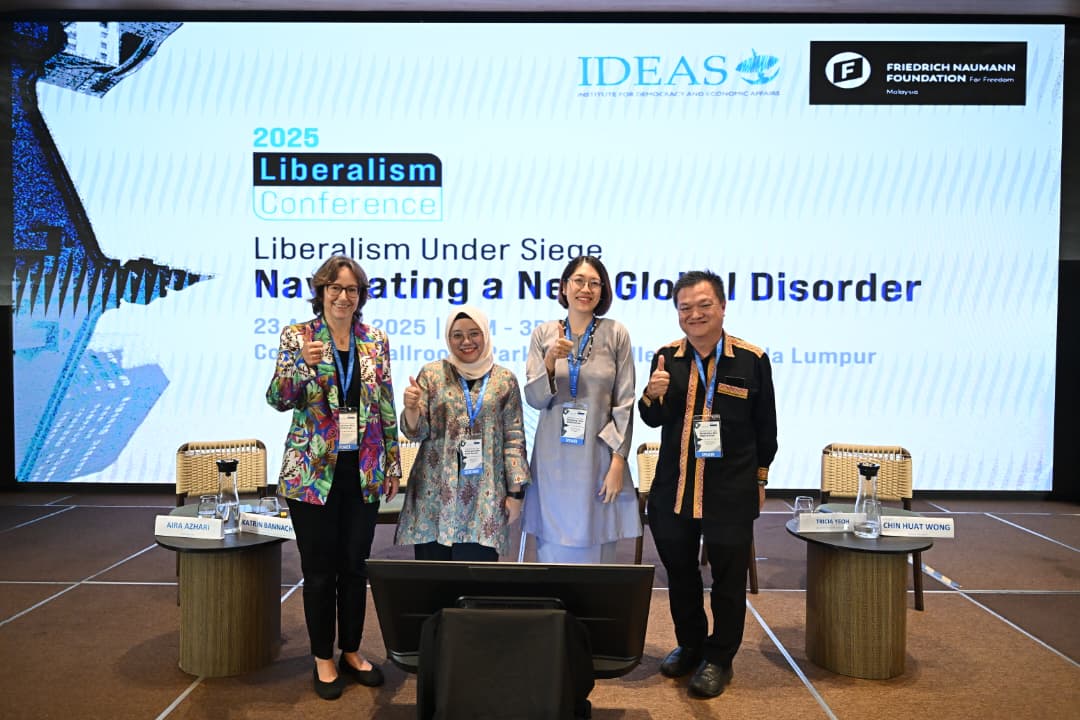
Panellists in IDEAS Liberalism Conference 2025.
From left to right: Katrin Bannach (Project Director, FNF Malaysia and Indonesia); Aira Azhari (Chief Executive Officer, IDEAS Malaysia); Dr. Tricia Yeoh (Associate Professor, University of Nottingham Malaysia); Prof. Chin-Huat Wong (Deputy Head of Strategy, Sunway University).
© IDEAS MalaysiaWhat happened to Liberal Democracy? Why are the threats posed by aggressive authoritarian regimes becoming more tangible today?
Those were some of the questions that were discussed in this year’s Liberalism Conference, an annual flagship event hosted by the Institute for Democracy and Economic Affairs (IDEAS) and the Friedrich Naumann Foundation for Freedom Malaysia (FNF Malaysia). Mrs. Katrin Bannach, the Head of Office of FNF Malaysia and Indonesia, shared her views on the German election results this year and their impact on the country during the plenary panel session.
In the German context, the concern about the erosion of liberal democracy manifests most visibly in the electoral rise of right-wing populism. The Alternative für Deutschland (AfD), now the second-largest party in the Bundestag, exemplifies the paradox of democratic systems that provide space for actors who openly seek to weaken the very institutions upon which those systems are built.
Germany has faced and overcome dictatorships in the past century. It has developed a vibrant civil society, resilient democratic institutions, and even integrated into its education system the lessons of history to prevent authoritarianism from resurfacing. Yet despite these safeguards, a right-wing extremist party now holds significant parliamentary power. Why has this happened?
Part of the answer lies beyond Germany’s borders. Invisible lines of influence extend from autocratic regimes that fund and fuel disinformation campaigns, particularly through social media. These campaigns erode trust, shape public opinion, and influence electoral outcomes by directly attacking the pillars of democracy.
Authoritarian actors often exploit democratic systems from within, using institutional mechanisms to weaken equality before the law and undermine the very foundations of democratic governance.
Another pillar under pressure is the rule of law. Authoritarian actors often exploit democratic systems from within, using institutional mechanisms to weaken equality before the law and undermine the very foundations of democratic governance.
This dilemma has sparked a fundamental debate in Germany: how should a democracy confront a party that uses democratic freedoms to dismantle democratic institutions — while still adhering to democratic principles in doing so?
The broader issue of liberalism under siege is not abstract. It is reinforced by economic anxieties and narratives of fear that create fertile ground for misinformation to be normalized. When fear becomes politically instrumentalized, democratic resilience is tested at its core.
*Vera Jasini is the Programme Manager of FNF Malaysia