DA Congress
2029's starting gun was sounded at Gallagher Estate

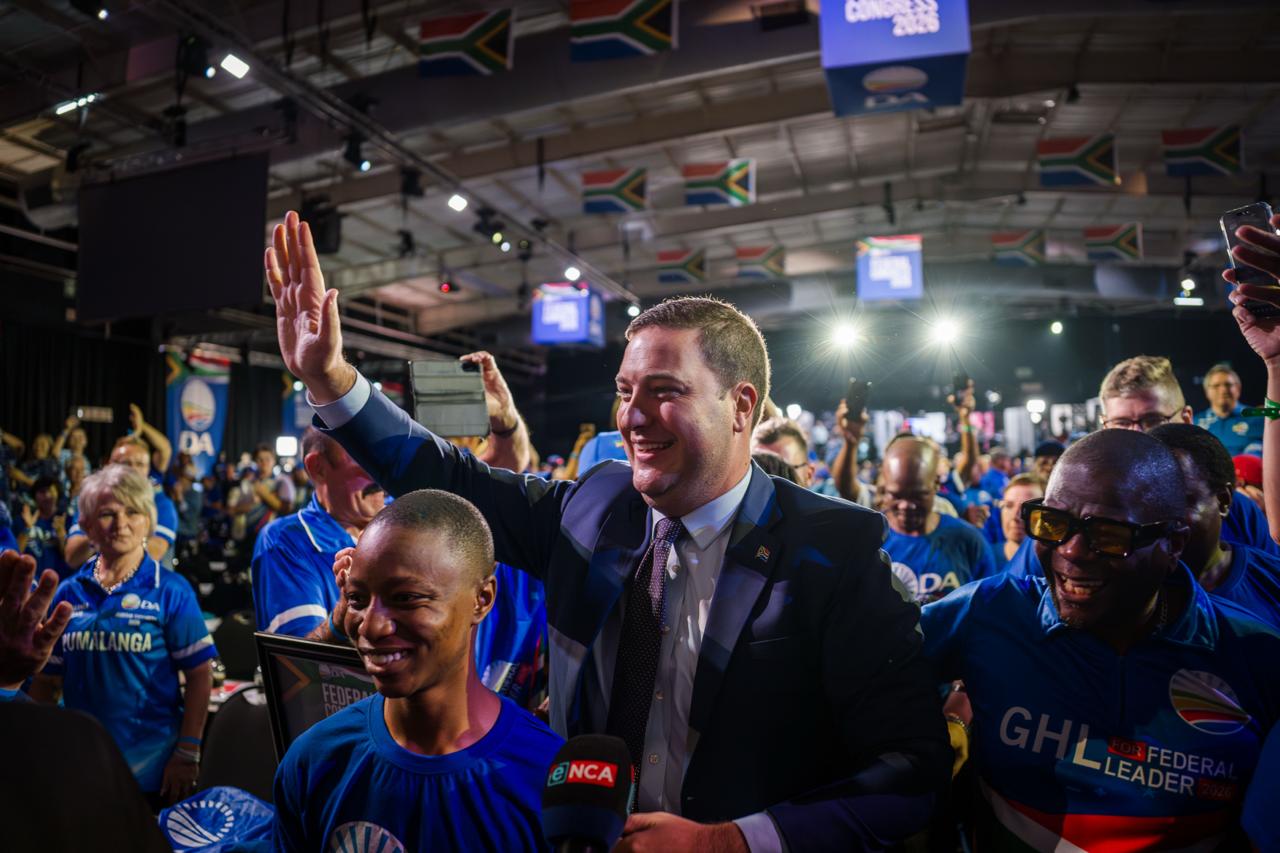
Geordin Hill-Lewis is the newly elected Federal Leader.
© Democratic Alliance - FacebookMore has been written, discussed and shared about the DA’s Federal Congress last weekend than ever before. For most of the party’s history, a DA Federal Congress was an event that mattered primarily to the DA, its supporters, and to political journalists and analysts. The party faithful would gather, elect their leaders, pass resolutions, and the country would largely carry on, accepting what seemed to be the permanent state of the country’s politics: the ANC as Government and the DA as the official opposition. ANC conferences seemed of far more consequence and import, as they directly determined the likely composition of the country’s government.
Last weekend’s Congress in Midrand was different. For the first time, what happened inside the Congress hall felt genuinely consequential to South Africa as a whole. This is the consequence of where South Africa now finds itself, how the DA has navigated the most significant political realignment since 1994, and the nature of the leadership it elected.
When the ANC was stripped of its parliamentary majority in May 2024, driven in large part by the electoral performance of Jacob Zuma’s MK , the DA made a decision that defined the next chapter of its history and, potentially, the future of South Africa. It chose to negotiate with the ANC and form a Government of National Unity (GNU). In reality, and despite the other GNU partners, this is a grand coalition between South Africa’s two biggest parties.
At the time, this was not an obvious step and it was one replete with risk. Junior coalition partners often get punished at the next election, and many inside the DA could not (and still cannot) fathom cooperating with the ANC.
But the DA has played the last two years well. Its ministers have, by and large, delivered in their portfolios. Simultaneously, the DA has been the most effective opposition to the ANC from inside the GNU and has managed to maintain its ideological distinctiveness even while sitting at the cabinet table.
The polls have responded, with DA support consolidating and increasing. Things look positive for the party ahead of this year’s local government elections, with the DA currently on track to retain Cape Town with a comfortable majority, become the biggest party in Johannesburg and Tshwane, and potentially be the biggest party in the Nelson Mandela Bay Metro and Ekurhuleni. As a result of MK’s growth, the DA will likely overtake the ANC in eThekwini and has the potential to be part of a coalition government in Mangaung. After November, it may find itself in government in seven out of eight metros, in addition to the GNU, the KZN GPU, and dozens of local municipalities across the country. It does face a significant threat from the PA in parts of the Western and Eastern Cape but in terms of the macro outlook, the party will grow in councillor numbers and governments it controls.
This momentum meant that last weekend’s Congress was not merely an internal party event. It was, for a meaningful segment of South Africa’s population, a moment of genuine interest: Who will lead the DA? What direction will it take? What does it mean for where the country goes next? Could this party lead a future national coalition? Could a DA leader actually be a South African President?
The headline from Federal Congress is the party’s new leader: Geordin Hill-Lewis, 39, elected with over 90% of the vote. But the full picture is more significant than any one name. Solly Msimanga as Federal Chairperson. Solly Malatsi, Cilliers Brink and Siviwe Gwarube as Deputy Federal Chairpersons. And Ashor Sarupen as Chair of the Federal Council, the second most powerful position in the party.
This is a young, diverse, collectively ambitious leadership slate. And crucially, these are not people who are leading the DA as a project they will hand to someone else. They are young enough to see it through: they will be at the height of their powers when 2029 arrives, and beyond. The DA’s new leadership has a personal stake in a long-term vision that they themselves can realise.
The one asterisk on that generational narrative is Helen Zille’s candidacy for Mayor of Johannesburg. But that is a pragmatic necessity. The DA needs to win Johannesburg, and Zille brings the profile, the fighting spirit and the name recognition to compete in a city where the DA has historically underperformed. In this local election, Zille is the proven general for a critical battle, while the next generation takes command of the broader war.
To understand what has changed, it helps to be clear-eyed about what Steenhuisen’s tenure was actually about. He was not, in truth, a leader positioned to take the DA to national government. His mission was to stabilise a party that had been through the trauma of the internal implosion in 2019, to restore ideological clarity, and to reclaim the support that had leaked away between 2016 and 2019.
Getting into national government was a bonus. The GNU was an opportunity created by MK’s extraordinary surge, which dragged the ANC below 50% and forced a coalition. The DA seized that opportunity with both hands and has used its positioning wisely. But the vision of the DA as a party that could lead South Africa was never really within Steenhuisen’s purview. Stability and credibility were. And to his credit, he delivered on both.
Hill-Lewis leads a party that is in far better shape than the one Steenhuisen inherited. And he arrives at the leadership with something none of his predecessors had.
Hill-Lewis is different in a way that has not yet been sufficiently recognised. He arrives as party leader with nearly five years as Executive Mayor of Cape Town behind him. Yes, Helen Zille was Cape Town Mayor when she became party leader in 2007, but she was just a year into the post at the time. Despite his age, Hill-Lewis assumes the leadership as a serious local government practitioner with significant party experience behind him: from the trenches of university politics, to running Helen Zille’s and Mmusi Maimane’s offices, to being an MP himself. Critically, he has experienced the highs and the lows of the DA’s trajectory from Tony Leon to now. Hill-Lewis brings serious credibility and experience together with youthful energy to the DA leadership. He is a serious threat - both to the ANC and to his opposition competitors. And he has been clear: his mission is to grow the party.
Most telling of all is what Hill-Lewis said from the Congress stage, and what he said to the media afterwards. They were the words of someone who understands precisely where the DA’s ceiling has been, and why.
“Most people already know that the DA governs better,” he said. “Now we must win their trust so they vote for us for the first time.” And then, with a directness rare in South African politics: “You can’t blame the voters. You have to look internally at why that trust deficit still exists.”
He also said, explicitly, that the DA must offer the country “more than competence alone”, and that it must become a party South Africans can not only see and hear, but feel. His prescription for closing the trust gap was deliberate: “community by community, street by street, conversation by conversation.”
This matters because it represents the clearest acknowledgment yet by a DA leader that the party’s problem has never simply been just a communications problem, a brand problem, or a racial optics problem. It is a presence problem. While the DA has governed well in places it already holds, it has not been genuinely and consistently present in the communities it needs to win. And presence builds trust and trust wins votes.
In the immediate term, the DA’s focus is the 2026 local government elections, and it should do well. The Steenhuisen era’s stabilisation has prepared the ground. The GNU has given the party national visibility and governing credibility. The new leadership slate projects energy and ambition.
But unlike the 2016 local government elections, the test of 2026 will not only be whether the DA wins key metros and muncipalities. It will be whether it can govern what it wins without self-destructing. There are some echoes of 2015 in this moment: then Federal Congress elected Maimane and served as the launchpad for a local government campaign that delivered serious breakthroughs in 2016. The lesson of what followed was brutal and clear: breakthroughs mean nothing if you cannot hold them together. This time, with Hill-Lewis’s experience and a more unified leadership bench, the conditions are better.
Between 2026 and 2029, Hill-Lewis faces the most delicate strategic question of his leadership: how long does the DA stay in the GNU, and on what terms?
The current arrangement suits the DA’s purposes up to a point. Being in government has given the party credibility, visibility and the ability to demonstrate that it can deliver nationally. But the GNU has a clock on it. Ramaphosa’s term as ANC President ends in 2027, and his likely successors will be a different political proposition entirely. A more assertive and factional ANC leadership, less invested in the GNU’s stability, could change things significantly.
Hill-Lewis has signalled that he intends to be an active partner, pushing the DA’s values agenda from inside government, not merely administering portfolios. That posture will become increasingly important as 2029 approaches. At some point the DA may need to make a decisive choice: remain in the GNU as a junior partner, or step out and position itself explicitly as the alternative to an ANC – as a realistic national government lead - that can no longer reform itself. The credibility to make that move will depend entirely on the trust-building work done between now and then.
Hill-Lewis has articulated four things the DA must do. Govern well - it likely will, in Cape Town, the Western Cape, and through the GNU. Connect with South Africans who haven’t voted for it - that is the work of the next three years, and the hardest work. Be a principled GNU partner - yes, but expect a more robust and assertive DA in that role as the ANC’s internal politics shift. And lead with belief in South Africa’s future - that is the culmination: the moment when a party that has earned trust attempts to convert it into a national mandate.
The structural challenge remains real. The DA’s growth has historically come from squeezing smaller parties’ votes, winning the voter registration game, achieving differential turnout and not from genuine conversion of ANC voters. Dissatisfaction with the ANC does not automatically become a DA vote.
For 2029, Hill-Lewis needs not just a governing record but a theory of conversion: a credible answer to why someone in Soweto, or Durban, or Polokwane, should vote for the DA for the first time.
That answer will not come from a slogan or speech. It will come from whether, over the next three years, the party is actually present in those communities.
What happened in Midrand last weekend was significant not because a new leader was elected, but because of what that leader represents and what he has explicitly set as his mission. For the first time in the DA’s history, the party has a leader who has governed, who understands why governing alone is not enough, and who has named the trust deficit with enough honesty to suggest he might actually try to close it.
2026 is not the destination. It is the starting gun for 2029. And fascinatingly, the story of success will be told away from the lights of the media and the podcasts. Whether Hill-Lewis’s mission succeeds will depend on what the DA does when nobody is watching. Community by community. Street by street. Conversation by conversation. Election 2029 has started.
Article Originally Published on The South Africa Brief on 17 April 2026