United Nations
Deafening Silence – The 4th Universal Periodic Review of the USA

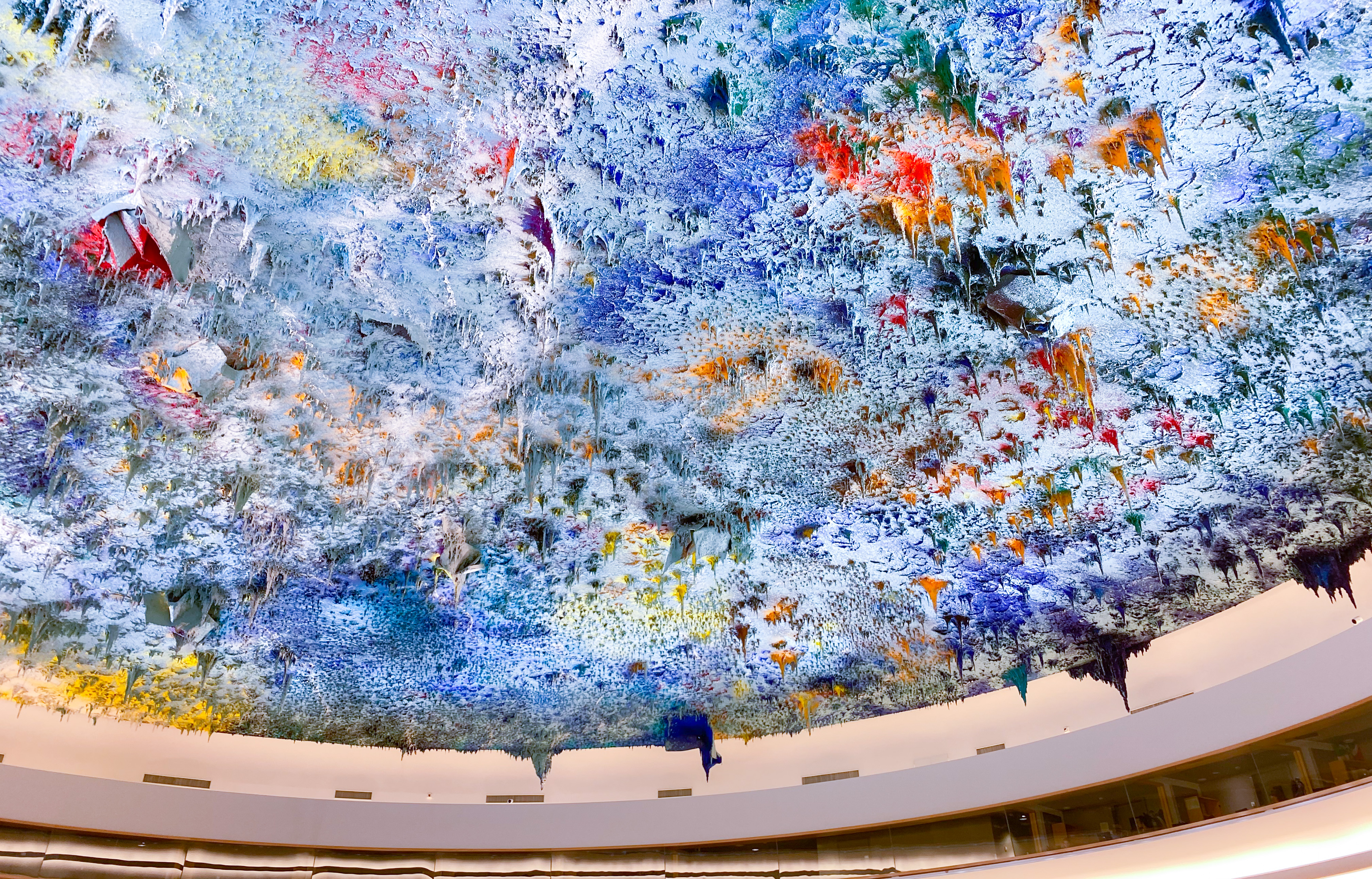
Ceiling in Room XX at the Palais des Nations in Geneva.
© FNF Human Rights HubThe United States’ 4th Universal Periodic Review is scheduled for November 2025. The US delegation missed the deadline to submit their national report and no US delegation showed up to the review on 7 November 2025.
In early February 2025, Trump launched attack on international organizations. Among other things, he announced the US withdrawal from the United Nations Human Rights Council. The UN Human Rights Council protects "human rights violators [...] by allowing them to use the organization to shield themselves from scrutiny." However, the US has not been a member of the intergovernmental body since the beginning of 2025, when its three-year membership ended as scheduled. Trump also announced that he would cut US funding for the UN Human Rights Council.
Changing relationship between the US and the UN Human Rights Council
The relationship between the US and the UN Human Rights Council has been tense at times throughout the various administrations. The Human Rights Council is the main organization of the international human rights system. The General Assembly elects 47 members from the 193 UN states by a simple majority for a three-year term.
The Human Rights Council was created in 2006 as a subsidiary body of the General Assembly. At that time, the Bush administration refused to support the founding resolution. President Bush had called for stronger mechanisms and even the possibility of excluding member states with poor human rights records.
Nevertheless, the US was among the first members to run for election and was elected to the Council from 2007 to 2009. Shortly before Trump's first election, the US was re-elected for a second term from 2017 to 2019. President Trump ordered the first withdrawal from the Human Rights Council in June 2018. Under Joe Biden, the US returned for a third term as an elected member until 2024, but declined to seek re-election.
Even under President Biden, both Republicans and Democrats accused the UN Human Rights Council of setting a biased agenda and criticizing Israel. This is also repeated in the current decree. The "human rights situation in Palestine and other occupied Arab territories" is a permanent item on the agenda of the Council's meetings – regardless of the current situation of the recent Gaza war following the terrorist attack by Hamas.
The Biden administration had already decided not to continue funding the body until three conditions were met: It must be clarified "that participation in the Council is important to the national interest of the United States and that the Council takes significant steps to remove Israel as a standing agenda item and ensure integrity in the selection of Council members."
Foreign policy through zero funding
Trump's second announcement, to cut US funding for the UN Human Rights Council, could have immense consequences for the entire human rights system. He has not yet done so.
The regular UN budget for 2025, which covers running costs, is set at US$3.5 billion. The United States contributes the largest share (22 percent, or around US$827 million). Germany, for example, contributes 5.69 percent (just under US$195 million).
Less than seven percent of the UN budget is earmarked for "human rights," including the Office of the UN High Commissioner for Human Rights (UNHCHR) and the UN Human Rights Council. The US share of this amounts to approximately $57 million. US Secretary of State Marco Rubio has now been instructed to withhold this sum. By comparison, Germany's share is around $13 million.
Trump's budget cuts affect the infrastructure of the Human Rights Council. The continuation and establishment of new commissions of inquiry, as recently decided on February 7 regarding crimes in the eastern Democratic Republic of Congo, would be jeopardized by the elimination of the US's mandatory financial contribution. Even greater, however, is the danger that numerous states could follow the US example and cause lasting financial damage to the entire UN human rights system. The 2025 president of the Human Rights Council, Jürg Lauber of Switzerland, has announced budget cuts – including reducing the number of sessions of the HRC and the number of mandates that can be supported.
Reports on the human rights situation in countries
The Human Rights Council's most powerful tool is the Universal Periodic Review (UPR) process. Every four to five years, each UN member submits a report on the human rights situation in its own country. The UN High Commissioner compiles information from other UN institutions (UN compilation). In addition, stakeholder reports from civil society actors, such as human rights organizations, can be submitted. Any non-governmental organization that is active in the country concerned or can provide expert input can write such a report. No special accreditation is required for this.
In the subsequent UPR process, the country reports, the UN compilation, and the stakeholder reports are reviewed by three member states and presented to the entire Human Rights Council in a final report. The plenary session makes recommendations to the state under review.
Neither the final report nor the state recommendations are legally binding. However, the political signal effect of the reports should not be underestimated. Journalists and non-governmental organizations are provided with important documentation that has been produced with the participation of other state representatives. Individual recommendations have repeatedly led to changes in legislation, thereby improving the human rights situation. In Albania, for example, impunity for gender-based crimes was ended. In the United Arab Emirates, the rights of migrant workers improved, as they are now legally allowed to change employers and terminate employment contracts, to name just two examples of implementation.
Immediate measures were also decided by the Human Rights Council on the basis of UPR reports, such as the establishment of a commission of inquiry into the situation in Syria. The UN Security Council was blocked by Russia's veto, but the UN Human Rights Council no longer ignored the serious crimes of the Assad regime.
All states participate in the reporting process
Since 2008, the response rate for state reports has been 100%. In the fourth cycle of the reporting process since 2022, all states have submitted their national reports so far and 76 percent of the recommendations have been accepted (as of November 2025). After all, no government publicly admits to systematically violating the human rights of its citizens. The argument put forward by the US president that countries are evading the process is therefore simply not true.
The new Trump decree has no impact on internal processes and UPR procedures, from voting on resolutions on the human rights situation to negotiations on new measures, such as commissions of inquiry or standing agenda items. However, the democratic voice of the US as an advocate for human rights will be missing.
In 2020, during the last US review in the UPR cycle, when Trump had withdrawn from the Human Rights Council, the US nevertheless still participated in the UPR and submitted a national report. This time in 2025, the Trump administration has followed their narrative and is the first country ever to intentionally refrain from submitting its national report to the UPR Working Group.
Subsequently, they are refusing to participate in their own review and the US review has reached a deadlock. Without the delivery of the national report, the UPR Working Group is unable to proceed with the review and the member states may not deliver their recommendations.
It is important to note that this differs from the situation of Nicaragua, whose UPR adoption is being delayed because the regime is currently not responding to the recommendations received. The Ortega regime did however submit a national report and thus received recommendations.
The US refusal to participate in this process sets a dangerous precedent. The strongest defenders of democracy and main driver behind the creation of the United Nations is refusing to be peer reviewed by other states. Other states might follow this narrative and the international rules-based order might perish.
The Human Rights Council adopted Decision A/HRC/OM/19/L.1, titled 'Non-cooperation of a State under review with the universal periodic review mechanism' by consensus. This calls on the US to re-engage with the process of the UPR and on the President of the HRC to undertake efforts to ensure US participation. The Decision reschedules the US review for the 53rd session of the UPR Working Group in 2026.