Liberalism
How liberals can win

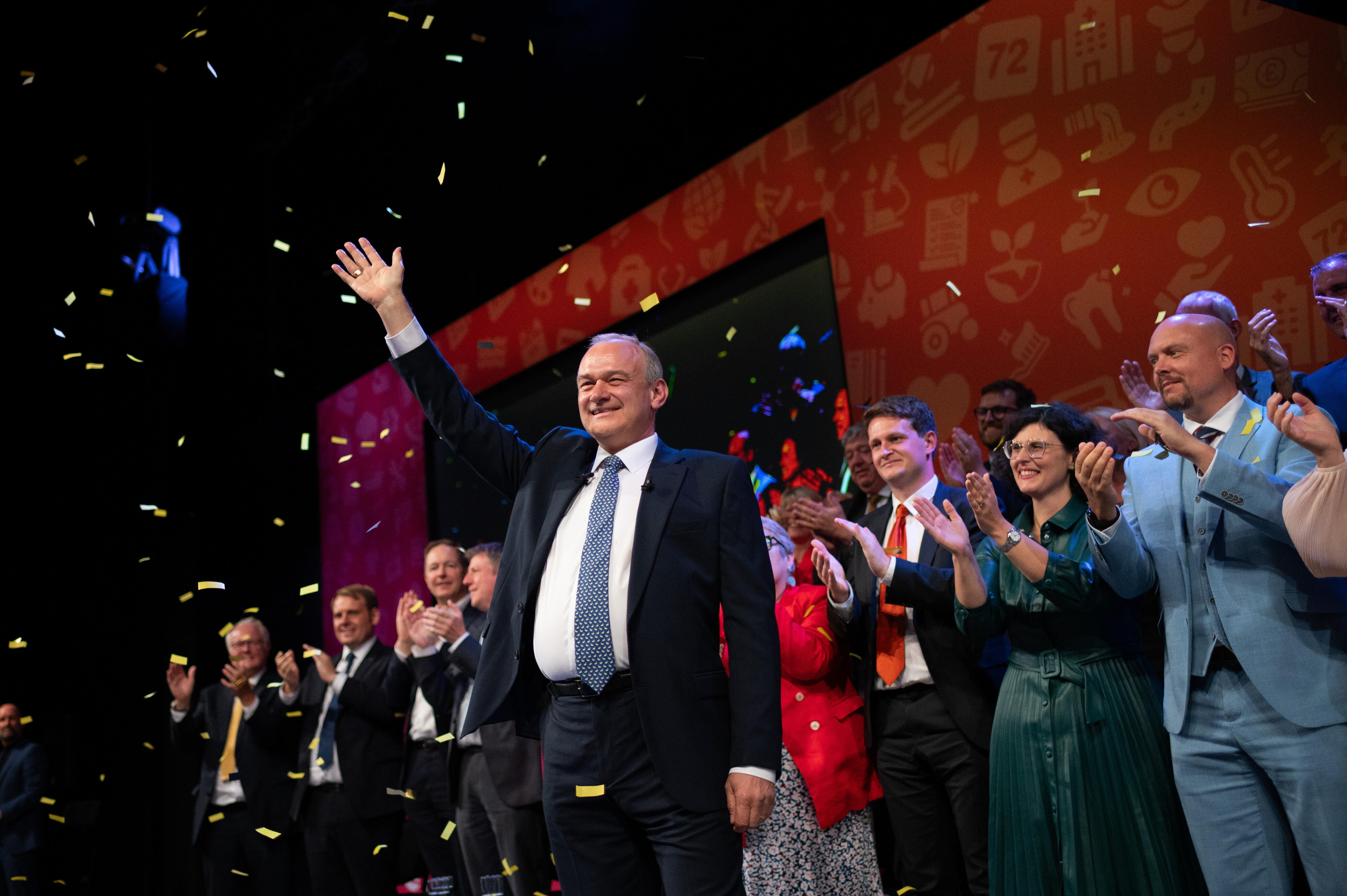
Liberal Democrats leader, Ed Davey, seen on stage after his keynote speech.
© picture alliance / Sipa USA | SOPA ImagesOn 4 July 2024, voters in the United Kingdom not only elected a new government but boosted the Liberal Democrats into a strong third party in parliament. Since then, support for the Lib Dems has continued in the local elections this May and in recent polling. But how did the British liberals manage to garner such widespread support? And what can European liberals learn from their strategies? One year after their victory in Westminster, it is time to take a closer look.
Winning big: The general election 2024
The 4th of July 2024 caused tremendous turmoil in British politics. After 14 years of Conservative leadership in Downing Street 10, Labour’s Keir Starmer victoriously secured a 411-seat majority in Parliament. But the Labour Party was not the only winner of the election. The Liberal Democrats managed to reach their best result in more than a century with 72 Members of Parliament elected, up from eight MPs in the previous election. Gaining 60 seats from the Conservatives, this success put the Lib Dems into a strong third position and an oppositional force to be reckoned with. How did they attract so much support?
There are different explanations for their success. During the 2024 campaign, the Liberal Democrats heavily focused on threeissues. These were at the centre of the voters’ interest: health, the cost of living, and the environment. They managed to find relatable and local examples to address voters’ fundamental concerns, campaigning to stop sewage dumping, for instance, a major weak spot in Britain’s environmental strategy. These examples boosted the Lib Dems’ credibility and displayed their “roll-up-your-sleeves” attitude. According to More in Common, their position on the financial deterioration of the National Health Service (NHS) and healthcare in general was the most important reason for voters to back the Lib Dems in the 2024 election. Especially in an election with a historically low turnout, this power of political mobilisation through policy prioritisation proved to be significant.
Combining fun with local tactics
As a smaller party with constructive policy ideas rather than populist cheap shots, the Liberal Democrats risked being overlooked in the weeks leading up to the general election. To make sure that no one can turn a blind eye on them, they became innovative. Lib Dems leader Ed Davey, along with local candidates, participated in an engaged series of “stunts” all over the United Kingdom to embellish the party’s political messages: He advocated for children’s mental health by whizzing down a yellow water slide. He presented the party’s manifesto in an interview during a teacup ride in a theme park. And he asked voters to do something they have never done before (voting Lib Dems) by doing something he himself had never done before (bungee jumping from a crane).
And while these stunts received their fair share of criticism due to their risk of mockery, also from within the party, their potential for drawing attention and making politics seem more fun should not be disregarded. In strong contrast to the stunts, Davey also presented himself as an empathic leader by sharing his life as a carer for his disabled son and emphasising the Lib Dems' commitment to carers. This positive communication approach of combining ‘unserious’ (light-hearted) stunts and ‘serious’ (truthful/genuine) stories with a clear political position characterised the Lib Dems' campaign. The result: on election day, Ed Davey was the only party leader in the UK with a positive net favourability.
But the Liberal Democrats’ success did not only revolve around their leader. Voters also wanted to support their local candidates or were dedicated to preventing other candidates from winning in their constituency – the latter being the second and third most-mentioned reasons given for voting Liberal Democrats. The party has often relied on its strong local connections. Building up credibility on the local level can create a trustworthy challenger in many constituencies. The general election showed that this strategy paid off. Additionally, the British electoral system calls for tactical voting, especially if you want to get rid of a government that has been in power for almost fifteen years. In the first-past-the-post system, sometimes you have to vote for someone with higher chances than your first choice to make sure a specific candidate is not elected. The Liberal Democrats not only acknowledged that but made it a crucial campaign message. Around 90% of all Lib Dems leaflets mentioned tactical voting, far more than leaflets of any other party.
The Lib Dems' results of the general election on 4 July were influenced by many external variables. The party itself, however, also left their mark: through clear messages on issues that matter, through positive communication with wild stunts and authentic stories, and local campaigns as a strategic backbone. Looking back after one year, one might ask: What remains? What parts of the strategy persisted? And which new developments do Liberals have to face in 2025?
Staying on top of voters’ concerns
Throughout the last year, the enthusiasm of the Liberal Democrats has not faded away. At their two party conferences since the general election triumph, the magic number “72” had a palpable impact. The high number of MPs is still a source of pride and fresh self-confidence. With their shadow cabinet in place, the Lib Dems have vowed to build a “constructive opposition”. This means cooperating with Labour where goals and intentions align in order to fix the shortcomings of the Conservatives’ previous leadership, all the while keeping the Labour government in check where necessary. This position also includes a continued and clear dissociation from the Conservative Party. After more than a decade of what the Lib Dems see as failed conservative leadership, the willingness to cooperate with the Tories in opposition to the Labour government is rather limited. After all, a lot of the ‘mess’, which needs cleaning up in the Lib Dems’ view, originated under the Conservative government.
The main topics have largely remained the same for the Liberal Democrats. They focus on fixing the NHS, supporting carers, and stopping problems around sewage treatment. The Liberal Democrats managed to gain the chair positions for the select committees on Health and Social Care as well as Environment, Food and Rural Affairs. These priorities are deemed so important by voters that the Liberal Democrats can expand them into other policy fields. Lib Dem Deputy Leader and treasury spokesperson Daisy Cooper, for example, used her critique of the government’s general spending review to readdress her assessment almost solely to the NHS and social care. While the repetitive use of the same topics might seem a bit narrow and question the Lib Dems’ responsiveness towards other critical issues, for the time being this focus helps them in two ways: first, staying relevant with stand-out positions in an increasingly fragmented electoral field with new parties at the margins of political consensus. And second, keeping all 72 MPs in line for one coherent communication strategy. This is especially helpful in a situation where most of these MPs are first-time electees and the party still needs to diversify its expertise in parliamentary work.
That said, the Lib Dems also focus on other issues in parliament and their work in constituencies. However, only one new topic has seen a similar level of attention in the Lib Dems’ political messaging as have health or the environment: the new Donald Trump administration. As foreign policy and global crises have continued to make waves in UK politics, the Lib Dems needed to find a communicational anchor to get their position across. Once again, they looked at the priorities of the British public and found an angle on which most UK voters, and certainly the Lib Dems’ supporters, could agree on: “Trump is bad for the UK”. With only 16% of the UK public viewing Trump positively, one would think that Labour and the Conservatives are also tapping into that potential for political messaging. But the Labour government is busy tiptoeing around the American president in the hope of a better trade deal, and the Conservatives are too worried about losing British Trump supporters to Nigel Farage’s right-wing populist party, Reform UK. This gives the Liberal Democrats an additional unique selling point as the only party outspokenly standing up to Trump’s US government. This has even helped the Lib Dems to push closer EU-UK cooperation into public debate, a topic which they care about but were hesitant to address too outspokenly during the general election campaign, as to not scare off Brexit supporters from voting Lib Dem.
A knack for good storytelling
When it comes to present communication tools, stories are now outweighing “stunts”. Leader Ed Davey is probably be happy to no longer have to dangle from bungee ropes for the time being, and he continues to present comfortable in showing his authentic personal, empathic side. His story about being a carer for his disabled son has moved many and continues to bring the Lib Dems’ demands for social care to life. Davey has even recently published a book, “Why I Care”, about his experience and appeared on talk shows alongside his wife to share their story. The authenticity makes him relatableand conveys that he has not simply constructed some soppy narrative to appeal to voters’ emotions; instead he convincingly insists that he intends to share his lived reality, and can relate to voters in vulnerable life circumstances. It has been working out for him: in terms of net favourability, he is still leading in front of Keir Starmer, Kemi Badenoch and Nigel Farage.
Meanwhile, the Lib Dems’ backbone of local popularity has received even more attention in the last months, partly due to the local elections in May. A few months before, Conservative party leader Kemi Badenoch gave an unvarnished insight into her view on the Lib Dems, saying, “A typical Liberal Democrat will be somebody who is good at fixing their church roof. And, you know, the people in the community like them.” While this might have been meant to be belittling, the Lib Dems quickly chose to take the comment as a compliment for their strong local connectedness. Ed Davey even claimed this to be the perfect recipe for the Lib Dems’ recent wins and attacked the Conservative leader for not caring about local communities. He seemed to have struck a nerve with voters: In the recent local elections, the Liberal Democrats gained 163 councillor seats, surpassing the Conservatives' total number of seats.
Next challenges: standing up against the far-right
British politics continues to remain turbulent. While the Liberal Democrats seem to have found a steady course, their paths may still very much change in the months and years to come. This calls for adaptability, something the Lib Dems will have to master. The biggest threat, not only for the Lib Dems but for the United Kingdom as a whole: the Reform UK Party. During the Liberal Democrats’ spring conference, most MPs and other party speakers solely focused on criticising Labour for their government performance, or the Conservatives for their previous failures. Only Ed Davey also focused on Nigel Farage, showing that the Lib Dems are beginning to acknowledge Reform UK as a problem. To date, the party is largely still looking to their leader to find a coherent form of confrontation.
The Lib Dems must find ways to respond to the rise of Nigel Farage’s populist Reform UK Party; surpassing the Conservatives in council seats seems like a success worth celebrating for the Lib Dems, but this was only possible due to Reform UK winning 677 seats from a standing start. A recent poll by YouGov suggests the possibility of a hung parliament with Reform UK as the largest party. And while the poll still sees the Lib Dems potentially securing an additional nine seats in total, projections for at least two constituencies expect a Reform gain from a Lib Dem’s seat. Reform UK is to be considered not only a threat to the stability of British politics but also to the liberal power potential of responding to this threat.
The challenges of finding responses to the far-right are omnipresent for liberals throughout Europe and beyond. The Liberal Democrats will have to find an answer along with their peers. But for now, the recent victories of the Lib Dems can serve as an inspiration for liberals on how to win elections in an increasingly dynamic political landscape with three main takeaways: Focusing on clear priorities based on voters’ interests and adapting to new developments with new additions to these priorities. Finding authentic and empathic stories for liberal leaders that underline the message and boost favourability. And finally, fostering party engagement in local communities even more to improve credibility and increase long-term support.
Liberals in Germany are currently regrouping after their election defeat in February. These three strategies might prove to be helpful. As diverse as the political battlefields in Europe are, the similarities should always encourage liberals to take a look at the success of others. Only then can they also find answers to new problems, including the upcoming electoral challenges of the far-right all over the continent.
Julius Graack is a liberal European affairs enthusiast with a bachelor's degree in economics and philosophy and previous experience as a policy advisor in the European Parliament. He is currently based in London, where he is pursuing a master's programme in Rhetoric at Royal Holloway, University of London. As Senior Fellow for the FNF Europe office in Brussels, he monitors topics around the EU-UK liberal dialogue.