DISINFORMATION
Yet another "conspiracy against the ruling coalition." Fico speaks of British interference in the elections and attacks journalists


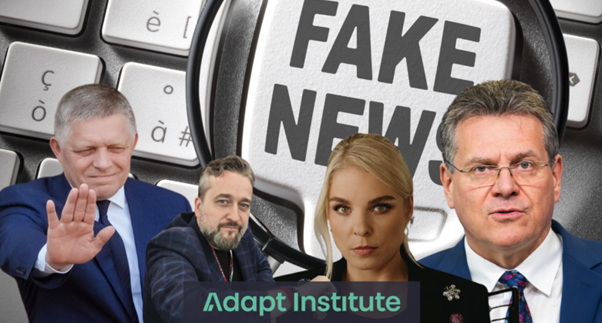
Adapt Institute provides an overview of disinformation trends that have been on the rise in the last two weeks:
- Findings by the investigative portal Declassified UK have shaken the Slovak political scene. The British government was allegedly contributing to campaigns aimed at building democracy and increasing voter turnout in Central and Eastern European countries, including Slovakia.
- What many would consider a relatively normal activity among allies, the ruling coalition decided to weaponise for political gain. Robert Fico spoke at a press conference about British interference in the elections through journalists and political activists. The original investigation only mentioned the involvement of influencers to mobilise young voters.
- Several disinformation actors exploited the situation to attack the opposition, the media and civil society. However, the narratives about influencing the 2023 parliamentary elections in favour of Progressive Slovakia and serving the interests of the West ultimately boiled down to an election calculator and a communication campaign for young voters.
- In addition, attention was also focused on the trade agreement between the European Union (EU) and the US. Ongoing attacks on Ursula von der Leyen and Maroš Šefčovič were accompanied by narratives about the EU being sold out and national interests being betrayed.
British interference in the elections? Or just a distraction?
At the end of July, information about British interference in the 2023 Slovak parliamentary elections entered the Slovak information space. At least, that was how members of the governing coalition and various courtiers from the alternative and quasi-media scene tried to present the situation. The information was first made available to the Slovak public (on July 28, 2025) by the relatively newly established portal Marker.sk. Among other things, this portal brings together various journalists and commentators with dubious pasts and a tenuous relationship with the facts. The content bombastically proclaimed secret influence on the Slovak elections, claiming that the British had supported the Progressive Slovakia (PS) party.
The article was based on investigative reporting by the Declassified UK portal, which pointed out how the British government (the Foreign Office and Zinc Network Ltd) had invested nearly £10 million in campaigns in 22 countries in Central and Eastern Europe. The campaign was part of a broader effort to build resilient societies in the fight against disinformation. Influencers and other popular figures were supposed to help promote voter turnout. Slovakia was no exception.
What could be seen as support for democracy and what original investigative journalism described as mobilizing young voters became, in the hands of the Slovak government coalition and friendly media, interference in the elections. They latched onto the opinion of a former employee of Zinc Network Ltd, the company that was supposed to coordinate the British campaign. In his statement, he described similar activities as "state propaganda" and accused the company of interfering in foreign elections.
On July 29, Robert Fico was backed at a press conference by the Minister of Foreign Affairs, the Deputy Speaker of Parliament, and the Prime Minister's chief advisor. According to the Slovak PM, "a foreign power influenced the Slovak parliamentary elections in 2023 to the detriment of SMER." He went on to say that in 2023, funds were to be spent on "journalists and political activists to influence the elections to the detriment of SMER as the opposition party and to the benefit of Progressive Slovakia."
Due to the situation, the British ambassador was summoned by the Slovak government, and he shared the statement of the British Foreign Office. It rejected Fico's accusations, saying that the activities were intended to "encourage young people to participate in democratic life in their countries by participating in elections, regardless of their political affiliation or support."
What is the reality? The author of the investigation himself, in a response to Denník N, clearly denied that the campaign was party propaganda. He also clarified that "no journalists were involved in this operation" and that "the campaign in Slovakia was only one part of a larger project in many European countries."
According to available information, in the case of Slovakia, the support amounted to several tens of thousands of euros – it was intended to help finance an election calculator from the organization Memo98 and a communicationally neutral campaign promoting voter turnout. The cooperation with Zinc Network was transparently stated on the website. However, this did not prevent many actors from claiming the exact opposite and using the situation to further attack their arch enemies – the opposition, journalists, and civil society.
That is why we looked at the issue of so-called British interference in the Slovak elections using the Gerulata Juno analytical tool. We used it to analyze the most popular posts on Slovak Facebook that contained the keywords "Britain," "British," or "Zinc." We excluded posts that did not contain problematic narratives from the list. We then evaluated the posts based on the total number of interactions (the sum of all reactions, comments, and shares).

The post with the most interactions belongs to Robert Fico. In the video, the PM appeals to his voters and supporters never to forget that “Slovak political activists and journalists, paid and controlled by a foreign power – Great Britain – helped PS at the expense of SMER-SSD.” Fico thus returned to the misleading narrative he weaponized at a dramatic press conference (see post below). According to Fico, Great Britain cannot "get over the fact that it is no longer a colonial power." He thus bet on portraying the West as an evil superpower trying to unjustly control Slovakia. Fico added to these reflections with further conspiracy theories about plots to damage his party or him personally. He mentioned the assassination attempt in Handlová and the so-called coup attempt – by which the Slovak PM means regular civil protests that were organized after the weakening of the rule of law and his visit to Moscow. In his post, Fico deliberately and openly lies. He talks about the involvement of journalists and political activists who were supposed to have been working on behalf of the PS. He presents this as a proven fact on which he bases his attacks on enemy groups. However, there is no evidence whatsoever, and as we wrote above, even the author of the original investigation disagrees with this statement. Fico relies on combining truth with fabrications. He does this in another case as well. The UK was supposed to confirm that it had tried to increase youth voter turnout. However, the prime minister continues to wrongly and without evidence confuse the mobilization of young voters with election interference, in which journalists were allegedly involved.
The second post was also published by the Slovak PM. It is a recording of a press conference at which Robert Fico accused the UK of influencing the parliamentary elections in Slovakia. He ironically referred to the opposition party Progressive Slovakia as "Obedient Slovakia," which he said was serving "on the orders of the West." The PM has tried to explain the whole case to the public, but he's thrown in his own fabrications, which he's using for political gain. The investigation never once mentioned the involvement of journalists or any direct support for a specific party. Regardless, Fico claims that "our ally financed a group of journalists and political activists in Slovakia through an agency whose task was to damage" his party in the 2023 parliamentary elections. The PM links the situation to the blocking of the 18th package of sanctions and paranoidly theorizes about a Western conspiracy targeting Slovakia because of its so-called sovereign foreign policy. According to Fico, the Progressive Slovakia party is "a fabricated product that is precisely financed by Western countries" with the aim of destroying the prime minister's party.
The third post was published by the dubious Slovak influencer Ľuboš Hrica, who has gained popularity in recent years by sharing controversial opinions and sometimes false information. He likes to contribute to socially critical topics, and the UK campaign was no exception. Hrica decided to attack PS voters and opposition politicians in his short video. He claimed that they were willing to "have their kidneys removed" for "a few pennies" while the British laughed at them (as if they were slaves). He paid special attention to Veronika Cifrová Ostrihoňová, who, as an influencer, took part in a mobilization campaign called "I want to stay here." The campaign was intended to motivate young voters not to give up on Slovakia and to participate in the elections. She later became a MEP for the PS, which, of course, part of the disinformation scene sees as a secret connection and the influence of foreign powers. However, the reality is probably a little simpler – if someone has a genuine interest in public affairs, it is quite possible that they will eventually become involved in politics.
Another post was published by the PM again. Fico posted a video (probably while on vacation) where he continues to theorize about British interference in the Slovak elections. This time, he focused on the media, which he claims tried to cover up the scandal. According to Fico, "the level of involvement of Denník N, Soros' SME and Aktuality, but unfortunately also others, [...] in covering up this scandal is so appalling that we have every reason to believe that this scandal affects them more than Obedient [Progressive] Slovakia itself." In other words, according to Fico, if you are a journalist and you verify the PM's statements, which are miles away from the facts, you are trying to cover up a conspiracy.
The last post in the series was published by Matúš Šutaj Eštok. In it, the Minister of the Interior uncritically repeated the PM's narrative about the British government secretly paying influencers and activists to "influence the Slovak elections in favor of PS." It would be difficult to say that this is surprising coming from the leader of the Hlas-SD party. He has long been a vocal proponent of Fico's claims, increasingly aligning himself with the PM's rhetoric throughout his career. However, it is quite dangerous when similar statements are made without any restraint by the Minister of the Interior, who, in a democratic state, should be a guarantor of security and order in society.
A chance to attack journalists and civil society
The mobilization of young voters by the British government has been essentially the most important domestic issue in recent weeks. As expected, it was dominated mainly by representatives of Slovak social democratic parties. Matúš Šutaj Eštok continued his communication by stating that the police had already begun investigating "suspicions of election interference based on intelligence information." However, he chose non-governmental organizations, which are supposed to appear "independent and impartial" but are in fact "engaged in political activities," as the main target of his rhetoric.
The SMER-SSD party was somewhat more aggressive in its communication, following the example of its chairman. The party's official profile reposted two posts by MEP Ľuboš Blaha. In one of them, he called for Veronika Cifrová Ostrihoňová to be sent straight to prison for treason. Blaha was not bothered by the fact that she had participated in the campaign as an influencer with no political ties. He preferred to stick to narratives about British interference in the elections, which was supposed to help Progressive Slovakia. Blaha also quite unfairly compared the situation of the former influencer to the case of Bohuš Garbár, who was caught in the past receiving money from a member of Russian intelligence and subsequently accused of spying for Russia.
In the second video, Blaha worked with his favorite term "agent" – he had long used it to attack former President Zuzana Čaputová, whom he labelled an American agent in the past. Slovak courts also took up this dispute and ordered Blaha to refrain from similar attacks. This time, he accused Ostrihoňová of “taking money from the British government to influence the elections in Slovakia according to the wishes of this foreign government.” According to Blaha, the reality is that the British government wanted PS to win the elections, not SMER. He claims that British investigators have uncovered this. As we have already mentioned, the original investigation makes no mention of this, and the author of the article also denied these claims. One of the MEP's lies in a live broadcast.
Another post by the SMER-SSD party claimed that even £10 million was not enough for Progressive Slovakia to win the elections. The official profile of the ruling party deliberately omitted the fact that this (attractive-sounding) amount was allocated by the British government to 22 countries, not just Slovakia. Nevertheless, Fico's party uses this as one of its main arguments for accusing the elections of being unfair. The deputy speaker of parliament, Tibor Gašpar (SMER-SSD), also lived up to his reputation. At the aforementioned press conference, he attacked the media outlet 360 and claimed, without evidence, that they were "financed from exactly the same sources."
Former MP György Gyimesi, who now is a member of the Hungarian Alliance party, also demonstrated athleticism in his reasoning. In his post, he accused the media (the so-called progressive dailies) of analyzing one newspaper article too quickly and concluding that "there is nothing to see here." Let's break it down: the article in question, which is investigative in nature, makes accusations that are exploited by the Slovak PM for his own political ends. Fico fabricates the situation and adds journalists who were not even mentioned in the original article to the conspiracy theory, alongside the British government. Is this an overly hasty analysis and a suspicious effort by the media? Or is Gyimesi trying to capitalize on the topic by forming conspiracy theories?
Let's not forget that when it comes to conspiracy theories, former MP Anna Belousovová, who has been trying to maintain her popularity in recent years by spreading misinformation on social media, cannot be left out. Belousovová was reportedly not surprised that the British government was supposed to pay influencers for a "political campaign in favor of Western interests in Central and Eastern European countries." Although this is not the case, the nationalist politician went on to say that she had a bad feeling that the time was coming when the West would "appoint its own governors or viceroys to its colonies without elections." In addition to her reflections on supporting the PS, she concluded her post by calling on the audience to start a national liberation struggle.
Brussels' serfdom
As far as Europe is concerned, disinformation actors were particularly interested in the trade agreement between the US and the EU. At the end of July, the world's two largest economies agreed on 15% tariffs on European goods. The agreement also includes the EU agreeing to purchase $750 billion worth of energy and to invest more in US military equipment. For one part of the political and expert spectrum, this is a halt to the trade war, while for the other, it is a political capitulation by the EU.
For Milan Uhrík and others, it was an opportunity to attack Ursula von der Leyen and EU Commissioner Maroš Šefčovič once again. The latter had already been the target of misleading rhetoric, particularly from members of the far-right Republika, two weeks ago. According to Uhrík's video, both European Commissioners are traitors who were part of a plan to exchange cheap Russian energy for expensive American fuel. Uhrík presents his audience with a simple black-and-white reality that lacks many contextual details – for example, the fact that trade with Moscow is limited due to Russia's aggression and not because of the incompetence of EU representatives.
György Gyimesi compared this agreement to a new era of dictatorship in Brussels, which will determine "modern quotas". These will allegedly be enforced through the "threat of withdrawing EU funds". Like Robert Fico, he pointed out the importance of the details of the agreement. However, in his post, the PM praised Maroš Šefčovič, whom he essentially pushed into the European Commission. He described the 15 percent tariff as “a good result of Commissioner Maroš Šefčovič’s negotiations.”
Paradoxically, while Fico praised the agreement, his party's official profile published a video in which Tibor Gašpar talks about the agreement as transatlantic obedience. He claims that it is "customs blackmail and arms deals" with which the EU is shooting itself in the foot. It seems that the duplicity of the SMER-SSD party knows no bounds.
Former Republika candidate Miro Heredoš said on his profile that the agreement "destroys European states." Heredoš also took issue with Fico's praise for Šefčovič, saying that the EU is "rushing towards destruction and we are singing odes". In another post, he accused the EU of destroying the continent and Slovakia. In addition to the Green Deal, he also spoke about the destruction of Slovak agriculture and food self-sufficiency. Heredoš concludes the video with the dramatic statement "we are a colony, we are slaves" and again calls for the collapse of the EU. With similar content, he offers his audience a rather one-sided picture of the Union. Focusing only on the negative effects and ignoring the positives and opportunities arising from European policies is one of the basic tactics used by both politicians and disinformers.
Project is organized by Adapt Institute and supported by the Prague office of the Friedrich Naumann Foundation for Freedom. It continuously monitors the activities of both Slovak and foreign disinformation actors, but focuses mainly on the former. The project activities are built upon daily monitoring of emerging disinformation, hoaxes, and conspiracy theories in the online information space. This approach allows the analysts to identify disinformation posts and narratives that resonated with the public the most, as well as to find out where they originated, and how they spread and evolved on social media. The report takes the form of a bi-weekly summary of arising trends in the spread of malicious information content online. Based on that, Adapt Institute can inform the public about emerging and current trends in the field of disinformation, manipulation, and propaganda.