DISINFORMATION
Let's save Russian gas! Propagandists cheer on the blocking of sanctions and continue to demonize Brussels


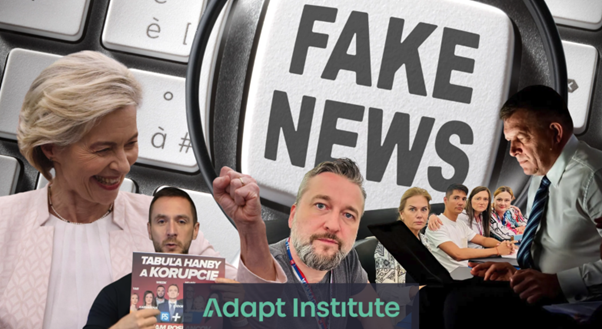
Adapt Institute provides an overview of disinformation trends that have been on the rise in the last two weeks:
- Slovakia blocked the adoption of the 18th package of sanctions against Russia for several days. In addition to attacks and falsehoods targeting European Union (EU) institutions, the disinformation scene rode on the remarks of Robert Fico, who described the eventual cut-off of Russian energy supplies as an imbecilic idea.
- In addition, the Slovak PM used the situation to attack the opposition, once again playing with the specter of World War III and even threatening to veto the 19th package of sanctions. All this was done to divert attention from Slovakia's failure to prepare for European long-announced intention to stop trading with Russia, an aggressor and unstable partner.
- Slovak MEPs boasted about calling for Ursula von der Leyen's dismissal, which ultimately ended in failure. Despite the vote of no confidence being defeated, the President of the European Commission (EC) faced manipulative accusations of incompetence, arrogance and involvement in mega corruption scandals. However, the actors involved at least revealed the political dimension of the motion, for which issues of corruption and transparency were secondary.
- At home, a wave of hatred towards journalists, sexual minorities and Ukrainians rose again. The start of the trial of Juraj Cintula, who attempted to assassinate Robert Fico last year, opened the floodgates for the return of narratives about a bloodthirsty opposition and media.
Slovakia's "moral battle" over Russian gas
In recent weeks, the adoption of the 18th package of sanctions against Russia has been a hot topic. The package, drafted by the EU, was aimed primarily at the energy, banking and military sectors. Its approval, which finally took place on July 18, was blocked for days by Slovakia. Slovakia blocked the adoption of new sanctions against Russia because it demanded guarantees for the European Commission's REPowerEU initiative, which includes a ban on Russian gas imports from 2028.
Prime Minister Robert Fico withdrew his veto on the sanctions package after the EU offered Slovakia guarantees. These are to relate to gas prices, transport fees, and the possibility of declaring a crisis situation in the event of high gas prices or shortages. However, in communicating his approach, Fico happily used narratives sympathetic to Russia, with the support of part of the disinformation ecosystem. He also launched attacks on the opposition.
This is one of the reasons why we used the Gerulata Juno analytical tool to look at the issue of blocking the 18th package of anti-Russian sanctions over the past two weeks. We used it to analyze the most popular posts on Slovak Facebook that contained the keywords "sanctions," "18," or "package." We excluded posts that did not contain problematic narratives from the list. We then evaluated the posts based on the total number of interactions (the sum of all reactions, comments, and shares).

The post with the most interactions belongs to Milan Mazurek. The MEP from the far-right Republika movement took advantage of the situation surrounding the blocking of the sanctions package to attack one of the European Commissioners. Maroš Šefčovič, the current European Commissioner for Trade and Economic Security, was the nominee who was de facto pushed through by Robert Fico. In his statement, Mazurek claimed, among other things, that while the Slovak PM openly criticizes the EC's plans, Šefčovič is selling out his own country by "agreeing" with them. The reason for this is said to be support for the "worst policies that will seriously damage the Slovak Republic" – from migration and green policies to cutting off fuel imports from Russia. Mazurek has bet on the narrative of the government coalition's hypocrisy, which he has supplemented with well-worn hateful phrases directed against EU policies. Naturally, he was mainly targeting the SMER-SSD party's electorate, where he has the potential to gain political support. For the sake of accuracy, however, it should be noted that it is not the role of European Commissioners to defend the interests of individual states or government coalitions. By their very nature, they are supposed to focus on the good of the EU as a whole, while the states have their own sphere of influence in the Council of the EU.
In a second post, published by Robert Fico, the PM explains his actions to block the adoption of sanctions, which he describes as one of the "next battles for Slovakia's energy security". Fico openly admits that Slovakia will not be able to block the approval of the REPowerEU plan, which will turn off the tap on Russian gas from the beginning of 2028. He has therefore linked it to the veto of the 18th package of sanctions against Russia, which requires unanimity. He described stopping Russian gas as an "imbecilic" proposal and the "result of a boundless obsession with Russia" that will damage Slovakia's economy "just" on the basis of the argument "because Ukraine." According to Fico, this argument is even enough to "start World War III." The PM concluded his video with an emotional addendum with a conspiratorial undertone, in which he tried to sell his audience the "deep moral meaning" of blocking sanctions and the threat of the EU "overthrowing the legitimate government of Slovakia." This situation shows once again that Robert Fico is willing to use any short-sighted tools to defend Slovakia's interests (whether real or fictitious). These tools also serve to shift responsibility away from the fact that the EU's plans to cut off its energy supplies from Russia have been known for a long time, but Slovakia has made no preparations whatsoever.
The third post was published by Milan Uhrík, who followed up on the rhetoric of his party colleague Milan Mazurek (post above). In addition to Maroš Šefčovič, he also attacked Ursula von der Leyen. She is allegedly doing everything she can to destroy the EU and force Slovakia to approve the 18th package of sanctions and cut itself off from "bad Russian oil and bad Russian gas". Uhrík links these two separate issues directly, probably for the sake of simplicity in his communication, which is also aimed at part of the SMER-SSD party's electorate. He directly tells Fico that he wonders why he "did not block the anti-Russian sanctions definitively, because we would have done so long ago." He then links the issue of cutting off Russian energy supplies, quite illogically and out of context, to the narrative of Slovakia's neutrality, which is now beginning to be linked to EU membership.
Another post was published by Robert Fico. It is a recording of a press conference on July 12, at which the PM emphasized the economic threat to Slovakia if it cuts itself off from Russian gas. He tries to present Slovakia's position as an exceptional situation and demands guarantees regarding gas prices, transit fees, and assistance in the event of a lawsuit by Gazprom (Fico claims that the contract between Slovakia and Gazprom, which is valid until 2034, provides for the possibility of legal action in the event of non-fulfillment of obligations by one of the parties). According to Fico, "we somehow built this country" because we had "secure, stable gas supplies from the Russian Federation." It should not be necessary to point out that it was Fico who dealt with the gas crisis caused by Russia's suspension of gas supplies to Europe in 2009. And, of course, it was Russia that destabilized the security situation in 2014 and 2022. It is therefore quite difficult to talk about a stable partner in this context. Fico should know this but despite that he once again described the REPowerEU plan as an ideological decision stemming from an obsession with Russia. He also attacked the Slovak opposition, which Fico considers to be mere servants of the West – "they would vote for anything [...] they wouldn't care about anything, just so long as they don't stand out from the crowd." There is nothing like sticking out when voting on sanctions against an aggressor because of one's own unpreparedness.
The last post in the series was published by Robert Fico on the eve of the approval of the 18th sanctions package. He announced Slovakia's success in the negotiations to the public and boasted about securing guarantees for Slovakia. For Fico, however, this was only the first stage of the battle with the EC, because there is still on the table "the imbecilic proposal of the Commission to cut ourselves off from Russian gas," which could threaten Slovakia's interests in the future. At least according to the PM, who, caught up in his own paranoia, is already sensing betrayal by Brussels officials and threatening them that he can cause a similar circus when it comes to "the next, unnecessary, 19th sanctions package, which will not change Russia's position but requires unanimity."
A massive corruption scandal?
In addition to the top posts, other Slovak figures also addressed the issue of sanctions. Like Robert Fico and the leaders of the Republika, they sought to portray Slovakia as vitally dependent on Russian gas, with no possibility of change. The EU and Brussels were, as usual, accused of ill-considered policies and totalitarian practices directed against member states.
Anna Belousovová described the approval of the 18th package of anti-Russian sanctions as "masochistic tendencies" on the part of the EU. The former nationalist politician continues to promote narratives that portray sanctions as ineffective measures, citing the serial number of the latest sanctions package as proof. Russia is said to have already overtaken Germany and Japan economically – although we do not know on what basis Belousovová bases this claim, easily accessible data (such key indicators like GDP) clearly show the opposite. Regardless of reality, Belousovová says that the EU "is controlled by total idiots or traitors who know that this is self-destructive behavior and are doing it deliberately."
Jozef Viktorín could not be absent from the defense of Slovakia's sovereign interests. In his post, the member of the Republika movement felt the need to respond to the German chancellor, who criticized Slovakia for blocking sanctions. Viktorín did so in his own way, accusing Friedrich Merz of "hostility" and "blackmail", and continuing with manipulative narratives about Germany's Nazi past. However, placing Merz's words in the context of 1939 and making stray calls for the payment of war reparations for World War II naturally did not contribute anything constructive to the information space.
The second topic that has resonated in the EU in recent weeks was the vote of no confidence motion against EC President Ursula von der Leyen. The main reason was the so-called Pfizergate scandal, which includes allegations of non-transparent conduct by the president during the COVID-19 pandemic. The General Court of the European Union also ruled that the EC had erred in refusing to disclose communications between Commission President Ursula von der Leyen and the head of the US pharmaceutical company Pfizer, Albert Bourla, regarding the purchase of vaccines. As we reported in a previous report, the court's ruling on the EC's failure to ensure transparency is being misused by various actors to launch further attacks on EU institutions. The vote of no confidence was finally defeated on July 10.
The vote was also initiated by the Europe of Sovereign Nations faction, which includes the Republika movement. Its chairman, Uhrík, said that von der Leyen is "extremely dangerous" and "arrogant and incompetent". In other posts, he spoke suggestively about mega corruption scandals and "sick" migration, rainbow and green policies. Of course, these have nothing to do with the Pfizergate affair, but Uhrík's rhetoric at least reveals the political dimension of the attempt to dismiss von der Leyen.
In addition to Uhrík and Mazurek, all Slovak MEPs from the SMER-SSD and Hlas-SD parties voted in favor of the no-confidence motion. The remaining Slovak MEPs (from Progressive Slovakia and KDH) were against the dismissal of the president. Both Uhrík and Mazurek called them "corrupt" and "traitors", who were supposed to protect von der Leyen from deserved justice.
The MEPs from the SMER-SSD party boasted about the vote of no confidence against von der Leyen in two posts. In one of them, she was said to have committed "the biggest corruption scandal in the history of the EU", while in the other she was held responsible for "unprecedented disgusting failures and mistakes". Ľuboš Blaha was particularly active in this regard. However, he followed the same line as his far-right colleagues from the Republika. In addition to attacking the EC President, he also focused on the opposition parties Progressive Slovakia and KDH, which, while supporting von der Leyen, are said to promote non-transparency and corruption.
Court trial of attacker revives hatred towards journalists
Several topics resonated on home turf. However, they lacked a unifying element. That is, if we do not count the artificial creation of enemies or the spread of hatred towards specific groups of people – from the media through Ukrainians to sexual minorities. In addition, the trial of Juraj Cintula, who committed an assassination attempt on Robert Fico in 2024, began on July 8. This contributed to the revival of narratives directed against the opposition and the media.
According to the PM, for example, it would be fair if “all those who created him were sitting next to the assassin in court without being charged. So that everyone in Slovakia can see what hatred represented by intolerant politicians and deceitful and rabid media can do." Fico also mentions that there is allegedly "ironclad evidence that the assassin was an opposition activist" and that he is "a product of opposition hatred, its extended arm." However, neither Fico nor the governing coalition has been able to produce this evidence in over a year. This should therefore be seen as nothing more than a tactic aimed at discrediting normal political scrutiny by the opposition and the media.
György Gyimesi (a politician from the Hungarian Alliance party) took a similar approach, saying that it was “amusing to watch how the liberal-progressive daily media tried to prepare their readers in advance of Cintula’s trial by insisting that they had nothing to do with the assassination attempt on the prime minister.” He claims that Cintula is their "hero" and "product." The statement that the media is "stirring up passions and assassinating the characters of coalition politicians" is just a cover for normal reporting on political missteps—which, of course, is not welcome by some actors.
This is also the case with Ľuboš Blaha, who described Cintula in his post as a “progressive Frankenstein” or “progressive murderer.” The intention is clear – Blaha used variations of the word “progressive” 10 times in his post, returning through the court process to demonizing the opposition and further spreading hatred towards the media and journalists. In the same vein, Cintula was described by Eduard Chmelár as "the golem of the opposition, brought to life by the poisonous words of the opposition media".
We will remain on the topic of attacks on journalists thanks to another MEP from the SMER-SSD party. According to Erik Kaliňák, journalists supposedly "dictate to people what they can think, who they should believe and who they must vote for" and "distort the battle of political opinions through censorship and one-sided criticism". Following in the footsteps of his older colleagues, the MEP is casting himself as the victim of a media witch hunt. However, behind his political views lie the weakening of democracy and, at the very least, dubious contacts with Russia.
According to Uhrík, "no normal person believes the mainstream media anymore." Many mainstream media outlets are said to function as "press organs of progressives or press organs of Brussels." In another video, in which Uhrík appears alongside Mazurek, the two mock the issue of journalists' mental health. They claim that they have "never met a mainstream journalist who does not have mental health issues."
Let's ban LGBTI+ people and send Ukrainians to the front!
In addition to journalists, hatred from the disinformation camp was also aimed at the LGBTI+ minority, for whom a cultural festival called Rainbow Pride was organized in Bratislava on July 19. While for some it is a safe space celebrating diversity of identities, for actors with a far-right past it is something unnatural and disgusting.
It probably comes as no surprise that one of them was Milan Uhrík, who considers such events to be a "threat to the moral development of children." In his post, he returns to the tried-and-tested narrative of Western decline and the dragging of sexuality onto the streets. The so-called rainbow ideology, as Uhrík and others like to call efforts to achieve equality for sexual minorities, is supposedly a "dead end of development."
The case of Miroslav Heredoš was similar. In his post, Uhrík's former party colleague called on the government to consider "banning such events, at least completely prohibiting access to young people under the age of 18, regardless of whether they are accompanied by their parents." Similar efforts to restrict freedom by people who describe marches for minority rights as "propaganda for their sick lifestyle" are still on the fringes of society, but they are nevertheless serious warning signs.
Heredoš also made headlines with a post about a Ukrainian young man who reportedly stabbed another young boy in Bratislava. The young man is charged with bodily harm and disorderly conduct and has been taken into custody as a preventive measure. Heredoš used the situation to demonize the Ukrainian minority and subsequently scare people about their presence. In Slovakia, he claims, "there is clearly a wave of Ukrainians on the rise," and because of the incident, it is unacceptable for the government to support Ukraine's membership in the EU.
According to Ľuboš Blaha, we have "Ukrainians with various war psychoses who do not hesitate to use weapons and kill people" running around here. However, the media allegedly does not report on this because Ukrainians are "protected animals". This is a prime example of dehumanization by an MEP, who continued to scare and demonize with questions such as "who will protect our children" and "why aren't they [Ukrainians] fighting on the front lines?" Marek Géci from the far-right Republic party went so far as to call for the deportation of "these aggressors to the front lines".
Project is organized by Adapt Institute and supported by the Prague office of the Friedrich Naumann Foundation for Freedom. It continuously monitors the activities of both Slovak and foreign disinformation actors, but focuses mainly on the former. The project activities are built upon daily monitoring of emerging disinformation, hoaxes, and conspiracy theories in the online information space. This approach allows the analysts to identify disinformation posts and narratives that resonated with the public the most, as well as to find out where they originated, and how they spread and evolved on social media. The report takes the form of a bi-weekly summary of arising trends in the spread of malicious information content online. Based on that, Adapt Institute can inform the public about emerging and current trends in the field of disinformation, manipulation, and propaganda.