Disinformation
Sovereign Babiš and adored Orbán. The disinformation scene rejoices in political developments and apologizes to Moscow for Russophobia


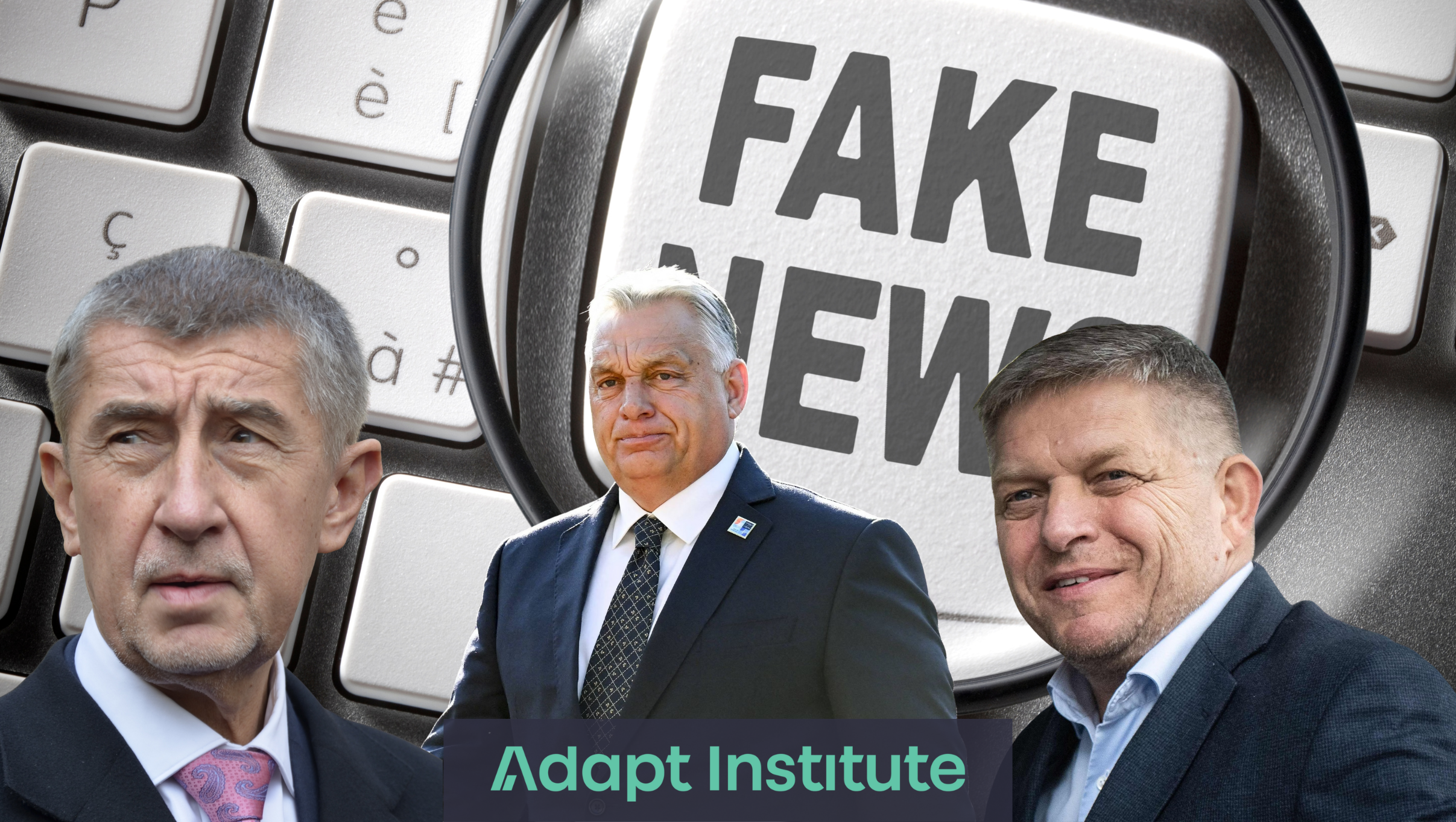
Adapt Institute provides an overview of disinformation trends that have been on the rise in the last two weeks:
- The beginning of October offered another historic moment for weaponization by the ruling coalition and the disinformation scene. The 81st anniversary of the Carpathian-Dukla Operation was marked by references to Soviet liberators and apologies for so-called Western Russophobia. The repertoire of pro-Russian propaganda narratives also included talk of Ukraine's lack of sovereignty and fascism in the EU among other topics.
- The mix of disinformation posts once again included narratives directed against the EU. In this sense, some actors exploited Viktor Orbán's statements against Ukraine's integration into the EU, as well as the vote to remove the parliamentary immunity of MEPs accused of various acts in Hungary. These topics were presented misleadingly by disinformers and served to degrade the entire EU.
- The Slovak political and media scene also followed events in neighboring Czech Republic. The election results, which were won by Andrej Babiš, pleased many actors in the Slovak disinformation ecosystem. On the contrary, the outgoing government of Petr Fiala was attacked for allegedly pursuing Western interests and undermining relations with Slovakia.
Czech Republic's well-earned future?
The first weekend of October in the Czech Republic was marked by parliamentary elections. Their course and results were closely watched in Slovakia as well. Expectations mainly concerned the future of Czech-Slovak relations and the Czech Republic's further geopolitical direction. Whether Prague will be inspired by the actions of Robert Fico or Viktor Orbán remains to be seen.
However, the fact is that the victory of Andrej Babiš and his ANO movement, which won more than 34% of the vote, was also welcomed by many well-known figures from the Slovak government and disinformation ecosystem. Before and after the elections, they focused primarily on criticizing former PM Petr Fiala and the SPOLU coalition. The coalition ultimately finished second with 23% of the vote. A total of six political entities entered parliament after the elections, and the government will likely be formed by Andrej Babiš with the far-right SPD and the controversial Motorists.
In addition to the usual narratives about being servants of the West, the outgoing government led by Petr Fiala was also accused of deliberately undermining relations between the Czech Republic and Slovakia. Similar rhetoric fits into the broader context of recent years, when Slovakia faced criticism from its partners for its foreign policy actions (gradual rapprochement with Russia, undermining the unity of Western structures, and weakening support for Ukraine).
The response of many government officials and friendly "alternative" media outlets has been precisely the attacks outlined above. We also reported on the wave of inappropriate criticism that befell Vít Rakušan, outgoing Minister of Interior (STAN), after his participation in the protest in Bratislava in our last report. However, this is just one of many incidents that have accumulated between the Czech Republic and Slovakia in recent years.
That is why we also looked at this topic using the Gerulata Juno analytical tool. We used it to analyze the most popular posts on Slovak Facebook that contained the keywords "Czech Republic," "elections," and "Babiš." We excluded posts that did not contain problematic narratives from the list. We then evaluated the posts based on the total number of interactions (the sum of all reactions, comments, and shares).

The post with the highest number of interactions belongs to Milan Mazurek. Its statistics significantly surpass other content in the ranking. The video, in which the MEP from the far-right Republika movement attacks, among others, the Czech media and Czech MEP Tomáš Zdechovský (KDU-ČSL), has been viewed more than 650,000 times. Mazurek faced criticism from the Czech community after expressing his pre-election support for Libor Vondráček from the SPD. Both politicians are anchored in the far-right part of the political spectrum. Mazurek specifically defended himself against accusations that he had questioned the Holocaust in the past. According to the Slovak MEP, he did not do anything of the sort and neither had he been prosecuted for anything similar. However, the fact is that in 2016, he wrote a post on social media in which he compared the six million dead Jews to a fairy tale. According to an article published by Aktuality.sk, Mazurek specifically wrote that "all we know about the Third Reich are lies and fairy tales about six million and soap made from Jews. They teach nothing but lies about Hitler." The post was also investigated by the Attorney General's Office at the time. It is not entirely true that Mazurek has not made statements in the past that resemble Holocaust denial. He continues to pride himself on other intolerant attitudes and builds his communication around them. To add to this, in the post analyzed here, he also called journalists "a bunch of liars" and urged voters not to trust the mainstream media.
The second post was published by Minister of the Interior Matúš Šutaj Eštok. In it, the chairman of the Hlas-SD party congratulated the election winner, Andrej Babiš. There would be nothing unusual about that, but Šutaj Eštok could not resist making a peculiar remark and attacking the government of outgoing PM Petr Fiala. In these elections, the Czechs were supposed to "make it clear that they want politicians who defend the interests of their nation, not foreign geopolitical interests." This is an exemplary display of a narrative that feeds on the search for conflicts between national sovereignty and membership in Euro-Atlantic structures. It also fits into the broader rhetoric that speaks of "hostile" politicians serving Western interests. At least, that is how politicians who prefer a so-called sovereign foreign policy in all directions (i.e., rapprochement with Russia) try to sell reality to their audience. Minister of the Environment Tomáš Taraba (elected for the Slovak National Party) took a similar approach, accusing Petr Fiala's government of "wiping its mouth on Slovakia to drag us into the election campaign." The Slovak course of recent years has been a bogeyman for part of the Czech electorate.
The third post was published by another Slovak MEP. Ľuboš Blaha (SMER-SSD) this time, in addition to congratulating Andrej Babiš, said that "the Russophobic right wing has been defeated." He also claimed that the results of these elections would end the "era of anti-Slovak hatred and war hysteria". Blaha's only disappointment was that the radical pro-Russian movement Stačilo! did not make it into parliament. This sums up, in a way, the MEP's view of the Czech election results. Through them, he continues to portray a reality in which aid to Ukraine or criticism of Russian aggression is something Russophobic or hysterical.
Another post was published by Milan Uhrík even before the Czech elections took place. In a video with Tomio Okamura (leader of SPD), the chairman of the Republika party spoke about growing cooperation and shared views on migration, green policies, and aid to Ukraine. As expected, they essentially agree on all issues, rejecting and stopping them outright. It is no surprise that these far-right groups have expressed mutual support on several occasions. They focused primarily on narratives about the evil Fiala's government, which allegedly intended to deliberately disrupt cooperation within the V4 and attack Slovaks. For the sake of objectivity, however, it should be added that at the regional level, cooperation with partners who are distancing themselves from common interests can indeed be challenging. This narrative also quite obviously allows for further manipulation — any criticism of government actions should not be equated with an attack on Slovakia or its inhabitants. These are clearly separate issues, even though some current Slovak politicians are pragmatically trying to equate "anti-government" with "anti-state."
The last post in the series was published by Anna Belousovová. According to the retired politician, who ran for the European Parliament on the Republic's ticket in 2024, the results of the Czech elections are good news for Slovakia. Above all, it is an opportunity to improve cooperation within the V4 bloc, which can be a voice of reason at a time when "the EU leadership is dragging it into war with Russia." She also described Petr Fiala as the weakest PM in the era of Czech independence. According to Belousovová, the Czechs have clearly shown that they wanted to get rid of "a weak, incompetent PM, a representative of what I call 'Vlezdopredelovská' (“bootlicking“) politics". Once again, the narrative that places the Czech elections between the West and the East was repeated, with Babiš being portrayed as someone who will not be a servant of so-called foreign interests.
Propaganda hodgepodge
This report is unique in that, unlike others, it contains only one post from Slovak PM Robert Fico, who otherwise dominates the Slovak information space and social networks. In early October, the PM commemorated the 81st anniversary of the Carpathian-Dukla Operation. The Carpatho-Dukla operation was a Soviet and Czechoslovak offensive in northeastern Slovakia in the fall of 1944, aiming to link the Slovak National Uprising forces with Soviet armies against the Nazis. It was one of the largest mountain battles of World War II. Fico also published a recording of his speech from eastern Slovakia.
In addition to commemorating the victims and the obligatory mention of the liberators, Robert Fico also focused on current geopolitical events. He returned to the narratives that have adorned his anti-Western rhetoric for several years. According to the PM, today "it is becoming very easy to talk about war in Europe again." He claimed that the EU is currently turning into a "military power" that is considering "a war adventure." In other words, Fico used another historical moment to scare people with war and present Slovakia as a peaceful country.
The same was true of Fico's party colleague and MEP Ľuboš Blaha, who, on the anniversary, sent further thanks to Moscow for the liberation and apologized for "Russophobia in the West". He praised the PM's "wonderful speech" and joined in rejecting Slovakia's involvement in the "West's war against Russia." Michal Bartek of Hlas-SD also tried to captivate his audience with a simple message: "Yes to peace, no to war!"
Similar narratives are shared by various dubious websites with pro-Russian-colored communication. One example is the Slovanský výbor (Slavic Committee) website, which specializes in uncritically spreading Putin's claims about the spread of fear in Europe and guaranteed information about Western goals to "start a war with Russia." It goes without saying that these are mainly attempts to question Russian aggression and seek reasons in some Western conspiracy or expansion, which comes from the Russian propaganda handbook.
It is worth mentioning that during the filming of the video, MEP Blaha wore a St. George's ribbon on his clothing. Although he presents it exclusively as a symbol of victory over fascism, the fact remains that in recent years the black and orange ribbon has been misused to express support for Putin's regime (but also in the context of supporting pro-Russian sentiments in Ukraine in 2014). Today, together with the letter Z, it is considered a leading symbol of approval of the Russian invasion.
Glorification or at least justification of Russian military actions also appeared in other monitored content. Marek Šoun, one of the newer faces of the Slovak disinformation ecosystem, decided to repeat narratives about Ukraine's lack of sovereignty, which has become merely "a tool through which Western elites are trying to weaken Russia", in one of his posts. Moscow, he claims, is not a threat to Europe, but only “to fascism, to the ideology of hatred and double standards that is permeating EU and NATO politics today.” In addition to misunderstanding the characteristics of fascism, Šoun also repeats the traditional but misleading story of the struggle between good and evil, in which Russia is the eternal rival of Nazi or fascist movements.
Ľuboš Blaha also tried to question the potential of the Russian threat. This time, however, he focused on portraying the threat in the form of Ukraine. He outlined a version of the future in which Ukraine loses and, in its disappointment and chaos, decides to attack the West. He therefore apocalyptically described the EU's continued sending of weapons as "ritual suicide". And as if that were not enough, Blaha described the possibility of using frozen Russian assets as "stolen Russian money".
EU sinking?
Deceptive and misleading posts about the EU have covered a number of topics in recent months. The most prevalent were statements by Hungarian PM Viktor Orbán about Ukraine, which he called a non-sovereign country. These were followed by posts that attacked the EU in various ways, either with regard to green measures or in response to the vote to remove the parliamentary immunity of several MEPs.
Adoration of Viktor Orbán appeared in posts by far-right politicians. One of them was Marián Ďuriš, a member of the Republika movement, who currently serves as an advisor to MEP Milan Uhrík. He shared an edited video of Orbán's speech on Facebook. In it, the Hungarian PM presented statements directed against the EU and its migration policy and efforts to integrate Ukraine into its structures. According to Orbán, the EU is a sinking ship, buffeted by problems such as economic debt, migrants, violence, and expensive energy, all of which are the fault of Brussels bureaucrats.
The video thus serves to blame the EU and its representatives for various problems regardless of their real causes — such as Russian aggression against Ukraine and the changing geopolitical situation — which logically causes discontent and undermines confidence in EU membership. Ďuriš and other similar actors in the online space are exploiting the now relatively established perception of Orbán as a strong politician "with common sense" who wants to protect traditional values. His tendency toward authoritarian rule is overlooked or even glorified.
In connection with Ukraine, narratives targeting its president, Volodymyr Zelensky, were presented. Miloš Kováčik (who ran for the Republika movement in the 2023 parliamentary elections) shared two posts on Facebook degrading Zelensky through speeches by Viktor Orbán. Kováčik presented Orbán as a true statesman, not a puppet of foreign interests. In contrast, Ukraine is supposed to be dependent on foreign powers: "Ukraine is not independent, but financially, politically, and militarily controlled from outside." According to Kováčik, this is "...the difference between sovereignty and subordination. In Hungary, the people make the decisions; in Ukraine, foreign powers make the decisions."
Kováčik misleadingly said that EU member states supporting Ukraine's membership in the Union "have no backbone" in another post. He therefore predicted that "Europe is standing in front of a mirror today and must admit: Either it returns to the principles of national sovereignty, or it will turn into an empire of obedience, where Washington decides everything." Ďuriš thus presented a false dilemma, framing the discussion in black and white terms without any other options.
In addition to his adoration of Viktor Orbán, the case of Italian MEP Ilaria Salis, who was accused of assaulting far-right militants in Budapest in 2023, was also misused against the EU. Her case was not investigated because she was later elected as an MEP and was protected from further proceedings by parliamentary immunity. Now, together with two other MEPs, she has become the subject of a vote in the EP on the possible withdrawal of immunity, but this was ultimately not approved.
Far-right MEPs for Slovakia Milan Mazurek and Milan Uhrík published a video post on the matter with very limited information. In the post, Uhrík claimed that she was a progressive fanatic who "should have been prosecuted for attacking unsuspecting people from behind at anti-immigration protests and smashing their heads with a hammer". From the fact that she was not stripped of her immunity in the EP and handed over to the police for criminal prosecution, he hastily concluded that "progressives supported her and refused to take away her parliamentary immunity... Because physical attacks on their opponents are 'okay' after all..."
This is a distorted presentation of the facts. In reality, the discussion on Salis's parliamentary immunity was fragmented, with only one vote deciding on its preservation: 306 versus 305 votes (another 17 MEPs abstained and 92 were absent). The vote also confirmed the opinion of the EP's Committee on Legal Affairs (JURI), which voted to maintain immunity by a margin of 13 to 12.
In the case of the accusation itself, the media provide only brief information about the attack on neo-Nazi militants. Uhrík and Mazurek supplemented this with video footage of injuries allegedly caused by Salis, but the source of the information and the broader context are absent. At the same time, politicians created the false impression that Salis' guilt was a proven fact and, through the incident, attributed negative values to the EP and the EU as a whole, such as condoning violence as a method of political struggle.
Furthermore, they failed to mention that the discussion was also framed as possible punishment of opponents of Orbán's regime in Hungary. Although Salis' case was less clear-cut, the vote also addressed the possible suspension of parliamentary immunity for Hungarian opposition leader Péter Magyar and Klára Dobrev, a socialist MEP who was charged with defamation in Hungary. Magyar was accused of throwing a man's phone into the Danube after an argument in a Budapest nightclub, where he was filmed without his permission. Although all cases are controversial, it is irresponsible to jump to conclusions without evidence or court decisions.
Milan Mazurek also communicated other topics. For example, he spread narratives about corrupt EU officials who want to usurp power for centralized decision-making and impoverish citizens by stealing public funds. According to Mazurek, EU politicians cover up each other's corrupt behavior, wanting to steal from farmers and use their money for armaments. The goal is allegedly to line their pockets together with arms manufacturers at the expense of European taxpayers. Mazurek used dramatic music and editing in the video to give the impression that he was presenting serious revelations in the EP and gained considerable attention. In reality, he did not provide any relevant evidence for the allegations, and his speech took place at a time when there were relatively few MEPs in the chamber.
Mazurek also linked economic issues to the allegedly nonsensical topic of banning combustion engines, which is in line with the Republic's long-standing criticism of green measures. MEPs from the movement also use misleading narratives and environmental skepticism. In this case, Mazurek falsely argued that the measures are "totally destroying the European economy." The narrative is in line with the claims of pro-Kremlin actors who are seeking to change public opinion in EU countries that remain dependent on Russian fossil fuels.
Project is organized by Adapt Institute and supported by the Prague office of the Friedrich Naumann Foundation for Freedom. It continuously monitors the activities of both Slovak and foreign disinformation actors, but focuses mainly on the former. The project activities are built upon daily monitoring of emerging disinformation, hoaxes, and conspiracy theories in the online information space. This approach allows the analysts to identify disinformation posts and narratives that resonated with the public the most, as well as to find out where they originated, and how they spread and evolved on social media. The report takes the form of a bi-weekly summary of arising trends in the spread of malicious information content online. Based on that, Adapt Institute can inform the public about emerging and current trends in the field of disinformation, manipulation, and propaganda