Disinformation
Two sexes in the constitution and questioning the Russian threat


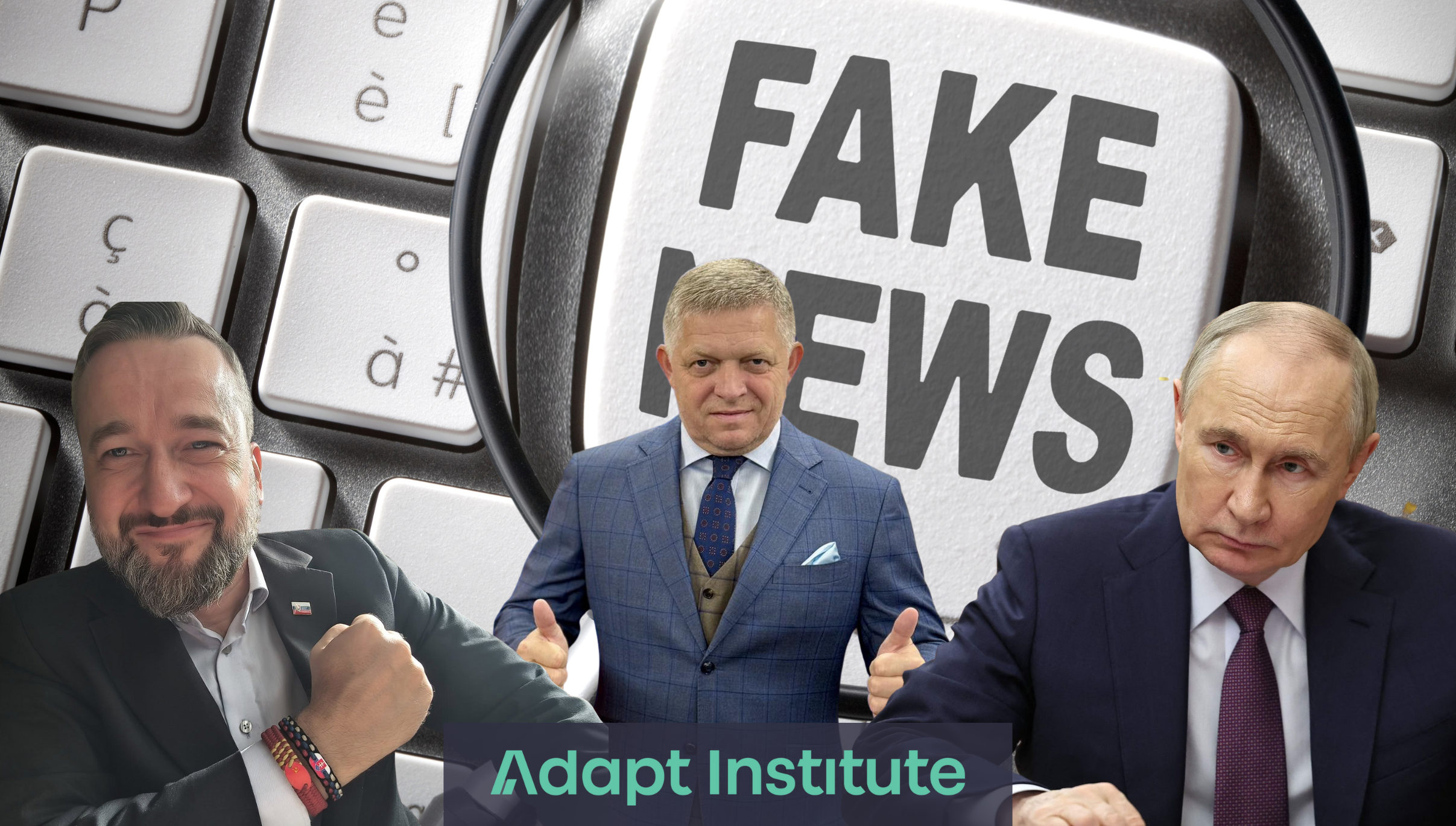
Adapt Institute provides an overview of disinformation trends that have been on the rise in the last two weeks:
- Disinformation sources dealt with the topic of consolidation only marginally. They focused their attention on criticizing opposition protests, questioning their size and delegitimizing them. They continued to blame the opposition for spreading hatred and attributed responsibility for the poor state of public finances to it.
- The amendment to the Slovak constitution enshrined two genders, modified the education and training process, and achieved Slovakia's sovereignty in matters of values and cultural ethics. This is another chapter in the story of cultural wars, which Robert Fico called building a dam against progressivism as part of his political campaign. Pro-government actors welcomed the change, which could also jeopardize EU funds, and proclaimed victory over LGBTI ideology.
- The growing tension between the West and Russia has not yet significantly affected the sentiments on the Slovak disinformation scene. Actors continue to question the Russian threat and hide provocations behind narratives about a stable energy partner. There have also been claims that the violation of Polish airspace was a Ukrainian conspiracy.
Protests against consolidation
Slovak economy continues to suffer. The new consolidation package by Minister of Finance Ladislav Kamenický was presented on September 9, 2025. Next year's austerity measures aim to reduce the public finance deficit by €2.7 billion. Without broader public debate and under the cover of summer silence, part of the package of measures was ultimately approved with express speed. So far, only those measures that target citizens, entrepreneurs, and local governments are known. In short, they mean higher taxes, lower incomes, and more working days.
There are no savings on the part of the state yet, and the presentation of measures in public administration has been postponed due to disagreements within the governing coalition. It appears that the package, which is one of the steps to rescue the Slovak economy, has probably not received the attention it deserves. Reports of various unnecessary budget expenditures and last year's increase in executive salaries also leave a bitter taste for citizens.
Over the past two weeks, a relatively small number of government officials and allied accounts have commented on the consolidation. They are trying to avoid the topic and are instead turning their attention to criticizing the new wave of opposition protests. They question the numbers of participants or delegitimize the protests themselves by repeating narratives about the opposition (or the media) spreading hatred. Above all, however, these actors seek to shift the responsibility for the disruption of state finances solely onto the shoulders of the opposition.
The opposition as a whole was portrayed in various posts as either incompetent or an aggressive entity seeking to overthrow the government. In general, however, the prevailing view was that it had no real solutions and would be unable to improve the economic situation. This was addressed, for example, by Judita Laššáková, a SMER-SD MEP with a background in disinformation media, who spoke in a video about the need for consolidation and the difficulty of implementing it. At the same time, however, she described the economic situation as a consequence of the previous governments of Igor Matovič and Eduard Heger, and at the end of the video she suggested that Matovič's voters were partly responsible for the current state of Slovakia.
The possibility of a general strike, originally proposed by the liberal center-right opposition party Sloboda a Solidarita (Freedom and Solidarity; SaS), became the target of attacks by disinformers. According to the Minister of the Interior, Matúš Šutaj Eštok (Hlas-SD), this is an insult to the labor movement, as SaS has allegedly never cared about workers and is opportunistically exploiting the situation to undermine the government.
Šutaj Eštok once again played the "assassination" card, stating that the opposition has always incited people against the government and its representatives and stirred up hatred, which was supposed to result in an assassination attempt on the PM.
MEP Ľuboš Blaha (SMER-SSD) also touched on the general strike in his post, claiming that the opposition wants to use it to change the regime to "liberal totalitarianism" and achieve "even more capitalism." According to this logic, workers are supposed to help the opposition destroy the state "so that a neoliberal government can come to power and take away their minimum wage, labor code, and thirteenth pensions." Blaha also conspired a little in his post when he wrote that the real reason for the opposition's actions is to cover up the alleged mega-scandal involving the mother of the leader of Progressive Slovakia. He did not spare any expletives when he stated that the Šimečka family "sucked the state dry like giant leeches with subsidy fraud".
Attacks on opposition leader Michal Šimečka, whose family is said to have been sucking on public finances and stealing from the state for years, also appeared in Blaha's video from Brussels. In it, the politician presented a narrative primarily about the opposition's responsibility for the current economic situation and the need to consolidate public finances. He again emphasized that opposition leaders who are now calling for protests against consolidation had themselves squandered public finances in the past. He also named specific politicians who had held high state offices in the past, were "scattered across key state offices," and stole public finances, for which they deserved to be condemned. According to Blaha, their actions today prove that "they are all extremists and that Cintula [name of the assassin who attempted to kill the PM] is their political child."
Blaha thus bases his posts on contradictory statements. He attributes responsibility for the assassination attempt on Robert Fico to members of the opposition and accuses them of long-term and sophisticated theft from the state, but at the same time he degrades them, insults them, and claims that they are a laughing stock: "...I would order such a ridiculous opposition from Wish if it were on offer."
The ridicule of the opposition is also aided by the questioning of estimates of the number of people participating in the protests. According to Blaha, "only a few thousand die-hards" attended the protests, which were a "complete fiasco," proving that the opposition is in total disarray. According to him, supposed inflating the number of protesters is a result of desperation. Blaha also devoted a separate video to this topic, in which he stated that there were not 18,000 people at the protest in Bratislava (an official estimate), and not even thousands, but only hundreds of people. Similarly, former advisor to the PM Eduard Chmelár wrote that "lying is their [the opposition's] working method and exaggeration is in their blood, so it's no wonder that they described these few thousand people as '18,000'".
Blaha manipulatively used photos from the protest, where the crowd of people appeared relatively sparse. The estimate of 16 to 18 thousand people came from SafetyCrew, a company that organizes large events and provides security. In the past, its expert Martin Královič explained how such estimates are made – in the company's case, mainly using photos taken from drones. The photo with the highest number of participants is used, which may not be the photo Blaha used in the video. Although the event organizers' estimate may differ, the number published based on this method is likely to be more accurate.
The participation of Czech Minister of the Interior Vít Rakušan in the protest in Bratislava, where he stood with a banner reading "We are with you", also attracted negative attention. According to Blaha, this was an expression of hatred towards a brother nation and interference in the internal political affairs of a neighboring state. However, he himself had no problem stating who he was "rooting for" in the upcoming Czech elections.
Non-parliamentary politician Anna Belousovová saw it similarly, according to whom it was also a sign of the impotence and incompetence of the Slovak opposition. It is allegedly unable to organize and carry out a protest without someone's help. In an effort to support this argument, Belousovová pointed to the alleged financial support of Progressive Slovakia from the UK during the European Parliament campaign, as well as the help of actors and artists in anti-government protests in the fall of 2024. In addition, she questioned Vít Rakušan's statements about his motivation to participate in the Slovak anti-government protest, sparing no expense in her use of expressive and even vulgar language – claiming, for example, that he was a fool who was threatening Czech national security.
Rakušan's participation in the protest against consolidation was generally viewed negatively, as he is a politician and high-ranking government official even in his free time. However, the above-mentioned posts did not assess the situation without sentiment; on the contrary, they sought to provoke controversy and reinforce the idea of Rakušan's connection to Progressive Slovakia. It is also worth noting that in the past, Czech politicians Andrej Babiš and Miloš Zeman have spoken directly for or against political candidates in Slovak elections, for which they have not received similar criticism.
Two sexes in the constitution
In addition to consolidation and protests, another topic of discussion in Slovakia was the issue of enshrining the two sexes in the constitution. The change was finally approved by parliament on September 26, with 90 MPs voting in favor, including some members of the opposition. In addition to the KDH (Christian Democratic Movement), which had indicated its cooperation with the government on cultural issues and the so-called protection of traditional values, two MPs from the Slovakia movement (Hnutie Slovensko) unexpectedly joined the vote.
This seals the promise – to build a dam against progressivism – that PM Robert Fico made to the Slovak public a year ago during celebrations at Devín Castle. At the time, it was his first public appearance after the assassination attempt on his life. However, following the constitutional amendment, real people have also fallen victim to a political campaign characterized by spin doctoring and the search for internal enemies (liberals and sexual minorities).
The new version of the constitution recognizes only two sexes (male and female), prohibits unmarried couples from adopting children, and also regulates the educational process. According to the coalition, the amendment is also intended to achieve Slovakia's sovereignty in matters of values and cultural ethics.
According to Amnesty International Slovakia, this is a draconian step that only worsens the situation of discriminated groups in Slovakia and does nothing to address the lack of legal protection for families.
Crucially, the supremacy of Slovak law over international conventions and human rights standards may mean that the constitution is in direct conflict with international law. The European Commission has already expressed its regret over the changes to the Slovak constitution, while public debate continues on the possible threat to EU funds. The political result is also a disruption of opposition cooperation. According to some experts, this was the PM's main intention.
Robert Fico continuously presented the vote on the constitutional amendment as a vote "on a constitutional barrier against progressivism". He did so again the day before the vote in parliament. According to the Slovak PM, it was supposed to show "who is normal and who is not". After the successful vote on the changes, Fico boasted in another post, in which he wrote about the successful goal of "protecting our essence, who we are and what future we want for Slovakia." In another post, he spoke of rejecting the "progressive experiment."
The PM's rhetoric and the content of his posts make it quite clear why he cares about the issue of two sexes. The argument of protecting traditional values or ensuring the healthy upbringing of children has a strong emotional charge that can mobilize the electorate or, alternatively, divert attention from more serious issues (such as Slovakia's economic situation). Similar rhetoric works especially well when you are actively and consciously working to create an image of an internal enemy in the form of liberalism or progressive experiments. And it is even more effective when you label your political opponents or critical media in this way.
In his video post, Ľuboš Blaha enthusiastically proclaimed that "there will be no 76 genders." He supplemented this so-called victory over the opposition with classic narratives, such as: "LGBTI ideology in schools without parental consent" or "Brussels imposing liberal nonsense on cultural and ethical issues".
The PM's party colleague and head of his team of advisors, Erik Kaliňák, spoke in a post about "the victory of common sense and normality". He argued in favor of the constitutional amendment by saying that 80% of the Slovak population supported it. However, it is not at all clear (and Kaliňák does not clarify) where he found this information. He labeled criticism of the constitutional amendments as "progressive fascism" and accused Michal Šimečka of totalitarian thinking. Similarly, Ondrej Ďurica (far-right movement Republika) used the constitutional amendment to attack the opposition, claiming that the so-called progressives (as he calls most of the opposition) have no connection "to our statehood, our independence, and our sovereignty."
Compassion for Russian provocations
Tensions between NATO and Russia have been growing rapidly in recent weeks. This is mainly due to Moscow's provocations, which began with Russian drones violating the airspace of Poland and Romania. Unidentified drones have also been spotted in other member states of the alliance, and Russian MiGs carrying weapons remained in Estonian airspace for 12 minutes without responding to warnings.
In Slovakia, these escalations did not receive such significant attention in the alternative media. They were overshadowed by the aforementioned consolidation, protests, and vote on changes to the Slovak constitution. Pro-government actors who addressed Russian provocations mostly tried to question or downplay their significance.
Therefore, we also looked at this topic using the Gerulata Juno analytical tool. We used it to analyze the most popular posts on Slovak Facebook that contained the keywords "Russia" and "NATO." We excluded from the list those posts that did not contain problematic narratives. We then evaluated the posts based on the total number of interactions (the sum of all reactions, comments, and shares).

The post with the most interactions belongs to Tibor Gašpar (SMER-SD). The Vice- Speaker of the Slovak Parliament shared an excerpt from his statement at a press conference. Specifically, he responded to a question about NATO's initiative to build a so-called drone wall on the alliance's eastern border in response to Russian provocations. Slovakia and Hungary were not invited to the negotiations. Gašpar sarcastically questioned this intention and indirectly dismissed the multiple airspace violations as mere allegations backed by the media. He claimed that this could be "part of influencing public opinion through such media". The SMER-SSD party member is increasingly active in using such narratives. He is primarily targeting two things: first, he continues to question Russia as a security threat, and second, he is looking for ways to reverse the gradual decline of Slovakia's status in the international arena. According to Gašpar, for example, there is no "isolation of Slovakia" or "distrust of Slovakia".
The second post was published by Ľuboš Blaha, who, like the others, tried to defend Russia's escalation of tensions. The MEP was reportedly shocked by the Polish foreign minister's statements about shooting down Russian aircraft. According to Blaha, this is Western "strong talk" and "sabre-rattling." As usual, according to Blaha, the only chance for peace is not to stop Russian aggression and provocations, but to "negotiate with Russia," which in the MEP's rhetoric mainly means turning a deaf ear to Ukraine and the West. There is no other way to describe Blaha's explanation of protecting sovereignty and territory. It fits in with the long-standing rhetoric of spreading pro-Russian sentiments, which the Kremlin presents as a victim of Western expansion and the war in Ukraine as a legitimate form of defense of Russian interests.
The third post was published by Robert Fico. In it, the Slovak prime minister, accompanied by Hungarian Prime Minister Viktor Orbán, praised the opening of a new bridge between Štúrovo and Esztergom. Among other comments, Fico expressed his delight at being in the company of "good and normal people" and assured Slovaks that Slovakia wants to follow Hungary's example. In the context of Russia, Fico touched on the topic of gas supplies, saying that Europe's decision to stop them is purely ideological and intended to harm Hungary and Slovakia. The Slovak PM is deliberately ignoring the fact that Russia cannot be seen as a stable partner and energy supplier after 2022. This period is also one that the Slovak government could have used to seek and secure alternatives, but it failed to do so. To sound the alarm about the formation of a war-torn Europe is, at the very least, a misguided distraction. Especially when Fico talks about the EU's efforts to "defeat Russia on the eastern front" in a way that completely ignores Russian aggression.
Another post was published by Miroslav Kamenský. He is a lesser-known figure in the Slovak disinformation ecosystem. However, he is a self-proclaimed national revivalist and former candidate for the far-right Republika movement. In a post with the unambiguous text "We want peace", he spreads pro-Russian sentiments. In the picture with a photo of Vladimir Putin, his audience will also find references such as "Never against Russia!" and "We are Slavs, we want peace!" This is a case of propaganda that, compared to the content of other actors, is, so to speak, stripped bare and does not hide behind any platitudes. For the sake of completeness, Kamenský operates with the idea of Pan-Slavism (brotherly Slavic nations), which in recent years has been associated with, for example, the narrative of West-supported mutual slaughter of these ethnic groups. Kamenský recently appeared in an interview with the disinformation media outlet TVOTV, where, in addition to criticizing Ukraine and speculating about Slovakia's withdrawal from the EU or NATO, he also tried to unmask those who "actually profit from the war."
The last post in the series was published by a rather unknown and anonymous profile called Koko Kiki. According to the information available, the page is based in Prague, but it communicates with its audience (more than 130,000 followers) in both Czech and Slovak. It has long been publishing content with a noticeable anti-Western sentiment and glorification of pro-Russian actors. The post uncritically shares the claims of former Polish judge Tomasz Schmidt, who now lives in Belarus and works as a propagandist for Lukashenko's regime. With his accusations, Schmidt sought to shift responsibility for the violation of Polish airspace from Russia to Ukraine. Without any evidence, he claims that approximately twenty drones were sent on the basis of a coordinated order "from the highest authorities in Kyiv." Allegedly, this was a deliberate provocation intended to draw Russia and NATO into direct conflict. However, the fact remains that official Polish sources clearly confirm the version involving drones of Russian origin. The only question that remains is whether these were lost drones or a deliberate attempt by Moscow to provoke or test the West. Other incidents we have already mentioned suggest the latter.
Project is organized by Adapt Institute and supported by the Prague office of the Friedrich Naumann Foundation for Freedom. It continuously monitors the activities of both Slovak and foreign disinformation actors, but focuses mainly on the former. The project activities are built upon daily monitoring of emerging disinformation, hoaxes, and conspiracy theories in the online information space. This approach allows the analysts to identify disinformation posts and narratives that resonated with the public the most, as well as to find out where they originated, and how they spread and evolved on social media. The report takes the form of a bi-weekly summary of arising trends in the spread of malicious information content online. Based on that, Adapt Institute can inform the public about emerging and current trends in the field of disinformation, manipulation, and propaganda