DISINFORMATION
On the road to peace: Slovak propagandists parrot Putin's words about the historical roots of the war


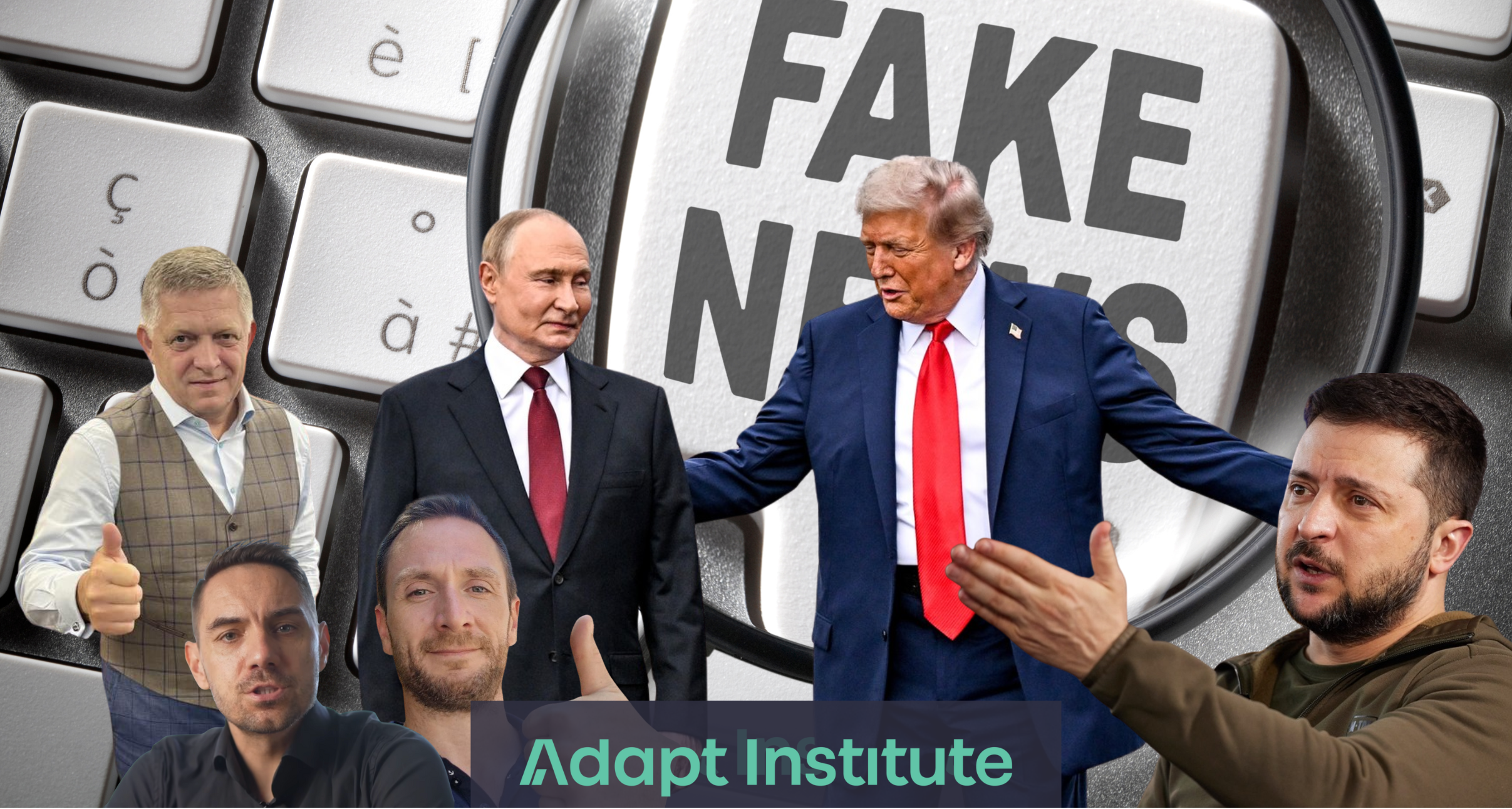
Adapt Institute provides an overview of disinformation trends that have been on the rise in the last two weeks:
- The summit between the US and Russian presidents did not bring any agreement on the war in Ukraine. However, it opened the floodgates for a new wave of pro-Russian propaganda, which echoes Vladimir Putin's words about the historical roots of the Russian-Ukrainian conflict. Moscow's demands were also repeated by Slovakian proxies.
- PM Robert Fico was also part of this effort, returning to the narrative of the unnecessary killing of Slavs and the war provoked by the West. His words got him into trouble with the Ukrainian Foreign Ministry. It warned him against using hostile propaganda narratives.
- Ľuboš Blaha, as a proper Russian propagandist, in reaction to Ukraine's warning said quite openly that the problem is not Russia, but Ukraine. He also proposed stopping humanitarian aid and expelling Ukrainian migrants. The reason? Ukraine is allegedly ungrateful and Russia is not an aggressor.
- At home, the ruling coalition is still trying to push through the narrative of British interference in the parliamentary elections in 2023. However, instead of successfully diverting attention, the government is facing opposition criticism for its inaction in response to a violent incident involving the Slovak minority in Bački Petrovac, Serbia. Some government officials have therefore accused the opposition and the media of trying to create a Maidan-style situation in Serbia.
The road to peace... through respect for Russia?
The meeting between Donald Trump and Vladimir Putin in Alaska did not result in any agreement on a ceasefire, but at least it marked the beginning of diplomatic talks on potentially ending the war in Ukraine. However, many analysts saw it as a success for the Russian president, which was also welcomed by the Slovak disinformation scene. Despite his aggression and war crimes worthy of international condemnation, Putin has emerged from several years of isolation.
According to various sources, he also communicated Russian interests, which he refers to as removing the roots of war – in addition to gaining part of Ukrainian territory, there was also talk of recognizing the annexation of Crimea and opening up the issue of the security situation in Ukraine (and Central and Eastern Europe). Their views on the future of the war in Ukraine were also shared by figures well known to the misinformed public in Slovakia. In addition to sympathizing with Putin, they continued their attacks on the EU and the West.
We therefore examined the topic of the US-Russia summit using the Gerulata Juno analytical tool. We used it to analyze the most popular posts on Slovak Facebook containing the keywords "Trump," "Putin," "Alaska," or "summit." We excluded posts that did not contain problematic narratives from the list. We then evaluated the posts based on the total number of interactions (the sum of all reactions, comments, and shares).

The post with the most interactions belongs to Robert Fico, who praised the meeting between the US and Russian presidents in a video. The Slovak PM essentially repeated Vladimir Putin's rhetoric about the historical roots of the war. According to Fico, it is not only security guarantees for Ukraine that should be discussed, but also for Russia. Indeed, for the Russia that destabilized Europe's security environment and thus also threatened Slovak interests. According to Fico, the summit "erased the only mandatory opinion on the war" in Ukraine. It was also supposed to hold up a mirror to European leaders and the Slovak opposition, who are allegedly longing for a new iron curtain with Russia. The way forward, he said, does not lie "in accusing the Russian political leadership or in sanctions, but in constructive dialogue." In other words, for Fico, criticism of aggression in retrospect is actually slander. It is necessary to move past the violation of international law and begin standardizing relations with Russia without any guarantees. This is the recipe of the PM of an EU member state who, like the rest of the pro-Russian establishment in Slovakia (including in the posts below), has told European leaders to jump on the bandwagon of negotiations and stop prolonging the war by helping the victims of aggression.
The second post was published by Milan Uhrík. The leader of the far-right Republika movement used the summit to attack the opposition, specifically the Progressive Slovakia party. He compared the meeting between the US president and Vladimir Putin to Fico's visit to Moscow in December 2024, which led to civil protests in Slovakia. In the video, Uhrík ironically asks whether the Alaska summit will also lead to the international isolation of the US. He manipulates by comparing the incomparable and attempts to discredit the opposition's rhetoric, which criticizes the current government for its foreign policy distancing itself from Western allies. For Uhrík, the way forward is through constructive dialogue and communication with the US, China, and Russia. He says that the role of politicians is not to "look for enemies and opponents around the world, but rather to look for friends and allies." This statement would, of course, be fine, but it is interesting (and hypocritical) that Uhrík applies this logic only very selectively. For example, he has not yet tried to apply it to Putin (who was probably just looking for friends when he invaded Ukraine in 2014 and 2022).
The third post was published by Ľuboš Blaha. In it, the SMER-SSD MEP essentially summarized the main points of the Kremlin propaganda that has been spreading around the world in recent days with the intention of explaining the new developments and further glorifying Russia. For Blaha, the summit with the Russian president was a "historic success" that "brought the world closer to peace." According to the MEP, the only way to achieve this is through "respect for Russia" and "dialogue with Russia." Putin was supposed to school the West, the EU is in decline, and Lavrov is cool because of his CCCP T-shirt. Not to say anything novel, but Ľuboš Blaha is simply a fanatical fan of Russia who is willing to sell out his values and parrot any narrative put out by Kremlin propaganda. While accusing the West of Russophobia and spreading war propaganda, he himself is a chronic Russophile who sells a toxic image of reality to his audience. He sympathizes with peace and therefore sympathizes with Putin (he applies this logic in his post). Of course, he does not mention Putin's warmongering.
Another post was published by Anna Belousovová, who used the preparations for the summit to discredit the Ukrainian president and European leaders. The fact that they were not invited to the bilateral meeting is proof for Belousovová of their insignificance and of the "declining EU". The retired national politician, who was also on the candidate list of the far-right Republika, continued to ridicule Ukraine's sovereignty. She used well-known conspiracy narratives about the West's involvement in the Maidanization of Ukraine and also questioned the legitimacy of the Ukrainian president. He allegedly does not want to allow presidential elections because he is afraid of "losing power". Once again, ignorance of reality and repetition of narratives from the Russian storybook.
The last post in the thread was published by György Gyimesi. In it, he spoke of the so-called marginal EU, which he claimed had "lost touch with reality in its arrogance, hubris, and unfounded self-confidence." Gyimesi perceives the calls of European leaders for a just peace for Ukraine as calls for the continuation of the war. He claims that Ukraine also wants the war to continue. It seems that for the former MP, who is now a member of the extra-parliamentary Hungarian Alliance party, anything other than immediate acceptance of Russia's terms is a manifestation of warmongering. It is precisely warmongering that has supposedly degraded Europe "to the level of an ATM from which the real powers withdraw money for weapons or energy". Gyimesi probably also classifies military aid to Ukraine, which has been facing Russian aggression for more than three years, as warmongering. The post is nothing more than an expression of attempts to deliberately undermine these Ukrainian efforts.
We are not done with pro-Russian propaganda
In addition to the meeting between Donald Trump and Vladimir Putin, the topic of war in Ukraine was also brought up thanks to a post by Robert Fico, who addressed the Slovak public from his vacation. Incidentally, he was found there by Slovak journalists who were investigating whether the PM owned property in Croatia. According to Fico, the journalists were "terrorizing him on vacation."
In his post, Fico accused Ukrainian leaders of "letting themselves be lured by the West and fully supporting the unsuccessful Western strategy to harm Russia." This is one of the longest-running narratives of Russian propaganda, which seeks to portray its own aggression as a just response to the West's malicious intentions. The Slovak PM was thus preparing the ground for another call for an "immediate halt" to the senseless killing of Slavs. The Ukrainian Ministry of Foreign Affairs also responded to Fico's posts. Among other things, it warned Fico against "using hostile folkloric analogies and attempts to boost domestic political ratings at the expense of Ukraine."
The Slovak PM responded with another post, in which he rejected the Ukrainian ministry's accusations. He hid behind the right to freedom of expression and claims that "any opinion other than the mandatory one [on the war in Ukraine] is sharply criticized and condemned." Fico went on to talk about restrictions on the right to a different opinion – however, it is difficult to speak of any effort on the part of Ukraine that would resemble a restriction of opinion. The Ukrainian ministry simply offered the public its opinion on the words of the PM of a country that should be a partner, but instead is pursuing a so-called sovereign foreign policy.
Meanwhile, SMER-SSD deputy chairman Ľuboš Blaha also joined the exchange. In his post, the MEP accused Ukraine of "openly attacking Slovakia." At least, that is how he described the Ukrainian statement, while claiming Slovakia should immediately respond by "stopping all humanitarian aid to Ukraine and expelling Ukrainian migrants". Blaha went on to fully reveal his character in his post, saying that "Russia is not the problem, Ukraine is", and "Russia is not an aggressor for us, it has never hurt us", he only confirmed his role as the main Russian propagandist in Slovakia, for whom the uncritical and immoral dissemination of pro-Russian narratives has become daily bread.
Is Slovak opposition stirring up unrest in Serbia?
Part of the governing coalition and kindred figures are still trying to resurrect the narrative of a British conspiracy and interference in the elections. We have already reported on how the disinformation scene is distorting the facts about the involvement of journalists and support for the opposition in our previous report. Accusations of direct support for Progressive Slovakia, which are not mentioned at all in the original investigative article and were blatantly fabricated by the government coalition for its own purposes, continue to be directed primarily at Veronika Cifrová Ostrihoňová, who before participated in the British-funded campaign as an influencer without political affiliation.
Tibor Gašpar (SMER-SSD) lied about paid promotion of PS in his post, as did Milan Uhrík, who compared Ostrihoňová to Ursula von der Leyen (he has long been manipulating his audience by portraying the head of the European Commission as a corrupt evil) and went on to accuse progressives of deliberately destroying Europe. In another video, Uhrík called for the withdrawal of Slovakia's gold reserves from London because of "the financing of progressives, NGOs and election manipulation in Slovakia."
However, the dominant theme in Slovakia was a nationalist assault that took place in Bački Petrovac (Serbia) at an event organized by the Slovak minority. It was an exhibition of photographs from anti-government protests in Serbia taken by Slovak students. Provocateurs allegedly destroyed the photos and intimidated participants with violence. The issue was seized upon by opposition parties, which accuse the ruling coalition of inaction.
Robert Fico, in his defense of the government, decided to use narratives about eminent efforts to "import the traditional Maidan into Serbia with the aim of overthrowing the sovereign and legitimate government." He compared the situation and the division of opinion in Serbia to those in Slovakia. He accused the opposition of exploiting the issue of the protection of national minorities and refused to "interfere in Serbia's internal affairs." In another video, this time from a press conference, Fico denied that the rights of the Slovak minority in Serbia were in any way threatened. He accused the Slovak opposition and media of attempting to stir up unrest.
Other coalition partners echoed this rhetoric. Ľuboš Blaha declared that he was “on the side of our Slavic brothers who are resisting progressive unrest” and “want peace” and “a normal life without rainbow extremism”. We are not making this up; the MEP really did combine these ingredients into his illogical mix, which he used to sugarcoat his attack on the opposition with other popular narratives. In the spirit of conspiracy theories, according to Blaha, progressives were supposed to have received "instructions to stir up nationalist passions in Serbia."
Tibor Gašpar did not stray far from this line of inquiry, speaking about a repeat of the Slovak political scenario and conflict in Serbia, which "seemed to have come straight out of Šimečka's manual inspired by Soros's 'color revolutions'". Gašpar even went so far as to accuse the PS of "helping to provoke this conflict [the protests in Serbia], which is to be fueled and gradually spread to Slovakia." If nothing else, it is at least amusing to watch the ruling coalition, in its criticism of the opposition, flip-flop between accusations of incompetence and accusations of a global conspiracy.
Project is organized by Adapt Institute and supported by the Prague office of the Friedrich Naumann Foundation for Freedom. It continuously monitors the activities of both Slovak and foreign disinformation actors, but focuses mainly on the former. The project activities are built upon daily monitoring of emerging disinformation, hoaxes, and conspiracy theories in the online information space. This approach allows the analysts to identify disinformation posts and narratives that resonated with the public the most, as well as to find out where they originated, and how they spread and evolved on social media. The report takes the form of a bi-weekly summary of arising trends in the spread of malicious information content online. Based on that, Adapt Institute can inform the public about emerging and current trends in the field of disinformation, manipulation, and propaganda.