COP30
Brazil at COP30: climate leadership and cooperation for a sustainable future

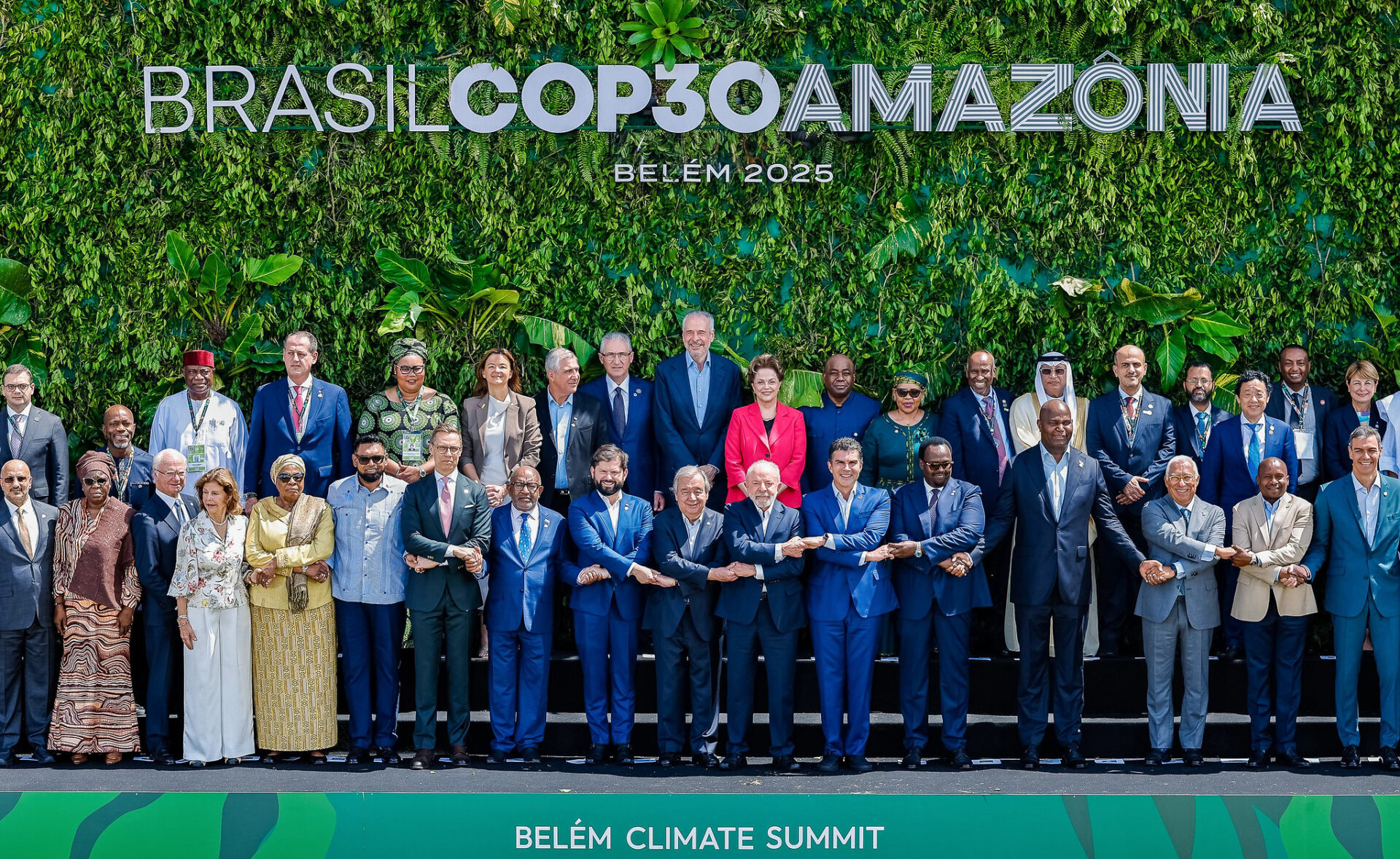
Leaders’ Summit at COP30, Belém, Brazil.
© Imagen: Mauro Pimentel/AFP
The Amazonian city of Belém is hosting COP30, the world's most important climate conference. It is surprising that, after three decades of history, Brazil has never before hosted a UN summit on climate change. The fact that the most biodiverse country on the planet is taking on this role has profound symbolism. It is one of the main economies of the G20, guardian of the Amazon — key to global climate stability — and a historical reference in environmental diplomacy since the 1992 Rio Conference, where the concept of sustainable development was born.
With this presidency, Brazil seeks to reaffirm its leadership in the global sustainability agenda, showcasing concrete advances in renewable energy, biofuels and low-emission agriculture. Its electricity matrix, with 89% from renewable sources, is one of the cleanest in the G20 and demonstrates that the country has unique conditions to lead the global energy transition.
Within this framework, the Friedrich Naumann Foundation for Freedom, together with the Federal University of Minas Gerais (UFMG), organised the meeting "Brazil on the Road to COP30: Pathways for Energy Transition and Sustainable Development", held in Belo Horizonte. The event brought together leading figures from the academic, business and financial spheres, including Paulo Guerra, Director of Programmes at the Dom Cabral Foundation; Aurea Carvalho, Manager of Financial Services at the Development Bank of Minas Gerais (BDMG); and Lucas Carlos Lima, Professor of International Law at UFMG. The discussion emphasised the need for institutional cooperation, technological innovation and legal stability as pillars of an effective and sustainable energy transition.
COP 30 at UFMG

Paulo Guerra, Lucas Carlos Lima, Dr. Hans-Dieter Holtzmann and Aurea Carvalho.
Climate change is now an undeniable reality. The World Economic Forum ranks it among the main global risks, along with extreme weather events and ecosystem degradation.
From a liberal perspective, the challenge is not to choose between development and the environment, but to reconcile the two. The most successful countries—such as Costa Rica and the Scandinavian countries—rely on innovation and market dynamism to drive green economies.
For Latin America, the energy transition will require investments of around $150 billion by 2030. Given fiscal constraints, private capital will be crucial, but it will only flow if governments guarantee stable and predictable legal frameworks. Institutional trust thus becomes as valuable an asset as clean energy itself. Development institutions such as the World Bank, CAF, EIB and BDMG play an essential role in coordinating public and private resources to generate a multiplier effect. In turn, greater trade openness—such as that promoted by the European Union-Mercosur Agreement—can boost the transfer of green technology and strengthen strategic sectors in Brazil.
Brazil has a historic opportunity to demonstrate that development and sustainability can advance together.

The preservation of the Amazon remains a central issue. Its protection, together with the creation of an international carbon certificate market, could enhance the value of environmental services through efficient market mechanisms. But reducing emissions is not enough: Latin America must adapt to the impacts of climate change, which are already causing rural migration and putting pressure on urban infrastructure. Without adaptation policies, the social costs will be enormous.
If Belém manages to translate global consensus into concrete and lasting actions, COP30 could mark a new turning point, comparable to that of the 1992 Rio Conference.
Brazil has a historic opportunity to demonstrate that development and sustainability can advance together.