Daimler Truck montage Senegal
Major German corporation ventures investment in Senegal: Possible Kick-off for new economic relations

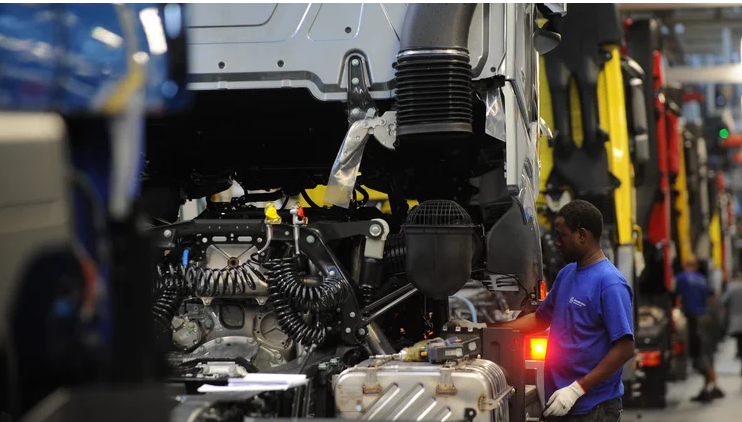
À partir de 2026, Daimler Truck assemblera des camions au Sénégal
© picture alliance / dpa | Patrick SeegerThere is also a holiday atmosphere in Senegal, West Africa. Flights from Paris and Brussels are full, and hotels are booked up by members of the African diaspora and Europeans who discovered the tourist potential of the African coast from Senegal to Ivory Coast many years ago.
German tourists are hardly to be seen here, even though they are considered particularly keen travelers worldwide. This is symptomatic of the Federal Republic's general absence from the African continent.
Although many analyses and forecasts emphasize the economic and security policy relevance of the continent, and West Africa in particular, for Europe, little is happening here.
Car manufacturer gets involved
This made a brief announcement in the Senegalese press in mid-July all the more noteworthy: the Daimler Truck Group, one of Germany's best-known large corporations, has signed a multi-year contract in Senegal.
Daimler Truck plans to start modestly by assembling various truck series locally for the Senegalese Ministry of Defense, the fire brigade and police, as well as for use in the private sector.
“The economy is the ideal basis for German-African rapprochement” says Alexandra Heldt, Head of Friedrich Naumann Fondation West Africa
The assembly plant is to be built in Diamniadio, Senegal's planned new administrative center, strategically located halfway between the capital Dakar and the international airport. The project is to be completed quickly, with the first vehicles rolling off the production line as early as 2026.
The model chosen for this branch is Completely Knocked Down (CKD), in which vehicles are assembled on site from individual parts.
This makes it possible to limit import costs while promoting the development of local expertise in the fields of engineering and mechanical production. It strengthens the industrial expertise of a country that has been heavily dominated by French and Chinese champions to date.
Cheers in Senegal
The project is being celebrated in the Senegalese press. Germany, which enjoys high recognition in West Africa, is expected to deliver partnership on equal terms and quality.
The hope here is that decades of development cooperation will lead to stronger economic cooperation. One step in this direction was the agreement concluded in 2023 to support the energy transition in Senegal.
Politics and business are not pulling in the same direction
This would also be in Germany's interest – the Federal Republic needs new sales markets, new energy sources, skilled workers and labor. The automotive industry can train and produce at low cost in Africa, conclude long-term contracts, including services. Mercedes-Benz is leading the way.
But despite the new German government's promise to focus more on Africa, the budget for Africa for 2025 has been cut by one billion euros for the ministry responsible for economic cooperation (BMZ).
Yet the economy is an ideal basis for German-African rapprochement. Traditional players in development cooperation, such as the German Society for International Cooperation (GIZ), the German Reconstruction Credit Institute (KfW) and German political foundations, can serve as pioneers and door openers.
Other countries have long understood this and put it into practice. In West Africa, where French influence is declining rapidly, countries such as China, India, Turkey, Morocco and Qatar are filling the gaps.
They want to exploit Senegal's assets – energy, agriculture, minerals, rare earths, gold and silver – as well as its growing population and middle class, which offer sales markets and training potential.
And Germany? According to the German Foreign Trade and Investment Agency (GTAI), its foreign trade with Africa declined by just under five per cent to 58.3 billion euros in 2024.
Yet intensifying economic relations would also be in line with the vision that Foreign Minister Johann Wadephul enthusiastically promoted at the meeting of European and African Union foreign ministers in Brussels in May 2025: the triad of security, freedom and prosperity.
The economy can help to stabilise African societies so that they are better able to defend themselves against extremist tendencies, migration no longer appears to be the only way out, and the shift towards authoritarian forms of government declines.
Germany and its companies should see African countries as allies with a desire to shape their own future and immense potential, and establish themselves as reliable partners – so that the Daimler Truck project does not remain a one-off, but marks the beginning of a win-win development.
This article first appeared on 20 August 2025 in the Berlin based German Newspaper Tagesspiegel.