G20 South Africa
Brussels’ bet on Pretoria, and its payoffs

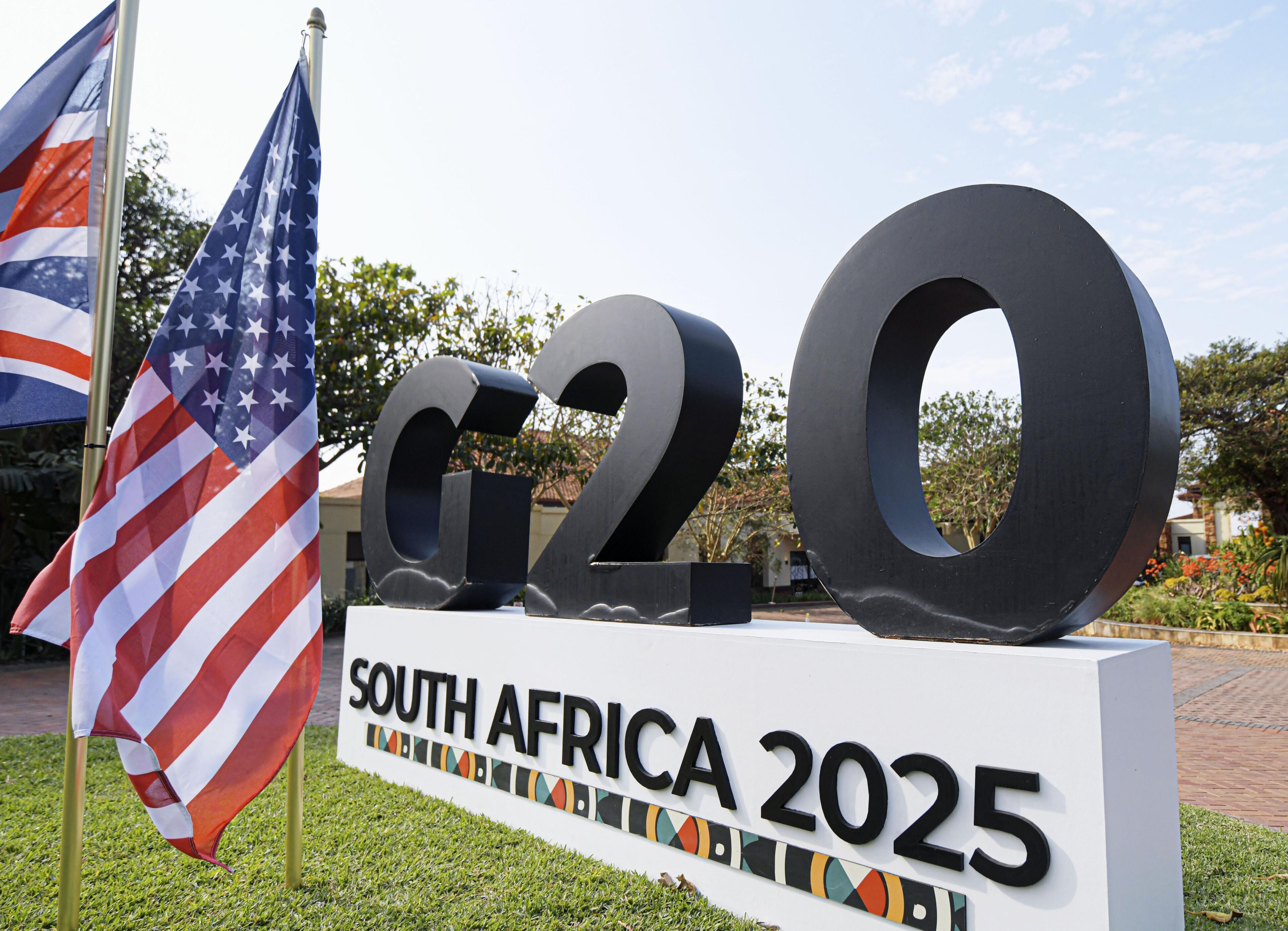
Der G20-Gipfel von Johannesburg findet vom 22. bis 23. November 2025 statt.
© picture alliance / Kyodo | -When Donald Trump announced the United States withdrawal from the G20 Summit in Johannesburg, there were fears that this absence would risk diminishing the relevance of Africa’s inaugural G20 summit. However, defying pressure from Washington for G20 leaders to oppose a leaders declaration, Europe has instead demonstrated its strong support for this strategic forum. The leaders of all core EU G20 members (France, Germany, Italy, and the EU itself), alongside several significant invited non-member states, have confirmed their attendance.
This is a strategic vote of confidence in South Africa, Africa, and the wider Global South amid a moment of geopolitical flux. But the question is: what does Brussels stand to gain?
To answer this, it is important to reflect on the international context in which the G20 is occurring.
For one, it comes amid a leadership vacuum left by the US. Donald Trump’s America-first doctrine has the US turning inward, prioritising domestic political survival and economic nationalism over global partnerships. Even its outward gaze is framed through the lens of domestic politics. Under Trump, aid has been replaced by leverage, free trade by the threat of tariffs, consensus by transactional bargaining, and principled oversight by selective accountability. This has undermined the US-led Bretton Woods liberal order that has been intrinsic to peace and prosperity in the post-World War II era.
For Africa, this has had significant consequences. Critical issues such as those on the G20 Agenda – disaster resilience and response, debt sustainability, just energy transition financing and critical minerals – have largely stagnated.
Against this backdrop, Brussels’ bet on the G20 in South Africa is significant. First, it represents a symbolic decoupling from US hegemonic influence on Europe’s foreign policy. It provides Europe an opportunity to assert its foreign policy autonomy in an age of geopolitical realignment. In attending en-masse, Europe is refusing to take part in the US’s political gamesmanship. Instead, it is reinforcing that it will engage whomever it desires on its terms. Second, Europe’s participation in the G20 is an attempt at filling the leadership vacuum left by the US. It adds strategic relevance to a summit that threatened to be redundant. Third it demonstrates Europe’s intent to remain a key player in the future of global multilateralism and its core issues, shaking off rumours of its irrelevance.
But, more importantly, this is a vote of confidence in Africa. At a time of geopolitical uncertainty when Africa and the wider Global South are looking to remould partnerships the G20 provides a structured platform to re-engage in a manner that is rules-based, predictable and less susceptible to the volatility that is becoming prevalent in the emerging world order. It also offers Brussels an opportunity to ease perceptions over a disengaged yet paternalistic and hypocritical Europe in Africa.
But presence alone is not enough to maximise Europe’s benefits from the G20. Reasonable alignment with South Africa’s agenda is also essential. If achieved, Europe can regain initiative in key areas. Whilst elements like disaster relief and energy financing are currently economically and politically unviable for Europe, debt restructuring presents a workable opportunity. Despite falling behind China as a creditor to Africa, Brussels still has deep and longstanding involvement in African sovereign finances. In addition it has sway within multilateral bodies like the International Monetary Fund and World Bank through which changes to global finances are likely to occur. Supporting reforms to the G20 common framework, sovereign ratings protocol and debt management standards sought after by Africa would position Europe as an indispensable partner in financial reform. Involvement in such processes would also narrow information asymmetries, insulate European creditors from haphazard reform risks and messy defaults, and secure goodwill from distressed African partners.
Engagement on critical minerals is may be more profitable for Brussels. Europe’s accelerated energy transition has exposed its dependence on supply chains dominated by China (and, to a smaller extent, Russia) and the serious vulnerability therein. China meanwhile, has consolidated its influence on Africa’s critical minerals, dominating extractives such as nickel, cobalt and lithium. For Europe, securing diversified, stable, and environmentally compliant inputs has become a strategic priority, as is diluting dependence on China. Partnering with Africa on mutually beneficial terms would allow Europe to go to the source, circumnavigating China’s supply chain stranglehold. Furthermore, Europe can position itself as an alternative, offering technology transfer, standards development, and industrial financing that align with African aspirations for beneficiation.
Brussels’ bet on the G20 is not merely symbolic, it appears to be a calculated strategy to recalibrate relations with South Africa and an opportune African continent. By supporting debt reform, critical minerals development and other initiatives Europe can generate economic and political returns. The precedent set at the G20 may even yield long term benefits that more directly address Europe’s core issues such as migration and demographic decline. Former Vice President of the European Commission, Joseph Borrel, said it best: “A part of Europe's future is at stake in Africa. To face our common challenges, we need a strong Africa, and Africa needs a strong Europe. Both our continents need each other to strengthen themselves, to strengthen each other, and to achieve a common ambition: a better world based on a rules-based international order