TAIWAN
"Democracy advocates must stand together"


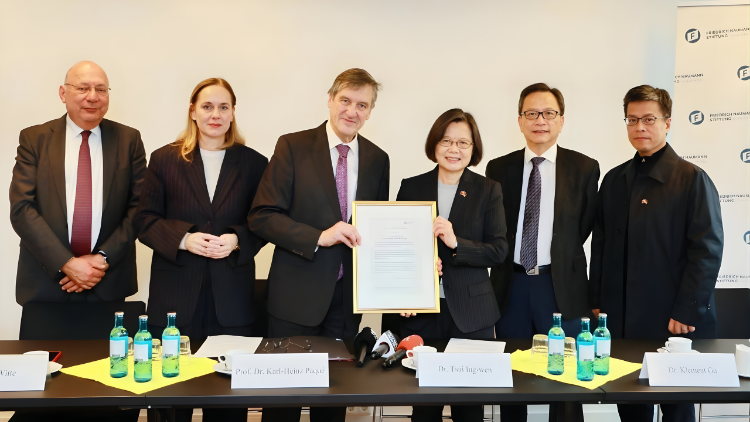
Tsai Ing-wen receiving FNF recognition in FNF Berlin Office
© MOFA TaiwanTsai Ing-wen, former President of Taiwan, visited the Friedrich Naumann Foundation for Freedom (FNF) in Berlin. She called for stronger cooperation among democracies as tensions with China remain high.
Tsai, the first female head of state and a central figure in Taiwan’s democratic consolidation, was in Berlin for Germany’s annual Berlin Freedom Week. At the foundation’s office, she was received by chairman Karl-Heinz Paqué, who presented Dr. Tsai with a certificate of friendship recognizing her leadership in promoting democratic cooperation in Asia. The gesture, he said, was meant to underscore the foundation’s commitment to supporting Taiwan’s democracy and its resilience in the face of pressure from the People’s Republic of China (PRC).
“As the global landscape grows increasingly complex with rising authoritarianism and geopolitical uncertainty, it is more important than ever that democracy advocates stand together,” Tsai said.
Professor Paqué echoed that message, warning that Beijing’s ambitions reach far beyond the Taiwan Strait. “The PRC is challenging not only Taiwan, but the entire liberal world order,” he said.

Tsai Ing-wen with Anna Marti Former Head of FNF Global Innovation Hub
© Friedrich Naumann Foundation for FreedomThe foundation, which opened an office in Taipei in 2021, has worked closely with civil society groups, politicians, and youth leaders to cooperate on democratic governance and innovation in Asia. FNF has longstanding ties with Taiwan’s Democratic Progressive Party (DPP), a founding member of the Council of Asian Liberals and Democrats (CALD).
Those partnerships were spotlighted again last month when the foundation and CALD screened Invisible Nation in Bangkok, a documentary chronicling Tsai’s presidency and Taiwan’s evolving strategy amid escalating tensions in the Taiwan Strait.
In the film, Tsai reflects on Taiwan’s political transformation since the end of authoritarian rule. “We have walked a long path from authoritarianism to a free and open democracy,” she says. “And that path is not an easy one.”
Beijing has consistently denounced any action that appears to confer international legitimacy on Taiwan. In a National Day address on Sept. 30, Xi Jinping vowed to “resolutely oppose separatist activities seeking Taiwan’s independence and external interference.”
Earlier this year, Chinese Foreign Minister Wang Yi warned Japan and other governments not to invoke Taiwan in security debates, calling suggestions that a conflict over Taiwan would endanger Japan “propaganda.” His comments resurfaced after Japan’s newly elected first female prime minister said her government might consider military involvement in a Taiwan contingency.
Tensions also flared this fall after German Foreign Minister Johann Wadephul canceled a planned trip to China following his criticism of Beijing’s assertiveness in the Taiwan Strait. In a phone call, Wang Yi reminded Berlin that China had supported Germany’s reunification and urged it to oppose “all ‘Taiwan independence’ separatist acts.”
Tsai’s appearance in Berlin, where she delivered a keynote at the Berlin Freedom Conference marking the fall of the Berlin Wall, added to the diplomatic strain. Her address, titled Threats Facing Democracies: Taiwan’s Experience Defending Freedom, called for deeper security collaboration among democratic nations.
Now, we are experiencing much-intensified threats and intimidation almost on a daily basis.

In Berlin, as throughout her presidency, Tsai’s message was unambiguous: Taiwan’s struggle is not a regional issue, she said, but a test of democratic resolve worldwide.
*Hnin Wint Naing is the regional communication officer of the Southeast and East Asia Office of the Friedrich Naumann Foundation for Freedom. Jim Hsu-sung Wu is the communication officer and program assistant at the Global Innovation Hub in Taipei.