China
Chinese Interests at Risk

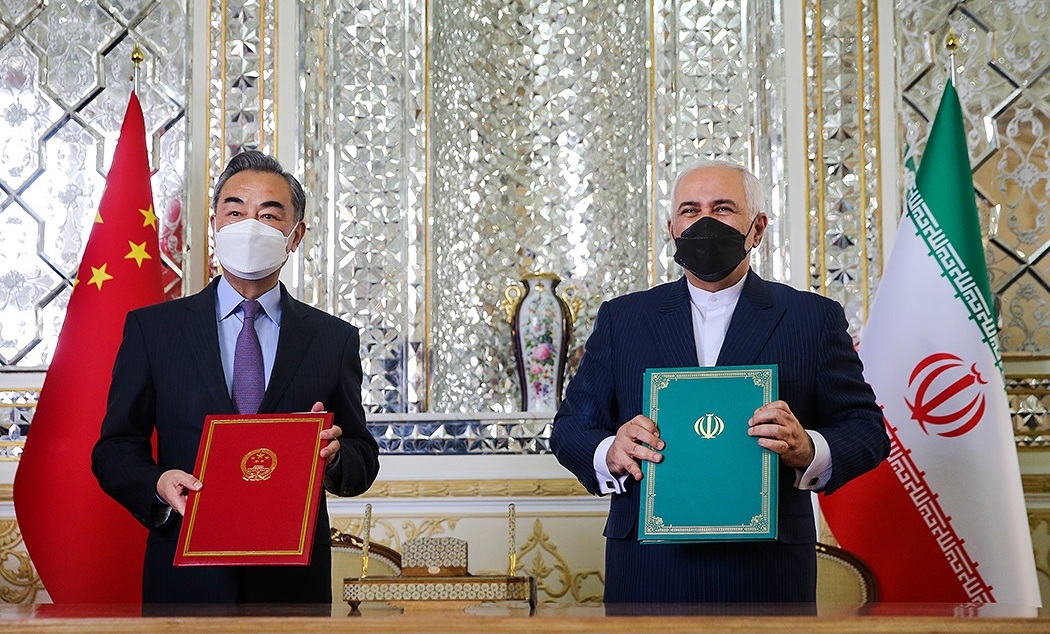
Wang Yi and Mohammad Javad Zarif at the Ministry of Foreign Affairs of Iran, after signing the 25-year cooperation deal between China and Iran, 2021-03-27
© By Fars Media Corporation, CC BY 4.0, https://commons.wikimedia.org/w/index.php?curid=102488832The American-Israeli attack on Iran threatens China's key strategic objectives: access to Iranian oil, preventing pro-American regime change in Tehran, and the perception of the Chinese Communist Party’s domestic rule as immutable. .
A change of power in Iran would not only mean China losing an important partner in the Middle East. Regime change would also heighten Chinese concerns that mass protests, supported by external pressure, could topple an established system – a scenario that the Chinese leadership greatly fears for its own stability. Beijing supplies the regime in Tehran with surveillance technology to prevent internal unrest, as well as military equipment such as anti-aircraft missiles. This is not only for financial reasons, but also to protect the mullahs from attacks.
Chinese investments in Iran
In addition to security interests, economic factors also play an important role in relations between the two countries. In 2021, the two countries signed a 25-year cooperation agreement under which China promised investments of around US$400 billion in return for the long-term supply of oil. In 2025, around 80 percent of Iranian oil exports went to China. This corresponds to about 13.4 percent of the People's Republic's total maritime oil imports.
The oil has been flowing, but Chinese investment in Iran has remained limited so far. The country is considered a partner in China's Belt and Road Initiative; in 2024, for example, a freight train connection between Qom in Iran and Yiwu in China was opened. However, Beijing is still a long way from the large investments it announced. The American think tank American Enterprise Institute estimates that Chinese investment in Iran since 2007 has amounted to only around five billion US dollars. Significantly more capital from China has flowed into other countries in the region, such as the United Arab Emirates and Saudi Arabia.
Large strategic emergency oil reserve
In view of a looming oil crisis, China is in a relatively comfortable position compared to other Asian countries. In recent years, the People's Republic has greatly diversified its oil imports. Supply shortfalls from Iran could be partially offset by additional imports from Russia, Saudi Arabia, or Iraq. Only about 6.6 percent of Chinese oil imports pass through the Strait of Hormuz. In addition, China has the world's largest strategic emergency oil reserve. According to experts, it could last for three to four months.
Against this backdrop, Beijing initially reacted cautiously to the military escalation. Later, however, Chinese Foreign Minister Wang Yi accused the US and Israel of a serious violation of international law. The tone in the heavily controlled Chinese media is becoming more aggressive. The mood is anti-American. AI-generated videos showing US soldiers begging President Trump to end the war are spreading on the platform Weibo. On Bilibili – the Chinese version of YouTube – many comments also criticize the US attack. Some support Iran's right to self-defense or call for a diplomatic solution.
However, there has been no political escalation between China and the United States so far. US President Trump is expected to make a state visit to Beijing at the end of March. There is currently no talk of a cancellation. For Beijing, the relationship with the US remains strategically much more important than the partnership with Iran.
*Frederic Spohr heads the offices of the Friedrich Naumann Foundation for Freedom in Taipei and Seoul.