PHILIPPINES
The party of progress must represent progress

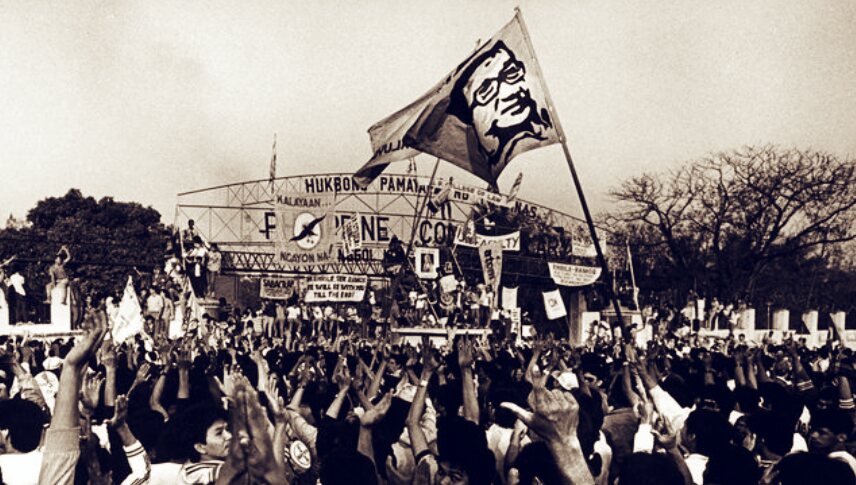
Edsa People Power Revolution
© https://krscsr.blogspot.com/In the late twentieth century, German philosopher Jürgen Habermas began diagnosing what later scholars would call “liberal pathologies”—internal contradictions within modern liberal democracies. These refer to the social, cultural, political, and economic dynamics that, though rooted in liberal ideals, evolve in ways that undermine liberalism’s original promise of freedom, prosperity, and equality within democratic institutions.
Scholars have traced these dysfunctions across democracies: political polarization fueled by hyper-individualism, weakened state capacity due to excessive proceduralism, and civic discourse driven more by moral outrage than public reason. In the United States, for instance, the Democratic Party has increasingly embraced identity politics that energize niche groups but often sideline a unifying economic agenda. This has led to pushback against universal policies like Medicare for All or zoning reform, especially in elite liberal enclaves where residents resist reforms that would expand housing supply. Some analysts cite these dynamics as reasons for the party’s recent electoral setbacks.
But liberal pathologies aren’t unique to mature democracies. In countries with weak institutions and fragmented party systems, like the Philippines, these contradictions often take a more self-defeating form.
The so-called Liberal Party, once at the forefront of democratic restoration after the Marcos dictatorship, has long worn the cultural garb of “modern liberalism.” Its leaders have defended civil liberties, reproductive rights, and anti-discrimination measures. Many support same-sex marriage and divorce legislation, though Congress continues to stall these reforms.
Yet on the economic foundations of liberalism—free markets, competition, and globalization—many within the party and its broader progressive alliance have hesitated. During debates on amending the restrictive economic provisions of the 1987 Constitution, several liberal lawmakers opposed lifting limits on foreign ownership in sectors like education, telecommunications, and transport. They cited fears of foreign control, even as evidence shows that these restrictions stifle competitiveness and job creation.
This same reluctance appeared in their response to the Rice Tariffication Law. Though the law ultimately liberalized imports, lowered rice prices, and created the Rice Competitiveness Enhancement Fund (RCEF), many liberals distanced themselves, fearing backlash from rural voters and populist critics. Yet as Adam Smith’s arguments helped repeal Britain’s corn laws, such market reforms remain essential to lowering food costs, boosting rural productivity, and combating hunger, the burdens that weigh heaviest on the poor.
By dodging these economic battles, the Liberal Party has lost coherence and relevance. Increasingly, the public sees liberalism not as a forward-looking force, but as a perpetually contrarian party—against charter change, against deregulation, against infrastructure projects—rather than articulating a clear economic vision that addresses the daily burdens of most Filipinos: high food prices, unreliable electricity, unaffordable housing, and the lack of stable, dignified jobs.
To many outside the political and media circles of Metro Manila, liberalism sounds moralizing, elitist, and out of touch. Habermas warned that when liberalism is disconnected from democratic participation and material progress, it collapses into itself, offering rights without responsibilities and social reform without economic growth.

Jürgen Habermas.
© https://enciclopedias.com/jurgen-habermas/But liberalism is not doomed. On the contrary, the country desperately needs a reinvigorated liberalism, one that is both aspirational and grounded in material reality. Political scientists Ezra Klein and Derek Thompson have called for an “abundance agenda”—a politics that delivers more: more jobs, more energy, more infrastructure, more housing.
These goals have historically been championed and delivered by liberals. The post-war reconstruction of Europe, for example, was spearheaded not by populist strongmen but by liberal statesmen through the Marshall Plan. This ambitious program didn’t merely aim to prevent the spread of communism; it was a concrete investment in abundance, fueling the rapid industrialization, housing construction, and infrastructure rebuilding of Western Europe. Post-war America likewise built a liberal order that expanded highways, subsidized homes, funded science, and broadened access to education.
The Philippines can follow this lead, but liberals must stop playing defense. They must articulate a bold, coherent growth agenda: revisiting constitutional restrictions on investment, building cities and industrial hubs beyond Metro Manila, modernizing agriculture, and promoting enterprise-led job creation. Liberals must stop being the party of “no.”
History provides precedent. During the Ramos administration in the 1990s, liberal reformers drove privatization and liberalization, from power sector reform to telecommunications and port operations, underpinned by a belief that competition and private initiative could drive national development. These were not laissez-faire experiments but state-engineered liberal reforms to unlock capital and improve services.
In the early 2000s, under President Arroyo, liberals pushed for deeper financial sector reforms and fiscal consolidation, including the expanded value-added tax (EVAT) law, which helped avert a looming debt crisis. While Arroyo’s administration was politically contentious, the economic stewardship during this time was shaped by liberal principles of macroeconomic stability, institutional strengthening, and market rationalization.
Under President Benigno Aquino III, liberal governance focused on public-private partnerships to increase infrastructure spending, enhanced anti-corruption mechanisms, and transparency through the Freedom of Information (FOI) bill. Though Congress blocked FOI, the administration’s “Daang Matuwid” agenda reaffirmed liberalism’s commitment to clean, rules-based governance.
Still, these leaders sidestepped the most critical long-term reform: amending the Constitution’s outdated economic provisions. They avoided this politically risky fight—and in doing so, created the vacuum that Rodrigo Duterte later filled. Ironically, it was an authoritarian president—not the liberals—who pushed for sweeping market reforms: the Rice Tariffication Law, the Corporate Recovery and Tax Incentives for Enterprises (CREATE) Act, and amendments to the Trade Liberalization Act, Foreign Investment Act, and Public Service Act. These are the very reforms that liberal economics demanded but liberal politicians long neglected, illustrating the pathological contradictions of Philippine liberal policymaking.
Philippine liberalism, then, must return to its first principles: empower individuals by expanding the economic pie and strengthening democratic institutions. Until then, it will remain a project of the few for the few, no matter how progressive its slogans may be.
Jam Magdaleno is Head of Information and Communications at the Foundation for Economic Freedom (FEF) in Quezon City.