Middle East peace deal
What next, Israel?
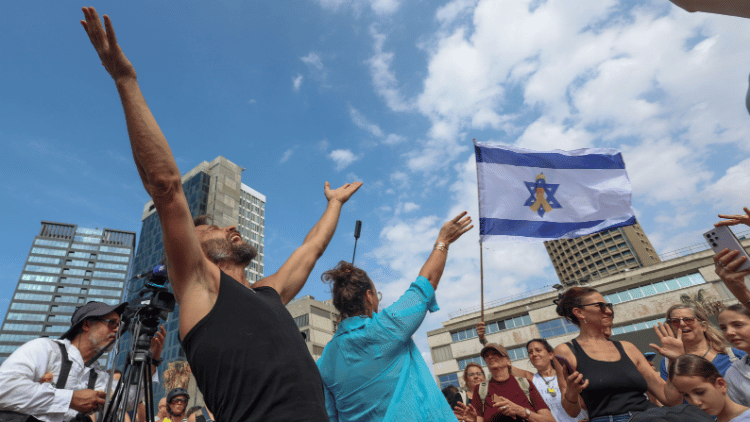
Crowds gather in Hostages Square, waving Israeli and American flags and celebrating the ceasefire agreement.
© picture alliance / Anadolu | Nir KeidarWhat Donald Trump has initiated with his 20-point plan could be a turning point for the better in the Middle East – two years after Hamas's horrific massacre of 1,200 people and the kidnapping of 250 women and men. It is a major opportunity, provided the plan is fully implemented—also, and above all, by Hamas. Let us not forget: a terrorist organization that has so far shrunk from neither brutality nor lies. But after two years of war in Gaza, it has been significantly weakened, and the regional balance of power has shifted fundamentally in that time—from Lebanon and Syria to Iran.
Yair Lapid, Israel's former foreign minister and now leader of the liberal-centrist Yesh Atid party, took this as an opportunity to outline his vision for the future of Israel, in Foreign Affairs a few days ago. ‘A Defining Choice for Israel’ is the title of his pointed article. He sharply criticises Benjamin Netanyahu's government for systematically dividing Israel and calls for a new beginning with new elections.
In doing so, he praises - quite rightly - the admirable resilience Israel has shown since the massacre. Despite trauma, daily life carried on: democracy continued to function, with its usual contention and volume; the “start-up nation” economy remained technologically dynamic; there was an unprecedented mobilization of reservists; and the moral support for the hostages, summed up in the call “Bring Them Home,” was - and still is - immense. At the same time, far-right ministers in Netanyahu’s government floated absurd demands, and settlers in the West Bank committed violence against Palestinians. The result: a resilient yet deeply divided country- with a strong foundation from below, but misguided leadership from above.
Lapid calls for a new path - “a different Israel”: in foreign policy, a return to the spirit of the Abraham Accords, with deeper cooperation with moderate Arab and Muslim countries worldwide; and domestically, a constructive approach to heal societal wounds and tackle structural challenges - such as fighting extremely high living costs and Increase labor force participation among Muslim women and ultra-Orthodox Jews. He urges the Palestinians to prove they can build functioning institutions in Gaza and the West Bank and, after Hamas’s disarmament, genuinely prevent the resurgence of terrorism - in self-governed areas under the supervision and involvement of the United States and supportive Arab states, with full security guarantees for Israel. The prerequisite for all this, of course, is rapid new elections in Israel and a new government.
All of this makes sense. If Israel follows this path, there is a renewed chance for a strong - and honest - push toward a better future. The EU, and above all Germany, should accompany Israel on this path constructively.