Israel
Robust Resilience
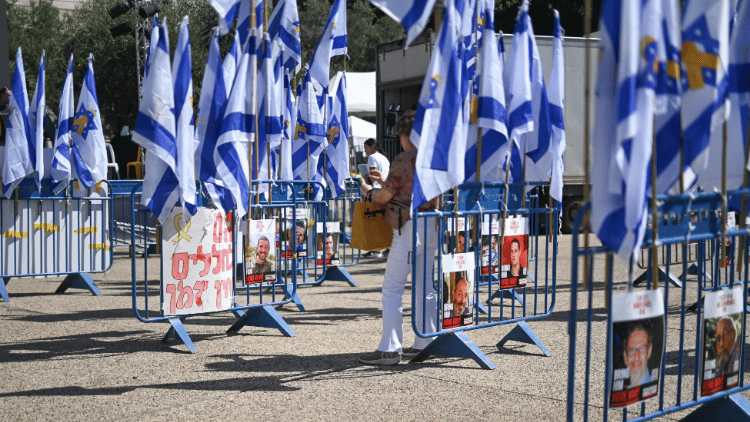
The “Hostage Square” in Tel Aviv.
© picture alliance / Sipa USA | Lionel UrmanKarl-Heinz Paqué, Chairman of the Board of the Friedrich Naumann Foundation for Freedom and President of Liberal International, spent four days in Israel this week—a journey originally planned for June of this year, but postponed at the time due to the Iranian-Israeli war.
The Foundation has maintained an office in Jerusalem since 1983, staffed by both Jewish and Palestinian colleagues. It sustains a dense network of organizations committed to liberal values—in Israel and in the Palestinian territories. Its political partner is the centrist party Yesh Atid, which also holds observer membership in Liberal International.
The following report conveys political impressions from this visit; a second report will follow shortly.
Two years have now passed since the Hamas massacre that claimed around 1,200 Jewish lives and saw the abduction of about 250 Israelis—among them people of various nationalities. Until only a few days ago, the country remained in a state of war, marked by intense Israeli military operations in Gaza. The last surviving hostages have now been freed, and a fragile ceasefire is in place.
Two years of warfare and repeated states of emergency have, of course, left their mark on Israeli society—how could it be otherwise? The memory of the traumatic events of October 7, 2023, is omnipresent: most vividly on Tel Aviv’s central Hostage Square, where panels and installations commemorate the victims—initiated and maintained by Israel’s remarkably vibrant civil society, one of the country’s defining strengths.

A view of Hostage Square in Tel Aviv, where a clock continuously measures the duration of the hostage situation since the Hamas terrorist attack on October 7, 2023.
© Karl-Heinz PaquéBut remembrance is everywhere—in Jerusalem and Tel Aviv, and beyond. Photos of the murdered, the hostages, and fallen soldiers, each with names and stories, are displayed even in the most ordinary of places: on the walls of parking garage elevators, for instance. It moves any visitor deeply. There is no trace of repression or forgetting—quite the opposite of what we so often see in Germany, where deadly terrorist attacks, too, have occurred in recent years.

And yet, amid the lively pulse of Jerusalem and especially Tel Aviv, there are few outward signs of what the nation has endured. The cafés and restaurants are filled with life during these late, summer-warm autumn days—people eating, drinking, debating, joking. Security forces and soldiers are visible now and then, but one would hardly guess that this is a society that has spent two years with roughly half a million of its citizens—most as reservists—drawn into the Gaza war.
For a country of ten million, that would be the equivalent of four million Germans being mobilized.
Over 900 Israeli soldiers have fallen—not only in Gaza, but also in the conflict with Hezbollah in the country’s north. There is an admirable, largely uncomplaining readiness to serve one’s country—even, in the extreme, at the cost of one’s own life or that of one’s children.
And this in a society that must still contend with the ultra-Orthodox minority, which remains exempt from military service—a policy the Supreme Court has now deemed unconstitutional, and which, after two years of war, has become one of the fiercest domestic fault lines.
Liberal Israel is no longer willing to accept this exception.
There is no doubt: this secular Israel possesses the kind of robust resilience that Germany is only beginning to discuss in theory. Of course, the strain has left its traces. The trauma support organization NATAL, which also partners with the Naumann Foundation, reports a dramatic rise in requests for psychological help—not only from families of hostages and soldiers.
Less severe but equally telling is the constant crowding of Jerusalem’s new National Library, which opened almost exactly two years ago but, due to the massacre, without any inauguration ceremony.Even on ordinary weekdays, its reading halls are full—a rare phenomenon, suggesting that people seek not only distraction but also the cultivated calm of this elegantly designed space, a refuge from the hardness of daily reality. All of this leaves a deep impression.
So too does the mix of anxious seriousness and self-deprecating humor with which Israelis discuss the difficulties of their polarized society.
Many find it hard to accept the often superficial, poorly informed, and moralizing judgments from abroad. Yet their responses—thoughtful and analytical—reflect genuine concern, particularly among secular, liberal Israelis who feel increasingly alienated from the values of Netanyahu’s right-leaning government, which caters to the uncompromising interests of settlers and religious parties.
What remains incomprehensible to almost everyone is the growing tendency toward boycotts of Israel in parts of the Western world—especially in academia, culture, and sports.
It leaves a note of quiet disappointment: How simple-minded, one wonders, is the worldview of those generations in Europe, the United States, and elsewhere who have long enjoyed the dividends of peace—without ever facing the constant existential threat that democratic Israel must live with, surrounded by sworn enemies like Iran’s theocratic regime, which fosters violent proxies across the region?
Such is the mood among secular, liberal Israelis—several of whom the author met on this trip.
For all their concern, life goes on—and economically, not even badly.
Once again, modern Israel—the Israel of high technology and start-ups—has shown a striking resilience. Two years of war, immense financial costs, hundreds of dead, and a nationwide trauma have not brought the country’s economy to its knees. Entrepreneurs in uniform, it is said, even managed to keep their young businesses running—digitally, from the front lines. The data reflect it: growth somewhat slowed, but steady; a healthy trade surplus; inflation kept in check despite the strain of war.
Conclusion: A remarkably resilient nation. We Germans should look closely. There is much we could learn.