International Women's Day
Pushback against women's rights: What is happening right now?

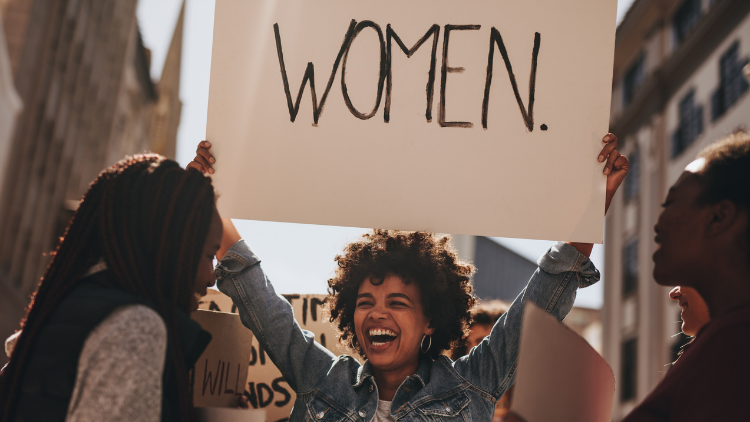
A pushback against women's rights can be observed worldwide. In war and displacement, women and girls are among the most vulnerable groups. An assessment of the situation on International Women's Day.
"The world is upside down. And everyone can feel it," said Volker Türk, the UN High Commissioner for Human Rights, at the opening of the current session of the UN Human Rights Council in Geneva. Global power relations are shifting and the consequences are uncertain. Some heads of state are predicting the end of the rules-based world order as we know it. Some are writing off "international law," even considering it opportunistic and reinterpreting it.
Women's rights are human rights
Yet it all began so promisingly just under 80 years ago: with the establishment of the United Nations on the basis of the UN Charter and its three pillars of peace and security, development, and human rights. After the Second World War, the promising idea of redefining the relationships between states, but also between governments and their own citizens, gained traction. This idea was based on a common hope and shared values: the pursuit of dignity, peace, and justice. It was shaped by the hope of making the world a better place, more peaceful, more just, and more free.
This included the formulation of universal human rights. As early as 1948, an international declaration of human rights was adopted for the first time, establishing the equality of all people in Article 1. For a long time, the draft stated: "All men are born free and equal (...)." Female delegates in the first UN Human Rights Commission, strong women sent from the Dominican Republic, India, and Pakistan, campaigned for "men" to be replaced by "human beings" in the final version.
Women's rights activist or feminist: for the interests of women
In the more recent history of women's rights, it was also women who particularly represented the interests of their gender. From the creation of the UN Convention on the Elimination of All Forms of Discrimination against Women in 1979 to the Council of Europe's Istanbul Convention on Combating Violence against Women and Domestic Violence in 2011. The pioneers of women's rights have improved the situation for many generations after them . They continue to do so today. Worldwide. The difference is that feminists are at best ridiculed, but in many places they are mostly defamed and subjected to hatred. The origin of the term goes back to the French word féminisme, which in turn comes from the Latin word femina for woman. So it's about standing up for women's issues.
Equality as a yardstick of democracy
Today, the idea of women's rights and equality forms a strong counterweight to autocratic, male-dominated political tendencies. After all, equality between men and women requires a free and open society. This presupposes a stable government, democracy, and the rule of law.
As soon as the number of democratic governments declines, women's rights also experience a pushback. The V-Dem Report 2025 from the University of Gothenburg highlights developments over the last 20 years and its findings are sobering. The percentage of people living in autocracies rose from 49% to 72% between 2004 and 2024. Conversely, the percentage of people living in democracies fell from 51% to 28%.
Equality is also suffering a setback in Europe's democracies due to the electoral successes of right-wing populist parties. Right-wing populist politicians convey a feel-good image of traditional family values and models that refer exclusively to the idea of a father, mother, and children. In speeches and party slogans, the demand for restrictions on women's rights is also openly articulated in Germany, in line with the motto "women back to the kitchen." Social media influencers are picking up on these slogans, contributing to a stereotypical understanding of gender roles that seemed to have been overcome long ago. It is the so-called "tradewives" who are glorified by supporters of the AfD youth in this country for a view of women that renounces professional careers and focuses on the role of mother and housewife.
Armed conflicts and wars
A second trend is influencing the situation of women (and women's rights) worldwide. It is the use of armed force, which is currently becoming increasingly normalized between and within states. Since Donald Trump's return to the White House, inflammatory threats have also been made by democratically elected heads of state against sovereign states, regardless of the devastating consequences. Language barriers are falling and International organizations that are places of dialogue and diplomacy, such as the United Nations, are being deliberately weakened.
Dominance is making a comeback. Listening to the rhetoric of some heads of state, one senses a belief that they are above the law and the UN Charter. The consequences are massive suffering. The daily news reports on the wars and conflicts in Ukraine and the Middle East. But there are numerous conflict situations and armed conflicts, massive violence against women and girls, that do not appear in our news.
Consider the situation of the Rohingya, a Muslim minority who were driven out of Myanmar by the military rulers and into Bangladesh. The catastrophic humanitarian situation affects women and children the most. They live stateless and far from the attention of the Western media, with no prospect of change.
Consider the fate of the Uyghurs, where men and women belonging to a Muslim minority in the Chinese province of Xinjiang are being imprisoned. Women are forcibly sterilized in the camps and robbed of their children, who are forcibly adopted. Women and girls in particular are vulnerable to sexual violence while fleeing and in overcrowded camps around the world.
Since coming to power in 2021, the Taliban in Afghanistan have severely restricted the rights of women and girls. Girls are only allowed to attend school up to the 6th grade. They are not allowed to attend secondary school and are denied access to education and the labor market. This currently affects around 2.2 million girls in the country, who are no longer allowed to continue their education from the age of 12. Equality is a distant prospect.
The list could go on and on. On International Women's Day in particular, we must remember the suffering and fate of these women and girls. Everyone should be aware of the value of equality. It is a cornerstone of our democracy.